

How to Start Your Own Community PR & Outreach System (Before You Hire It Out)
Here's what people probably won’t tell you about building a community-building methodology well: it doesn't just grow your business, it grows your actual life. Done right, community building leaves you with relationships rooted enough to outlast whatever reason first brought you together, the kind of connection most of us are hungry for and were never taught how to build on purpose. That has been my own experience. When I first set out to focus on community building, I actually began to do so with the purpose of making new friends and gaining a sense of connection with the local community I am a part of. I actually didn’t even go into it with any mindset around how it would benefit the work I do. I went into it with the focus on finding folks who shared in passions and interests. What I didn’t realize then, but fully understand now, is that, in taking that approach, it benefited my business by default. I didn’t have to work hard for it in any sense. It was a natural, truly fulfilling thing to prioritize, and I still take the same approach today.
There are plenty of people out there talking about how important it is to cultivate community. Yet, there isn’t as much information about what it actually takes to build a system for it, day to day, before you ever hand a piece of it to someone else. I spoke a lot about my approach to community building, specifically why I do not take a “networking” approach here if you’d like to learn more.
Most PR and outreach advice is written for a different goal than the one most of the folks we work with actually have. It teaches you to pitch until someone says yes, collect mentions like trophies, and treat every relationship as a means to a bigger reach. That's audience-building, and it can work for some people, if that’s your style. But it costs you something on the way there: the relationship itself, traded for whatever metric it produced.
What follows in this article is a starter system for the other kind: outreach and community-building that's rooted enough in relationships to tend, not so transactional that you're always chasing the next ask. Build it once, and it keeps giving. The same practice that grows your business is the one that fills your life with people you want to surround yourself with, this month, next year, and the one after that.
Community Building Runs on Different Logic Than PR Usually Teaches
Most outreach advice runs on ladder logic: climb by accumulating mentions, followers, and reach, and treat every relationship as either useful to that climb or a distraction from it. There's no such thing as a relationship that matters for its own sake, only ones that get you somewhere.
A community-building system runs on web logic instead. There's no top relationship and no throwaway one. A quiet local partnership can matter as much as a big press hit, because what you're actually building is a set of connections that hold each other up, not a ladder with you at the top of it. That's the difference between building an audience and building a community, and it changes almost everything about how you spend your outreach time.
Before You Build Anything, Define These Three Things
This is the work most people skip, and it's also the work no one can do for you, whether that's a studio or a system. Before you write a single outreach message, get honest about three things:
What "community" actually means for your specific work
Not everyone who could buy from you or benefit from your work in some way. That’s extractive, and we don’t do that type of thing around here. Think about the people you're actually desiring to grow and build alongside, whose work you'd want to see succeed, who you really resonate with and would love to collaborate with.
What you have the capacity to give before you ask for anything
Every person has a natural way of showing up for others. Maybe you're the one who amplifies other people's work when no one else will. Maybe you're the connector who introduces people who'd never otherwise meet. Knowing which one you actually are, rather than which one sounds impressive, is what makes the rest of this sustainable. This relates deeply to our Ecological Roles of Care framework. Worth checking out if you haven’t before!
What you're not willing to do to grow
A boundary, stated plainly, before you're in a room where it would be easier to bend it. This could look like refusing to collaborate with folks that don't share your values. Or that you refuse to participate in stuffy networking events just to be seen. Or that you refuse to trade a real relationship for a faster yes.
The Starter System: Four Parts
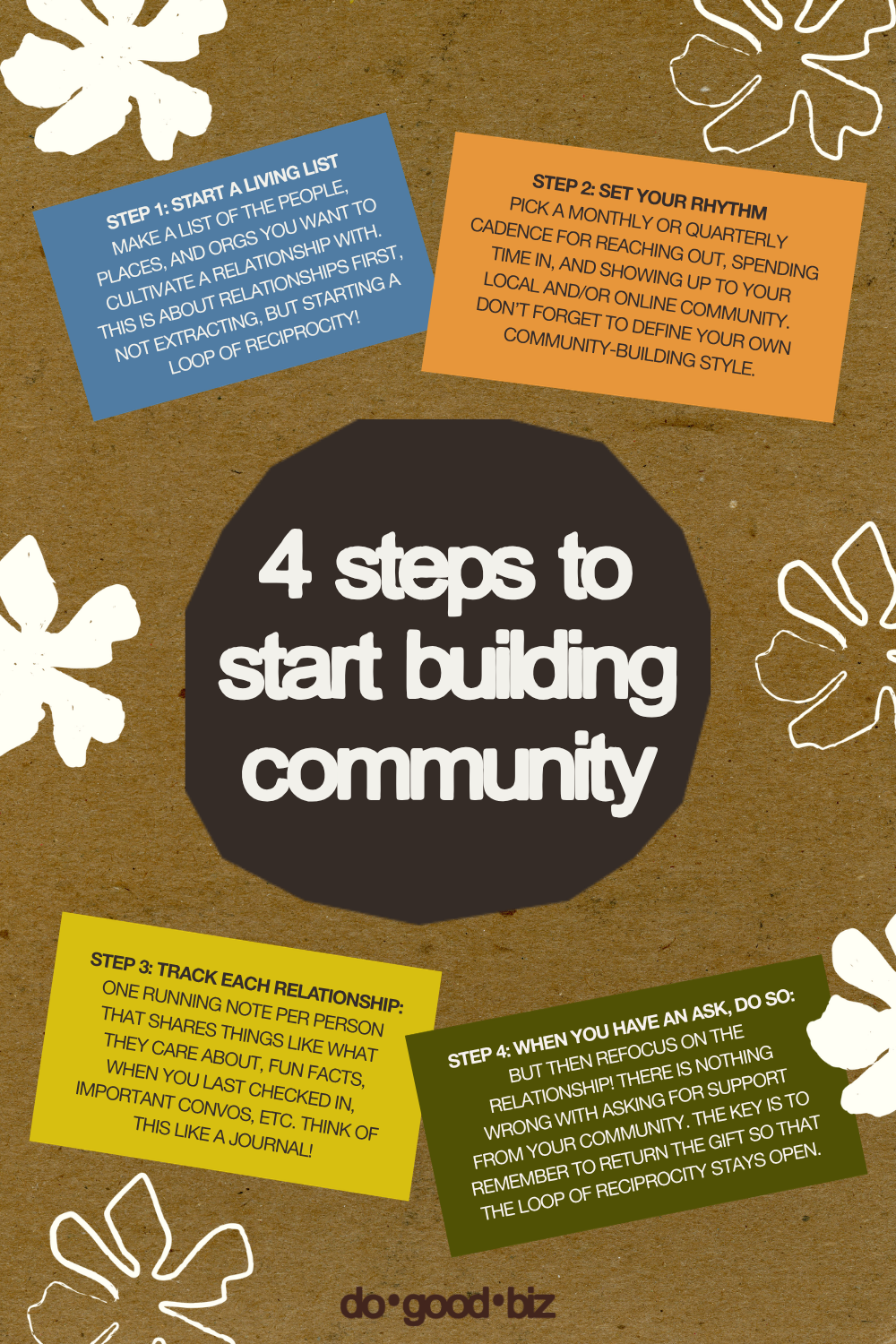
Once those three above points are settled, the system itself is simple. Not easy, necessarily, but simple. Four parts, and you can build all of them this month.
1. A living list, not a target list
Keep an ongoing, growing list of the people, publications, and organizations already doing work adjacent to yours or whom you’d love to connect with, build a relationship with, and collaborate with. This isn't a list of who to pitch next quarter. It's a genuine map of who's already in your world or on your radar. Add to it whenever you notice someone. Personally, I have a running list I keep track of in my Notion hub. To keep it easy, I often will just drop the URL to the person or place that I want to remember to look into more or connect with later, as this makes it easy to just document what I discover on the go. For the clients we work with, for whom we manage their community-building and PR outreach system, we have an entire documentation page where we keep track of ideas, inspirations, and names.
2. A rhythm for showing up before you need something
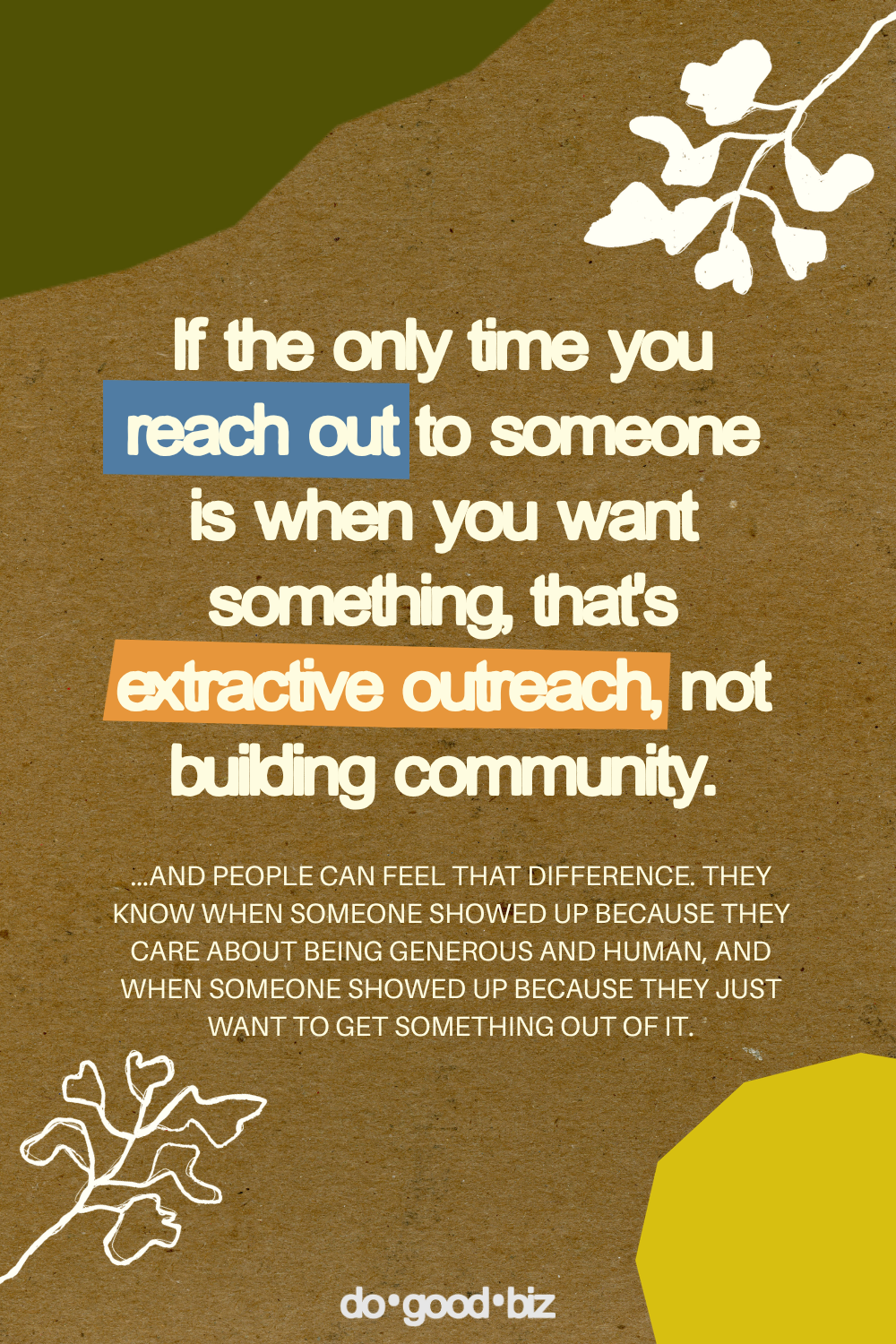
This can look like reaching out, sharing someone's work, showing up in person, on a rhythm that has nothing to do with your launch calendar. The relationships that actually hold when you need them are the ones you tended before you needed them. If the only time you contact someone is when you want something, that's extractive outreach and gets a nope from us. Personally, I set goals every month and quarter for how and with whom I want to reach out to or participate with. Some months I may have a lot of things going on with collaboration and outreach, so I may take a lighter load the following. It always ends up balancing out in the end. For our clients, we work to achieve specific goals for certain bookings, events, and collaborations that we establish and manage.
3. A way to track relationships as relationships
Not a CRM full of ask dates. A running note, even a simple document, of who you talked to, what they care about, what you offered or learned from them, and when you last checked in, with no agenda attached. The point isn't to be organized for its own sake. It's to remember people the way you'd want to be remembered. This is something we also use Notion for. We create a document for each individual that then gets all notes and documentation placed within; that way you can always look back to refresh your memory.
4. An honest way to ask when you do have something to share
When you do reach out with an actual ask, lead with what you noticed about their work, be specific about why you thought of them, and make it truly easy for them to say no if it isn’t aligned or the right time. A pitch that only works if they say yes was never built on relationship in the first place. One thing we love to do as a studio is always end an ask with an invitation to collaborate or just connect, regardless of whether the answer to the ask is a yes or not. That way, we are intending to leave the door open to a relationship forming no matter what.
Where This Goes Wrong Early
A few patterns worth naming before you fall into them:
Measuring by reach instead of relationship
This is the easiest one to fall into, because reach is visible and trackable and a relationship isn't. A follower count updates instantly. A real relationship takes a time investment, and for a long stretch of that time, it can look like nothing is happening at all. But reach and relationship are measuring two different things: reach counts who saw you; a relationship is about reciprocity and mutual benefit. A person with two hundred followers who comes to your event, tells three friends about your work, and messages you every time something you shared resonates has done more for your community than ten thousand people who scrolled past a post. If you catch yourself checking who followed you before you check who actually replied, that's the moment to notice you're measuring the wrong thing.
Outreach with no follow-through
This one usually isn't intentional. You reach out with real enthusiasm, get a warm reply, and then the conversation slowly goes cold, because something else took priority and you told yourself you'd circle back soon. The relationship reads that silence as disinterest, even when that's not what it was. The fix isn't a grand gesture. It's small ones, done consistently: an actual follow-up after an event, a reply to something they posted weeks later, a check-in with no agenda attached.
Waiting until you need something to start
This is the pattern most people don't notice they're in until it's already too late. Community-building stays on the mental list of things to get to eventually, and then a launch comes up, or you need press, or you need a partner, and suddenly you're trying to build the relationship and make the ask in the same breath. People can feel that difference. They know when someone showed up because they cared and when someone showed up because they needed something. By the time you actually need press or partners, it's too late to start tending the relationship that would have made the ask feel natural instead of transactional; that ease only comes from time spent before you needed anything at all.
What This Looks Like in a City Like Portland
Community-based business isn't an abstraction within Portland. Portland runs on a dense, overlapping web of makers markets, mutual aid networks, neighborhood business associations, and independent shops that already know how to show up for each other. It’s truly the thing I love most about living here. I have never, in my over 40 years of life, experienced a sense of genuine, heartfelt community as I have since living here. If you're building a community-based business in Portland, or anywhere with that kind of texture, the system above isn't theoretical; the infrastructure to practice it already exists around you. We are truly so fortunate to reside in an area that not only preaches the value and importance of community, but practices it with full dedication. The work is choosing where to plug in, showing up consistently, and giving before you ask. Within our studio, we work with a lot of folks who are local to the PDX area. One of those clients is Mollie Birney, a clinical life coach who is gearing up to publish her first book with Wiley Press in 2027. We have been working with Mollie for all of this year in developing a robust PR and community outreach strategy, targeting both her local community and her virtual community. It has been especially fun working in this way because we not only got to get Mollie more involved in her local area- from booking new venues for speaking and hosting workshops to participating in groups and making new friends- we also we able to support Mollie in things like getting on podcasts, joining virtual communities, getting writing and virtual speaking gigs. Being able to build community in those two very different ways at the same time has been quite fulfilling as it expands your level of impact while also expanding the creative opportunities to connect with other folks of like mind and values.
When to Hand Pieces of This Off
You can run this whole system yourself, and for a while, you probably should. I find it important to build awareness around what your preferences and style are for community building. We all have different ways in which we can, as well as want to, connect with other human beings. As someone who goes through chronic illness paired with social anxiety, I can’t emphasize enough how important it is to give yourself permission to not expect your way of community building to look like anyone else’s. This has a lot to do with why I am personally so passionate about supporting folks in the process of managing a PR and community outreach system. There's a point where keeping up the rhythm starts costing you time your actual work (and life!) needs.
Two specific pieces of this are built to be handed off:
The ongoing outreach that turns into ongoing media placements, guest contributions, and partnership relationships, and the ongoing community presence, events, and collaboration strategy that keeps the web growing once you've started it. Let’s face it, this type of work takes time, energy, and consistency. If you’re anything like me, it’s easy to let life take over, and before you know it, you can’t remember the last time you socialized or got out in your community. Having someone who is helping you stay accountable to the value and importance of ongoing community building can be truly life-changing. I’ve gratefully found a few communities over time that have given me such a sense of accountability because I know I am valued and vital to the whole. That is how I encourage others to think about community building: We all have an important role we can play in the environments surrounding us. It is our responsibility and opportunity to commit to community building just like we would commit to any other relationship we want to nurture. It’s about creating the first chains of a beautiful, recipricol loop.
Handing these types of tasks off doesn't mean outsourcing the relationships or you. Because this is not about taking the whole point of having a system like this and throwing it out the window. It means outsourcing the maintenance of a system whose values you already defined, so it doesn't fall away the moment you get busy. These are the types of systems we love managing, so if you are at a place in your community building journey that you feel like you’re ready for some support, feel free to reach out!
Where to Start This Week
If you take nothing else from this, take the order of operations:
● Define before you build, and build before you hand anything off.
● Name who "community" actually is and what it means for not just your work, but your life.
● Name what you have the capacity to give before you ask for anything.
● Name one boundary you're not willing to bend to grow faster.
● Start the living list- even five names is a great start.
● Pick one rhythm you can actually keep, and keep it before you need it.
Until next time,
Natalie Brite - DoGoodBiz Studio
