

A Field Mark, Not a Brand: A Nature-Based Branding Method
When was the last time you walked into a garden, on a forested trail, or in your local park and looked at what's actually happening?
A leaf's pattern isn't random; it repeats because that exact structure moves water and light to where the plant needs it most.
A wildflower's color isn't random either; it evolves in direct partnership with the pollinators it depends on, each one shaping the other over generations.
Nothing in nature is improvising an identity, and nothing in nature is self-made or self-sustained. It's all a web of purposeful relationships. That's the understanding my series on nature-based branding is built on, and it's the opposite of how most of us were taught to build a brand.
(If you missed Part 1, Before It Was a Brand, It Was a Burn, I go deep on where the word "brand" actually comes from and why the vocabulary we inherited keeps producing this gap. Worth reading first.)
A field mark, not a brand
Over the last few years, I've become more and more involved in birding. The first time I realized that I was becoming deeply passionate about building a relationship with the local birds in my area here in Portland, OR, was when I was on a solo hike in the trail system known as Forest Park. I had my camera in hand, and it was a pretty wet and drizzly day. Upon winding around a curve in the trail, I came to a cluster of shrubs. I quickly noticed that there were a lot of small birds bouncing around within the shrubs that caught my attention (and interest!). I stopped and stood still for over 20 minutes, just listening, watching, and noticing. The longer I stood there, the more I got to know the birds that I discovered were probably a family of thrushes.
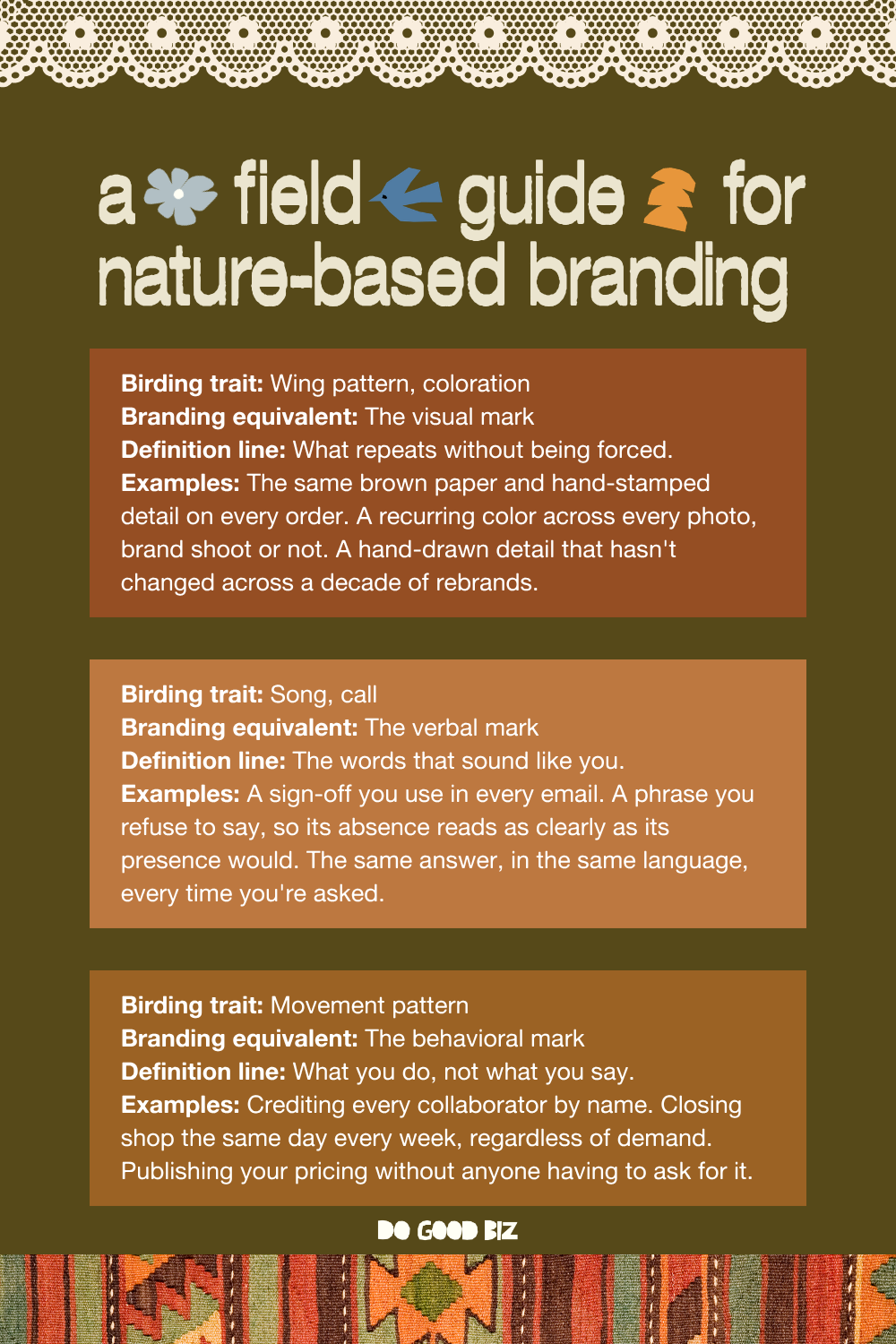
In birding, a field mark is the specific, visible trait that lets you identify a species in the wild. Oftentimes this shows up as a particular song or call the bird makes, or a known wing pattern or coloration. A field mark exists so something can be recognized as its true nature, in its own habitat, without needing to be caught, captured, or owned.
Nature-based branding starts from that instinct. It focuses on the practice first: witnessing a person, a business, an organization, whatever it is you're working with. Then it lets whatever mark follows be a way for people to recognize something that was already true.
My relationship with birds gave me a really cool structure for this, because a field mark isn't typically just one thing. It often shows up in three registers, which I like to adopt in branding.
The first is known as a visual mark.
In birding, this is often associated with things like wing patterns, colors, etc. For branding, it can show up as the same brown paper and hand-stamped statement on every order. A recurring color that shows up in every photo you post, whether or not it's actually a brand photo or not. Or a hand-drawn detail that hasn't changed across a decade of rebrands, even as most other things did.
Then there is the verbal mark.
In birding, this is associated with bird songs or calls. In branding, it can show up as a sign-off you use in every email that signals your personality and style. A phrase or approach to language that you refuse to say, such as refusing to use urgency language, so its absence becomes as descriptive as its presence would be. Or the way you answer a specific question or respond with your stance on a certain topic, in the same language, every single time you're asked it.
And finally, there's the behavioral mark.
In birding, this is known as a movement pattern. In branding, this is not about what you say, but about what you actually do (on repeat, without being asked). This can look like crediting every collaborator by name and happily collaboratively amplifying other people's work and closing your shop on the same day every week regardless of demand. Or, publishing your pricing without anyone having to DM you for it.
The thing to understand about field marks is that none of these get invented out of thin air. You find them the same way I found the thrushes, by standing still long enough to notice what was already repeating. What comes naturally. What's automatic without even having to think twice. Go back through the last ten things you last made, sent, or created and look for what shows up in most of them without you planning it there. That's usually the actual field mark. Everything after this is just making it visible on purpose.
It's also worth noting that a field mark isn't always static. What repeats this year might not be what repeats in three. That's just what a living thing does; it changes and evolves with time.
What grows from a different root
Try picturing an ecosystem trying to lead with a claim about who it is, what it owns, and what it does.
A fern issuing an "About me" bio before it's allowed to unfurl in the shade of an oak. A mycelial network gatekeeping nutrients behind a subscription tier, more generous to whichever fungi has the biggest following.
A river trademarking its own name and invoicing the salmon a licensing fee to swim upstream.
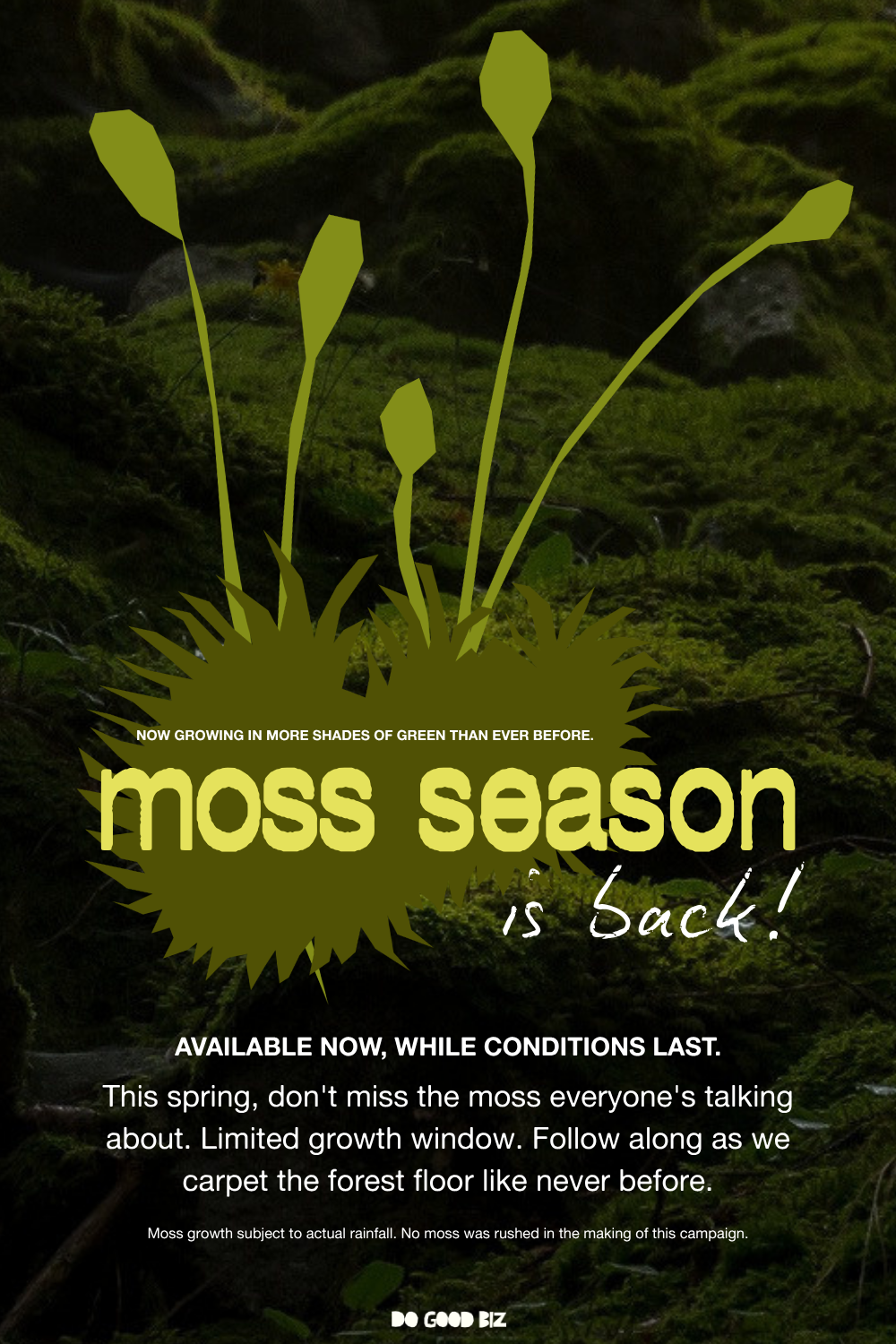
A wildflower refusing to open until it's confirmed the bees are actually watching, timing its bloom for maximum visibility instead of maximum pollination. A patch of moss running a "moss season is back, bigger than ever" campaign, scheduled around a marketing calendar instead of actual rainfall.
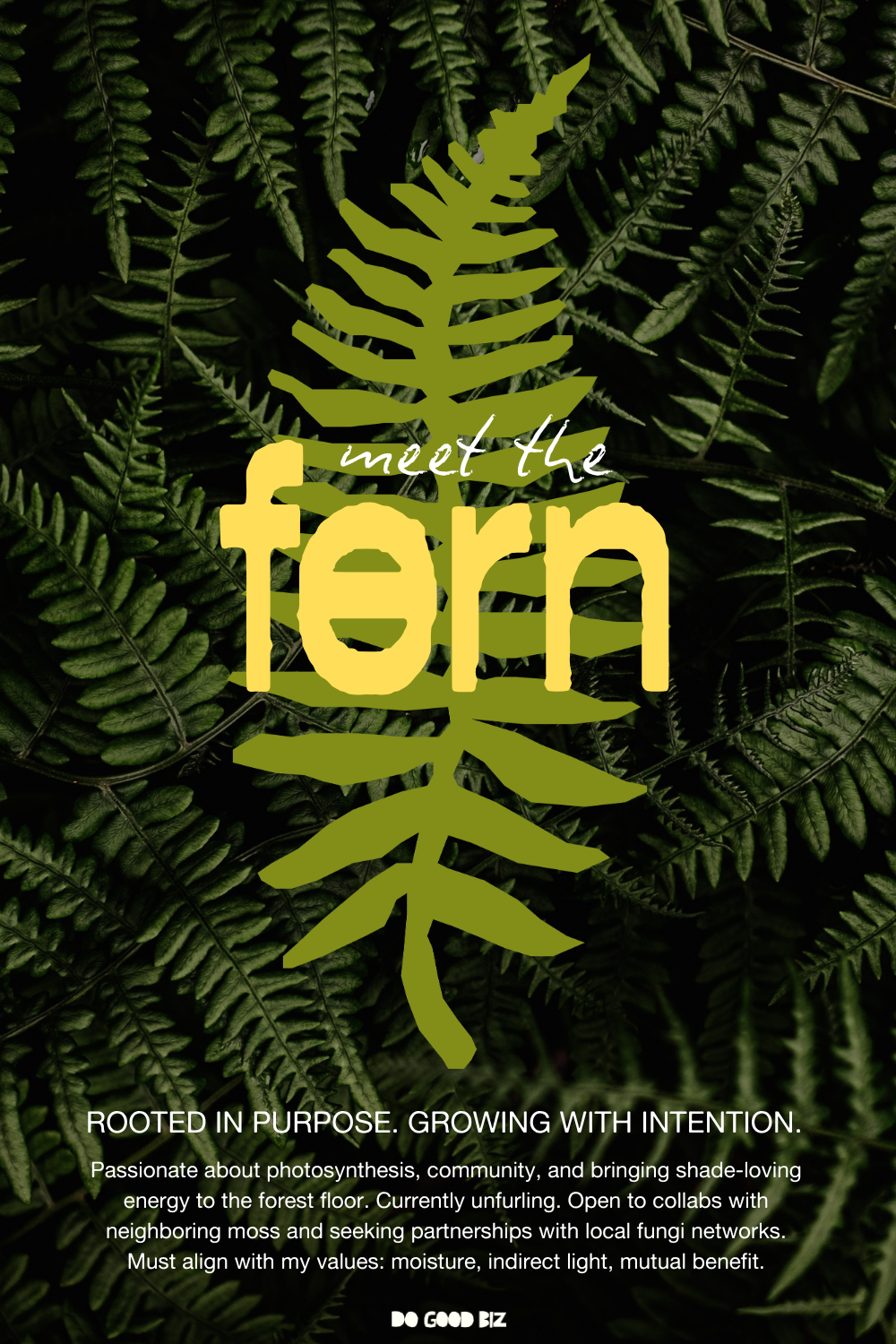
It sounds absurd, because it is. And it's absurd for a specific reason: nothing in an ecosystem exists separately enough to pull any of that off. A fern that spent its energy on an "about me" bio instead of its relationship with the light, the soil, and the surrounding flora would likely not even survive the season. Ownership requires separating something from everything around it so that you can claim it as yours and yours alone. Nothing in an ecosystem is separate enough to own anything. And why do we really need to own everything, anyway?
An ecosystem leads with relationship instead. A plant's traits aren't decisions made in isolation; they're responses to soil, light, what's growing next to it. It's trying to stay in right relationship with what surrounds it, season by season, because that's what supports the whole it's part of, and therefore what's actually in its own best interest.
Performance asks to be noticed in the moment. To capture attention. Relationship is what people actually carry with them, because they can feel the difference between being marketed to and being meaningfully in relationship.
That's nature-based branding. Not a more palatable version of the same machine. A different operating logic. Performative branding starts with ownership. It marks what it owns, then performs whatever will sell, with no obligation to what's true underneath. Nature-based branding starts with what's already true and lets the aesthetic grow out of it.
We'd spot the absurdity instantly in a fern. We're slower to spot it in ourselves.
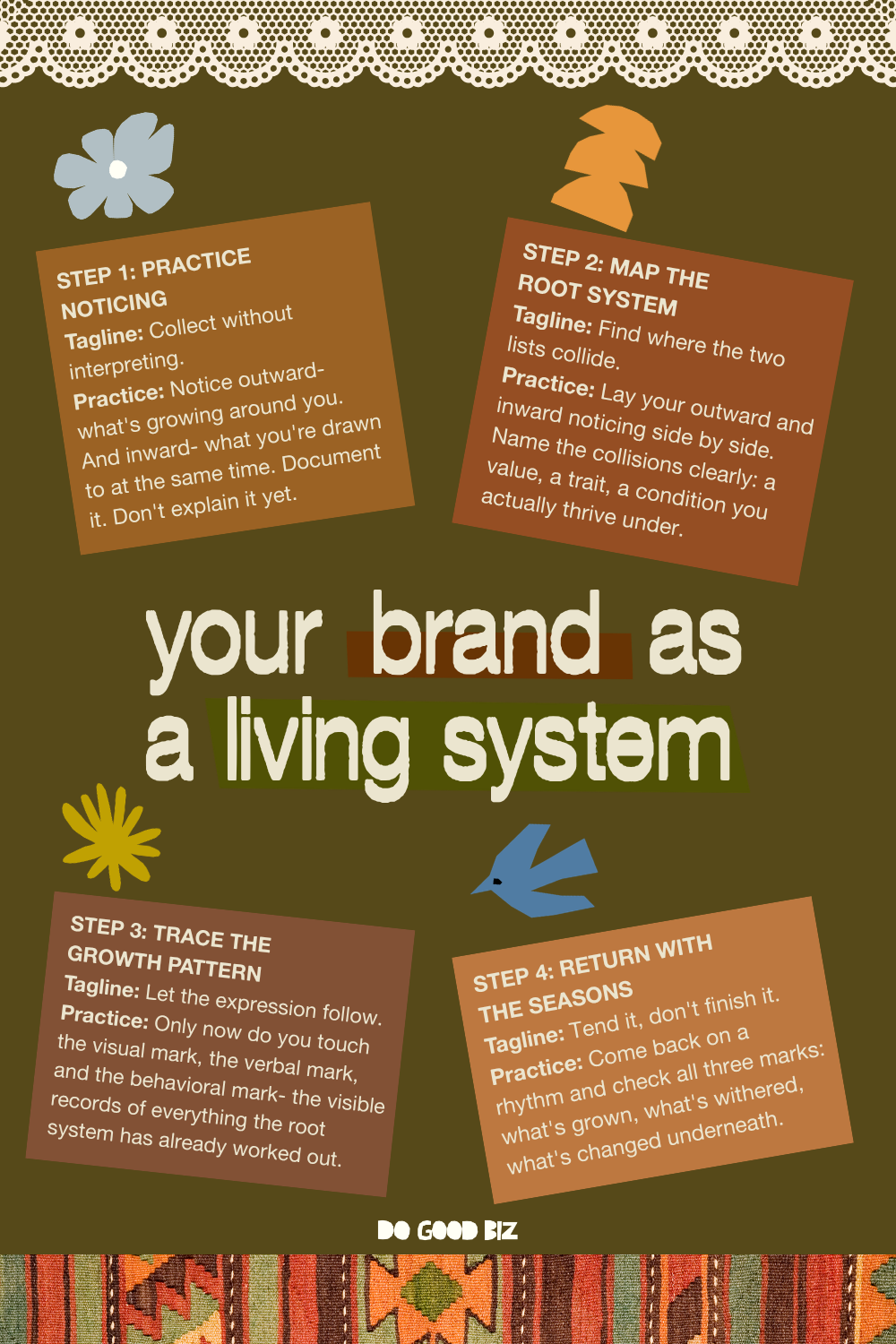
The method
These four steps are adjusted from the process I use in Wild by Design, the in-person workshop I've built and will be starting to offer here in Portland, OR. I've also been weighing whether to adapt it into an online experience, so if that's something you'd be interested in, let me know.
Practice noticing.
This is your discovery phase, except you're not filling out a brand questionnaire or studying competitors. You're outside, or paying attention to what's already growing around you, and at the same time, paying attention to what's happening within you.
Document what resonates outward: traits, textures, colors, relationships, the stuff that feels like you rather than trendy. A pattern that repeats. A color pairing that you love. What's growing next to what, what's feeding on what, what's shading what.
Notice inward at the same time. What are you drawn to, the way a pollinator is drawn to one particular flower and passes the others by? What relationship catches you, the way a certain plant and a certain animal seem to have worked something out between them over generations? That pull is information. So is whatever else surfaces while you're standing there: a topic you keep circling back to without meaning to, a belief you didn't realize you held until it showed up in what you were looking at, a value that suddenly feels more specific than it did prior. These are more behavioral than visual.
Don't interpret any of it yet. Just collect it, outward and inward both, and document your discoveries in a field guide.
Map the root system.
This is your positioning work, done from the ground up instead of the top down. You now have two lists from the last step: what you noticed outward, and what surfaced inward while you were practicing noticing. This is where you lay them side by side and look for where they collide.
Examples of what you could discover: the plant-and-animal relationship that caught your attention, and the actual collaborative dynamic your own work already is founded on. The color pairing you couldn't stop looking at, and the personal style you feel called to naturally and without force. Name the collision in plain language: a value, a trait, a condition you actually thrive under versus one that you perform or feel like you "should" be.
This is also where your lived experience belongs, part of the same root system. Your upbringing, your identity, your personality, the things about you that were true long before you ever started to work or had the world tell you who you should be. Where does what you noticed outside actually trace back to something in your history, your culture, the way you were raised, the way you naturally move through a room? Maybe you even experienced nostalgia or a memory pop up during your noticing; this happens quite often. A root system doesn't grow from the noticing walk alone. It grows from everything that made you who you are.
A root system feeds what blooms above ground. You can't skip it and expect the bloom to hold. This is where most positioning work fails: it gets written from what sounds impressive instead of what's structurally true. Three or four real alignments beat ten performed traits.
Trace the growth pattern.
Only now, after noticing and mapping, do you touch the actual expression, and it shows up in the same three registers the birds taught you to look for. The visual mark: your palette, your imagery, the color or texture that keeps repeating without you forcing it. The verbal mark: your name, your voice, the phrase or tone someone would recognize as you even with your name removed. The behavioral mark: not what you say you'll do, but what you actually do on repeat, the practice that holds steady season after season.
Remember: this is far less about using your brain to logically react to these steps, and far more about tapping into your true nature from an intuitive space. A plant's shape isn't arbitrary. It's what its roots, its light, its neighbors made possible. Your visual mark, your verbal mark, and your behavioral mark should read the same way: relational, and the sum of everything underneath it.
Return with the seasons.
This is the phase most brand work skips entirely, treating the brand as a document you finish instead of a living system you tend to over and over again. Nature doesn't hold its shape year-round, and neither should your field marks. Come back on a rhythm, a season, a quarter, whatever cadence feels good to you, and check all three: what's grown, what's withered, what's changed underneath that your visual, verbal, or behavioral mark doesn't reflect currently.
That's the method in a nutshell: notice, map, trace, return. Four steps, but really one instruction, repeated in different directions.
None of this is meant to be perfect on the first pass, and it isn't meant to be finished, ever. Let yourself tune in, connect, and express. A brand built this way behaves like everything else in the ecosystem it's trying to reflect: living, responsive, occasionally showing up different from how it looked last season while somehow still being unmistakably itself.
If you find yourself working through these steps and want some support, a second set of eyes, or a version of this built specifically around your work instead of a general framework, that's what I love to do with folks. Reach out, and we'll figure out what that could look like for you.
Further reading: this sits close to the ground I covered in "Before It Was a Brand, It Was a Burn," Part 1 of this series, where I trace the word "brand" back to its origins.
The final part of this series is up next: the gift economy, why businesses optimized for growth collapse the same way monoculture farming strips soil of life and sustainability, and access to my nature-based branding zine with interactive worksheets to help you develop your own nature-based brand.
Subscribe to our Substack, Field Notes, for transmissions from the creative wilderness. Trail guides packed with interesting education, honest reflections, and curious little stories from behind the scenes at DoGoodBiz Studio. For conscious creatives, values-led founders, and anyone building something good for people and planet.
