

One Piece of Content, Many Lives: A Repurposing Guide for Solo Marketers
If you're running your own marketing, which, if you're reading this, you probably are, there's a good chance you've felt a common kind of guilt: the type that shows up when you haven't posted anything new in a while. Before adding one more thing to the list, it's worth asking whether the problem is actually a shortage of content, or a shortage of permission to use what you've already made.
The Pressure to Keep Creating More
Most content advice assumes a production team behind it: someone dedicated to design, a calendar that refills itself via a strategist, a person whose whole job is content management. When you're doing this alone, on top of the actual work of running a business, that same standard doesn't just feel unrealistic. It manufactures a very understandable kind of exhaustion, the sense that a slow or quiet week of content creation means you're disappearing, even when the real work is going fine. That pressure is an inherited assumption about what “enough” content looks like, built for a context most solo marketers don’t actually function within.
Content Lasts Longer Than We're Told
Some of the pressure to constantly produce doesn't come from content itself. It comes from comparison. Influencer culture and large brands post constantly, sometimes multiple times a day, because that's genuinely what their model requires, and they have teams, tools, and budgets built for exactly that pace. Solo marketers absorb that same cadence as the standard to hit, without the resources that make it possible, and often without asking whether it's even the right pace for the work and type of brand we are building.
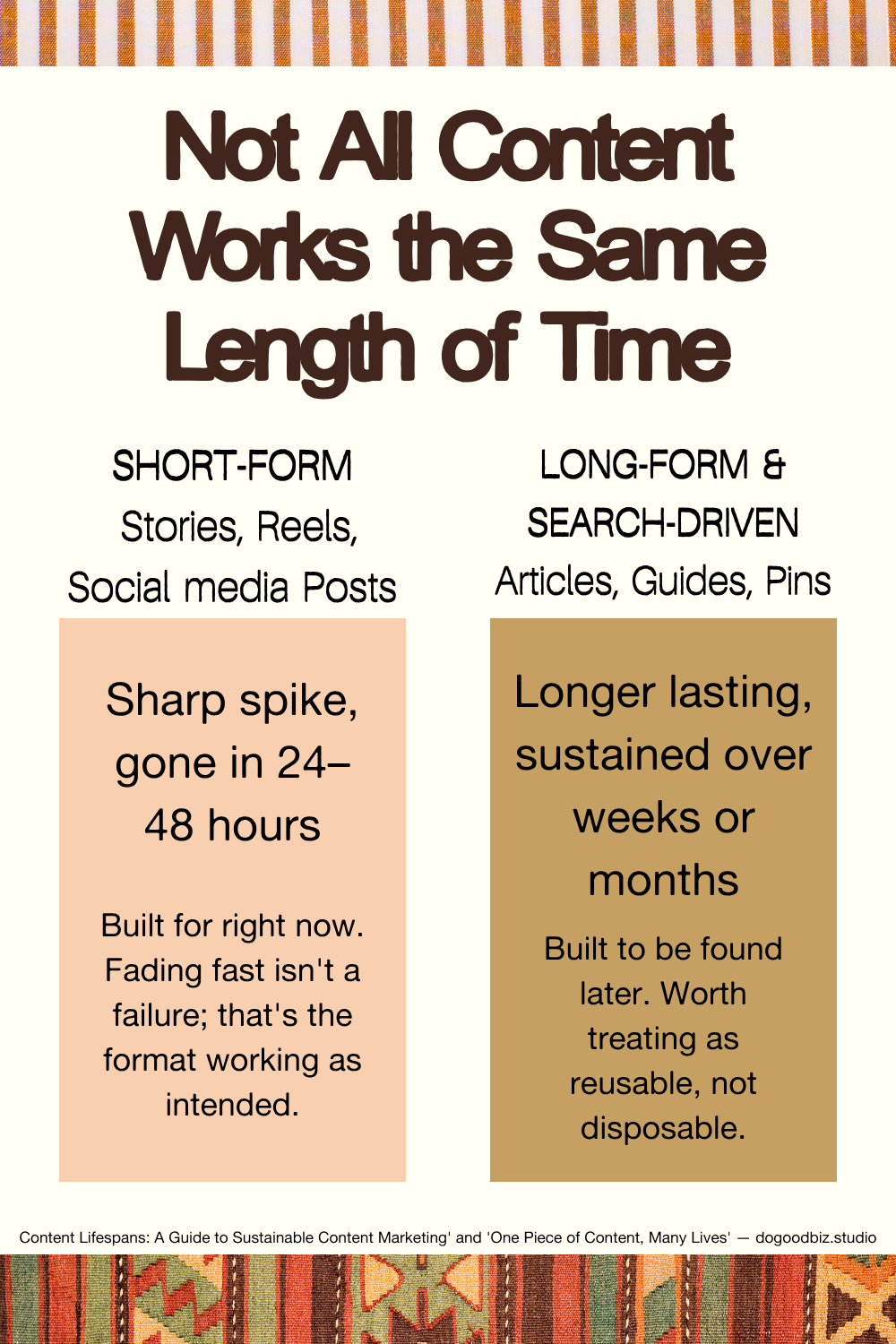
It's also worth being honest about something else: some content really is ephemeral. A Story disappears in 24 hours. A Reel's real visibility window in most feeds is closer to 48 hours than a week. If most of what you make lives in short-form, fast-moving formats, it's not wrong to feel like you're on a treadmill, because in that format, you actually are.
The nuance is that not all content is that format. Long-form and search-driven content- articles, guides, anything built to be found rather than scrolled past- runs on a completely different clock. It can keep earning attention weeks or months after it was published, without needing to be refreshed daily. Treating that kind of content with the same short shelf-life you'd give a Reel is where the real waste happens: rewriting or replacing something that was actually still working, because a pace built for somewhere else convinced you it wasn't.
That's the actual math problem. Not that content magically lasts forever, but that solo marketers are often measuring their evergreen work against an influencer's ephemeral pace, and their genuinely ephemeral work against a standard built for teams, not one person.
This is the whole argument behind “Content Lifespans: A Guide to Sustainable Content Marketing”… worth reading alongside this one if the idea is new.
What Repurposing Actually Looks Like
Not slicing one piece into thirty pieces for a content calendar grid. Something closer to this:
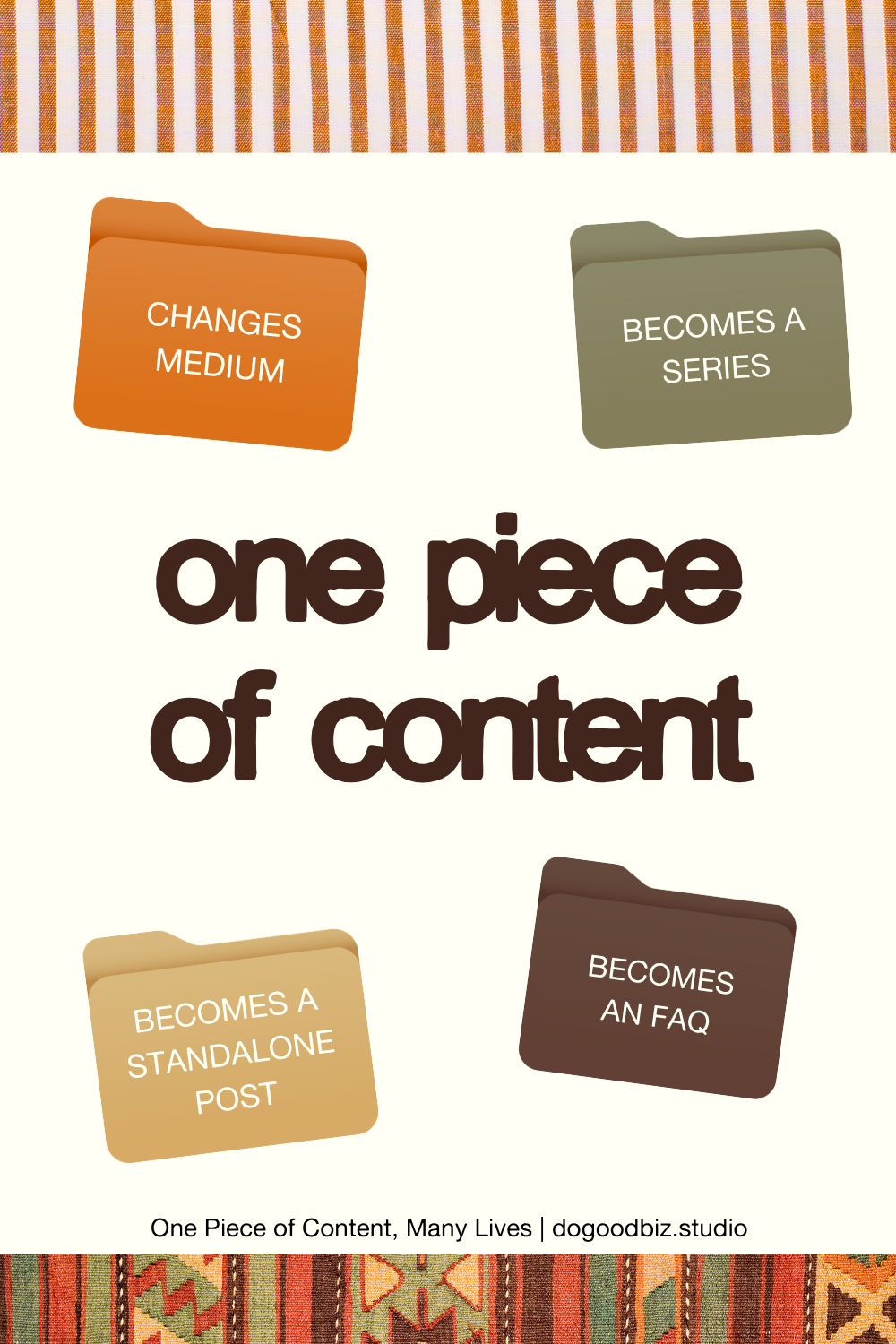
A paragraph becomes its own post
Pull one paragraph out of a longer article and let it stand alone as a caption, with nothing added. If it was strong enough to sit inside something longer, it's usually strong enough to hold its own weight.
A real answer becomes an FAQ
The next time you give a genuinely good answer in a client email or a call, save it. That's an FAQ entry or a short post already written, in language that's already true, instead of something invented from scratch later.
One piece becomes a short series
Instead of publishing a long piece once and letting it disappear, split it into three or four smaller moments spaced out over a few weeks. Same amount of writing, more chances for it to actually reach someone.
The same idea changes medium, not message
A written piece becomes a voice note. A voice note becomes a short video. The idea doesn't need to be reinvented for each format, just re-said in the shape that format wants.
One Question Instead of a New System
Rather than a fully fleshed-out repurposing framework you now need to manage on top of everything else, a repurposing strategy can be as simple as running on one question, asked before making anything from scratch: what already exists that could do this job? "This job" just means whatever's actually needed in the moment… a caption for tomorrow, an answer to something a client keeps asking, a response to whatever's happening in your industry this week.
In practice, that means checking three places before starting new: recent client conversations (emails, calls, DMs) for a real answer you've already given someone; your own published work for a paragraph or idea that never got its own moment; and your past posts for something that got a solid response and might have a natural next chapter. Most of the time, one of those three already has what's needed.
Say you want to publish a piece of content tomorrow and nothing's planned. Instead of starting from a blank page, the question becomes specific: did I explain something valuable to a client last month that would make a great piece of content? Is there a paragraph in an older article that would be valuable to turn into a short-form series? Did a post from a few weeks ago perform well and therefore provide room for expanding on that same topic? Usually, one of those turns something up.
Sometimes none of the three do, and that's fine… make the new piece if so. But checking first, instead of defaulting to new out of habit, is the entire practice. It's not a system to build or maintain. It's a pause before assuming nothing exists yet.
Depth Over Distance
Repurposing isn't only a way to save time. It's a different orientation to the work entirely: depth over distance, quality over quantity. Most of what we're taught about content success rewards distance… how far something spreads, how many platforms it's on, how often something new goes out. Almost none of it asks whether any single piece was actually allowed to finish its work before getting buried by the next one.
Depth means the opposite instinct. It's letting one piece of writing, one idea, one real conversation be used fully, revisited, reshaped, and returned to, instead of being published once and left to disappear under whatever gets made next. Quality, in this sense, is about whether something was given enough room to actually do its job before being replaced.
Constant, low-depth production has a real byproduct, even if it's harder to see than the physical kind: digital waste. Posts made, barely seen, buried within days, never revisited, functionally disposable the moment they're published. It runs on the same pattern as fast fashion… more made than anyone actually needs, most of it barely used before it's replaced. Except here, what's being thrown out is time, attention, and work that could have kept mattering.
Every time something existing gets reused instead of replaced, that's one less thing added to the pile, and one more piece of work finally allowed to finish what it started. Depth over distance isn't a slower version of the same treadmill. It's a way off it.
Less Made, More Used
What this actually buys back isn't more content. It's time and headspace that wasn't going toward this in the first place… an evening that doesn't need to go into writing another caption, a weekend that isn't shadowed by the sense that you're behind. A solo marketing practice built on reuse leaves more of you left over for the parts of your life and work that actually need it.
This is close to how we run content for clients inside Tend & Grow, our ongoing creative partnership. Instead of building a new content calendar from scratch each month, we start by mapping what already exists (past client conversations, older articles, things that have already resonated) and build the next stretch of work by reusing and extending it before anything new is made. It's less flashy than a fresh campaign, and it's a large part of why it holds up over time.
This pairs naturally with “Content Lifespans: A Guide to Sustainable Content Marketing” and “How To Run Your Marketing Department As One Person”… both worth reading alongside this one if you're building toward a lighter, more sustainable practice.
