

What Is Performative Branding? The Hidden History Behind Why We Do It
Most of us didn't fully choose how we talk about our businesses. Rather, we inherited the approach from every course, every framework, every “brand strategy” template, and every brand before us. We didn't know what we didn't know. This is an attempt to look at where some of that language actually comes from and why so much of it is completely outdated… even bordering on harmful.
What We Were Taught, and What We Weren't
If you've ever felt that tinge of discomfort at the thought of sharing a values statement, a solidarity post, your mission… and couldn't quite name why, it's worth considering that the discomfort might be pointing to something. Most of us learned to build a brand the same way we learned most things about business: secondhand, from templates and frameworks that were never built with the present tense or our values in mind, and we adopted them before we had the context to question them. That's completely understandable, and I'm not here to shame anyone on what you have or have not done in the past. You can't interrogate a pattern you don't know you've taken on.
Some of what we were taught was explicit
Courses that handed us a list of "brand voice" examples lifted from companies with entirely different values, and entirely more power, than the ones we were building. Templates that told us exactly which fonts read as trustworthy and which colors activated certain emotional states, developed for markets that had nothing to do with the work we are doing. Frameworks with names like brand pillars and unique value proposition… vocabulary built in advertising departments to move product, repurposed for people trying to build something closer to community.
Other things we were taught weren’t so explicit
The sense that visibility and worth were the same thing, and that a slower business season meant you were disappearing rather than recharging or working underground. The instinct to lead with a bold stance so people knew exactly where you stood, before you'd necessarily lived into it yet. The unspoken order of operations… statement first, practice later, if ever. Even "personal branding," presented as self-expression, mostly asked us to package ourselves for consumption and call the packaging truth.
Before naming any specific practice for shifting into a more nature-based approach to relating to branding, it's worth going back further than any of us were taught to go… to where the word "branding" itself comes from.
Where the Word Comes From
The word "Brand" comes from the Old Norse word, brandr, which meant to burn. It originally meant a piece of burning wood. It didn't become a verb until late Middle English, when it came to mean marking something permanently with a hot iron. By the seventeenth century, "to brand" meant exactly what it still technically means: making a permanent mark of ownership. The practice itself is older than the word by thousands of years. Egyptian funerary art roughly four thousand years old depicts branded cattle. And the same hot iron used on livestock was used, by ancient Egyptians, Greeks, and Romans, on enslaved people. Centuries later, Spanish colonizers carried branding into the Americas, where it was used the same way it had always been used… to mark a living being as property, permanently, whether that being was an animal or a person.
The word didn't stay here, though. As trade shifted from local exchange, where you bought your flour from someone you actually knew, to mass production like we know today, buyers and makers became strangers to each other for the first time at real scale. Trust had to be manufactured instead of earned in person, and the same word we'd used for centuries to mark ownership got repurposed to do that job. Quaker Oats trademarked its name and mascot in 1877, one of the first packaged goods to do so. The U.S. passed its first federal Trademark Act in 1881. Coca-Cola followed in 1886. None of this was about identity or connection yet. It was still, functionally, a claim of ownership: this good is ours, distinguishable from every other good that looks just like it, just stamped on a product instead of burned into skin.
Over the next century, branding picked up an entirely new job: not just claiming a product, but shaping what people want in the first place. Twentieth-century advertising leaned hard into psychology, associating goods with identity, status, belonging, the fear of missing out, turning the mark from a claim of ownership into an engine for manufacturing desire.
Then, in 1997, things took yet another turn. Management writer Tom Peters published "The Brand Called You" in Fast Company, telling readers, "We are CEOs of our own companies: Me Inc.," and that our most important job was to become "head marketer for the brand called You." The same word that once marked ownership over a body, then ownership over a good, was now being applied directly to a person's own sense of self… except this time, we were being asked to hold the branding iron ourselves, and use it on our own identity, willingly, as a career strategy.
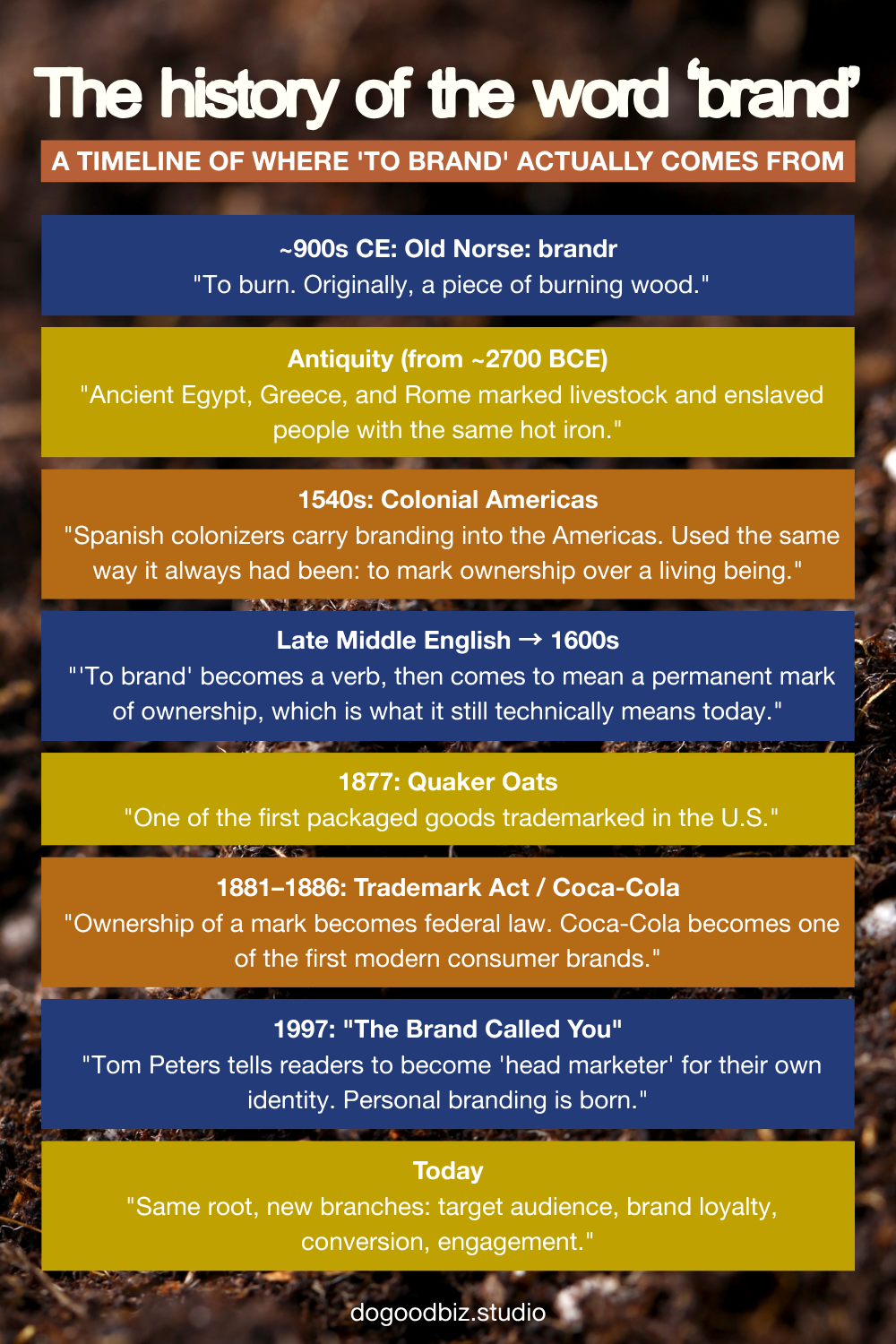
The documented arc of the word we use every day
That is the documented arc of the word we use every day to describe logos and taglines and "brand voice": a mark of ownership, first applied to living bodies, then to products built to feel personal in a market too big for real relationship, and now applied to ourselves, as if turning our own identity into a managed asset were simply the next natural step, instead of the same root doing what it has always done. It's worth sitting with the reality of where this word originated, and what we're upholding by continuing to use it without ever looking at its roots.
When the Root Is Rotten
A brand, at its origin, was never about expression. It was about ownership: a mark that emphasized that something was owned. Modern branding has softened the origins considerably: we talk about differentiation, identity, visibility, positioning. But underneath the words, the structure is still intact. Claim something. Mark it. Make the mark visible. Repeat, so the claim holds. If the whole discipline we inherited was built to make ownership visible rather than to make care or authenticity visible, it starts to make sense why performing a value comes so much more naturally than building the practice behind it. Performance wasn't a corruption of the original design. It was actually a foundational concept of the original design.
That root doesn't stay contained to the word "brand" itself, either. Look at the vocabulary that grew up around branding…
Target audience: the word target is aim-language, borrowed from hunting and warfare, applied to actual people as though the goal were always to hit something rather than relate to someone.
Brand loyalty: loyalty is a word for allegiance, historically owed upward to a lord, nation, or person/”thing” that is seen as supreme. Applied to a brand, it asks for faithfulness toward a mark, flowing in one direction without much obligation or reciprocity flowing back.
Conversion: a word borrowed from religious transformation, for changing someone's fundamental belief, now used to describe moving a person from "not yet a customer" to "customer", a change in status that, not coincidentally, is also a change in what's owned.
Brand equity: treats trust and reputation as a financial asset, something built, leveraged, and cashed in, rather than something held and continually earned in relationship.
Engagement: a word for mutual, relational commitment, repurposed to mean measurable interaction, harvested as data, rewarded by an algorithm that has no relationship to anyone.
None of these are new words. They're the same root, doing what roots do: sending the same instructions up through every branch that grows from it, however far from the trunk that branch appears to be.
This is what a rotten root does. You can prune all the branches you want… swap out language, refresh a values page, post the right thing at the right moment… and the tree still grows from the same ground. When the root is rotten, the rest of the plant follows, no matter how carefully you're trimming the leaves.
The Patterns This Produces
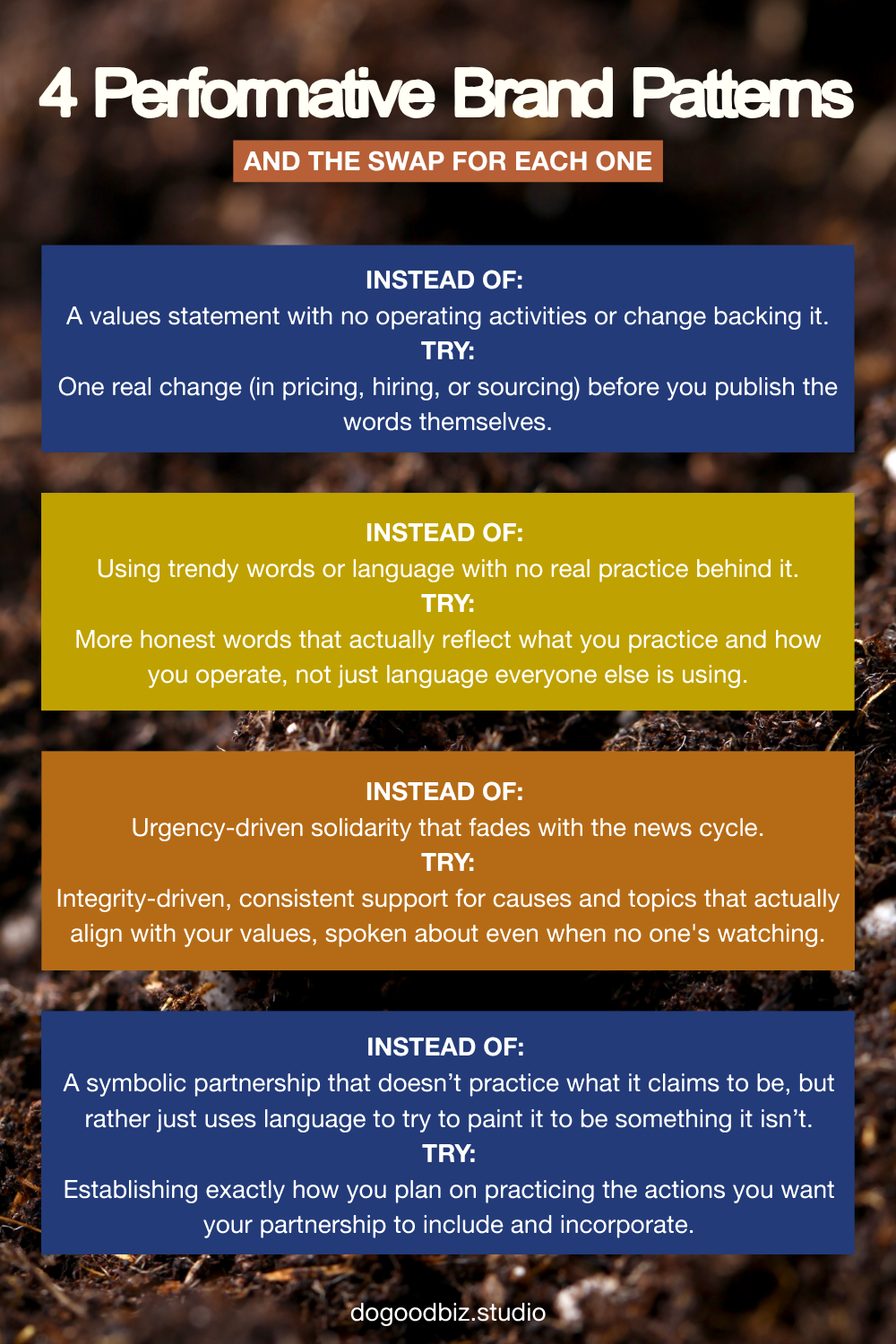
What follows is what a rotten branding root often produces in businesses, often run by well-intentioned people (which is most of us). Naming the pattern is only half of it. Each one has a swap: something to reach for instead, so this doesn't just leave you with a diagnosis and nowhere to go.
A statement with no operating change behind it
The values page says one thing. Pricing, hiring, sourcing, and who actually gets paid on time say another. The gap isn't hypocrisy so much as it is the predictable result of treating language as the deliverable, because that's what we were taught branding was for.
The swap:Before publishing a values statement, name one operational thing that's actually changing because of it (pricing, hiring, sourcing, how you pay people, how you build community, work with people, etc) and let the practice go live alongside the claim, not after. If there's nothing concrete to point to yet, that's information: the work comes before the statement, not the other way around. In the meantime, try describing what's actually true right now instead of what you're aiming for… "here's what changed because of this thing we care about and value" instead of "we value this…" without any actual action to back it.
Borrowed language with no underlying practice
Words like community, sovereignty, inclusion, authenticity… used because they signal something we want to signal, not because there's a practice under them. Borrowing the language of a movement or cause is easy. Building the internal structure that actually reflects it takes a lot longer, and doesn't always award you the satisfaction of claps and praise along the way.
The swap:Retire the big word until you can describe the specific practice behind it in one simple, clear sentence. Until then, use more honest language that matches what's actually happening… "the people who buy from me" instead of "our community," "how I decide who to work with" instead of "our values-led ecosystem." Let the other words earn their way in as a practice, not before.
Urgency-driven solidarity that fades with the news cycle
A post goes up while attention and interest are high, and then disappears from practice once it isn't trending. This is what happens when solidarity is treated as a visibility strategy instead of an ongoing relationship… because visibility, not relationship, is what branding was built to focus on.
The swap:Before posting in response to a trending moment, ask whether you'll still be doing this in six months when no one's watching. If not, that's useful information: it usually means the more truthful move is to support consistently and with integrity (like redirecting resources, amplifying without claiming credit) rather than publishing something that reads as commitment but functions as a performance.
Symbolic partnerships without real accountability
A shared commitment within a relationship, a partnership, a collaboration… standing in for what real partnership would actually require: sharing revenue, sharing decision-making, sharing power, handling conflict ethically and compassionately, being transparent and respectful… not just acting like that’s the case but really, genuinely practicing it.
The swap:Replace the phony collaborations with something more implemented as a practice… a fixed percentage of revenue that is split, an ongoing seat in real decision-making, a truly collaborative environment rid of hierarchies, a standing practice of reporting back and documenting processes. Something with a rhythm and real consequences if it stops.
Uprooting, Not Just Pruning
You can't fix root rot by simply trimming branches. The practice has to change where it starts, not just where it's seen. If you're recognizing your own business somewhere in the patterns above, here's a place to actually start… less a rebrand, more a checklist for turning performance back into practice.
1. Audit the gap first. Put a list of your values next to your actual pricing, hiring, sourcing, payment practices, community building and relationship nurturing habits, client treatment, and so on. Write down where they don't match (without editing it into something more comfortable to look at!).
2. Let practice lead the language. Don't publish a new statement, stance, or bit of brand voice until there's something real being practiced to uphold it. If the practice isn't there yet, that's the work. Begin brainstorming what practices may need to begin being implemented so your values match what you actually do and how you show up.
3. Say less publicly than you're doing privately. If you find yourself needing to announce something to make it feel real or validated, that's usually a sign the practice needs more time before the language does. Remember: Your values don’t have to be stated as much as they should be able to be witnessed. The actions you take to practice your values is the evidence of the values, where people should be able to say what your values are based on how you show up.
4. Build a real feedback loop. Find at least one person outside your own head (a client, a collaborator, a close friend, or someone who isn't invested in your comfort) who will actually tell you when the gap between what you say and what you do starts opening. Make it easy and safe for them to say so. This is how we hold ourselves accountable.
5. Replace one trendy word with a true one. Pick a single word you've been reaching for because it signals rather than describes community, ecosystem, aligned, and swap it for language that actually represents you. We see certain words become quite trendy very quickly. For example, I remember a time earlier in my career when the word Manifestation was being used by every single coach in the online space. Yet, many didn’t even understand what they were actually preaching or teaching. It was a trendy word that everyone decided to jump on the bandwagon over, just like any other online trend.
6. Measure by what changed, not by what performed. At the end of a quarter, don't just ask how a post did or how much money you made. Ask what's structurally different in the business because of it (pricing, hiring, actions taken, who has power, who gets paid, etc). Real branding that is ethical holds itself to a standard of accountability that performative branding does not.
None of these are fast to implement, and very little of it is visible in the way we were trained to chase. That's probably a sign it's the right direction!
Fresh Ground
We didn't choose the root we inherited. We get to choose what grows from here.
The word Brandr meant fire before it was ever a weapon of ownership. And fire isn't only good for burning something down to claim it… a controlled burn is also how a forest clears what's dead so something that was never granted the space to grow naturally finally can. That's closer to what this work actually is. Not a rebrand. Not a refresh. A controlled burn on everything performative that's been standing in the light, so what's actually true underneath finally has room.
This isn't the version of "brand" we were handed. It might be the most solid version worth keeping.
Further reading: this sits close to the ground I covered in other writing, such as:
“Hyperreality & Social Media: How Conscious Brands Can Keep It Real"
"Nobody Owes You Anything. Create Accordingly"
Sources:
