

Nobody Owes You Anything. Create Accordingly.
How mutualism, ecological thinking, and the web of care can transform your creative practice, and your livelihood

This piece connects directly to our thinking on creative liberation: what it actually means to create from freedom rather than obligation.
What are you actually doing it for?
When you show up online to share your creative work, when you post, write a newsletter, or put something out into the world, what are you actually doing it for?
For a lot of us, if we sit with that question long enough, the honest answer is some version of: to get something. Clients. Followers. Visibility. Revenue. Validation that the work is landing somewhere. A sense that the effort is converting into something measurable.
Here is the thing, though. We do not actually own anything.
Not the platforms we are on. Not our audiences. Not our reputations, our income streams, or our creative work once it leaves our hands. The concept of ownership, claiming something as permanently, exclusively yours, is, when you trace it all the way back, a story we have been taught to tell ourselves. A framework invented to justify extraction, to make accumulation feel natural, to turn the web of life into a ladder of acquisition.
When we approach our creative work, our marketing, and our visibility from inside that framework, we are not participating in community. We are strip-mining one.
This is what the average marketing advice will never tell you, because it is built inside the same framework it is trying to help you succeed within.
What ethical creative business can learn from the living world
No organism in a healthy ecosystem exists solely to extract. Every fungus, every tree, every insect, every bird has an ecological role. Something it does that feeds the whole. Something it contributes to the web of life around it simply by being the expression of what it is.
This is mutualism. Not transaction. Not exchange with conditions attached. A web of relationships where giving and receiving are so interwoven that the distinction between them starts to dissolve.
Mycorrhizal fungi, the underground networks that connect tree roots across an entire forest, do not charge a fee for the nutrients they carry. They do not post about their reach or check their analytics before deciding whether to feed a struggling seedling. They do what they do because it is simply what they are, and the forest is more alive because of it.
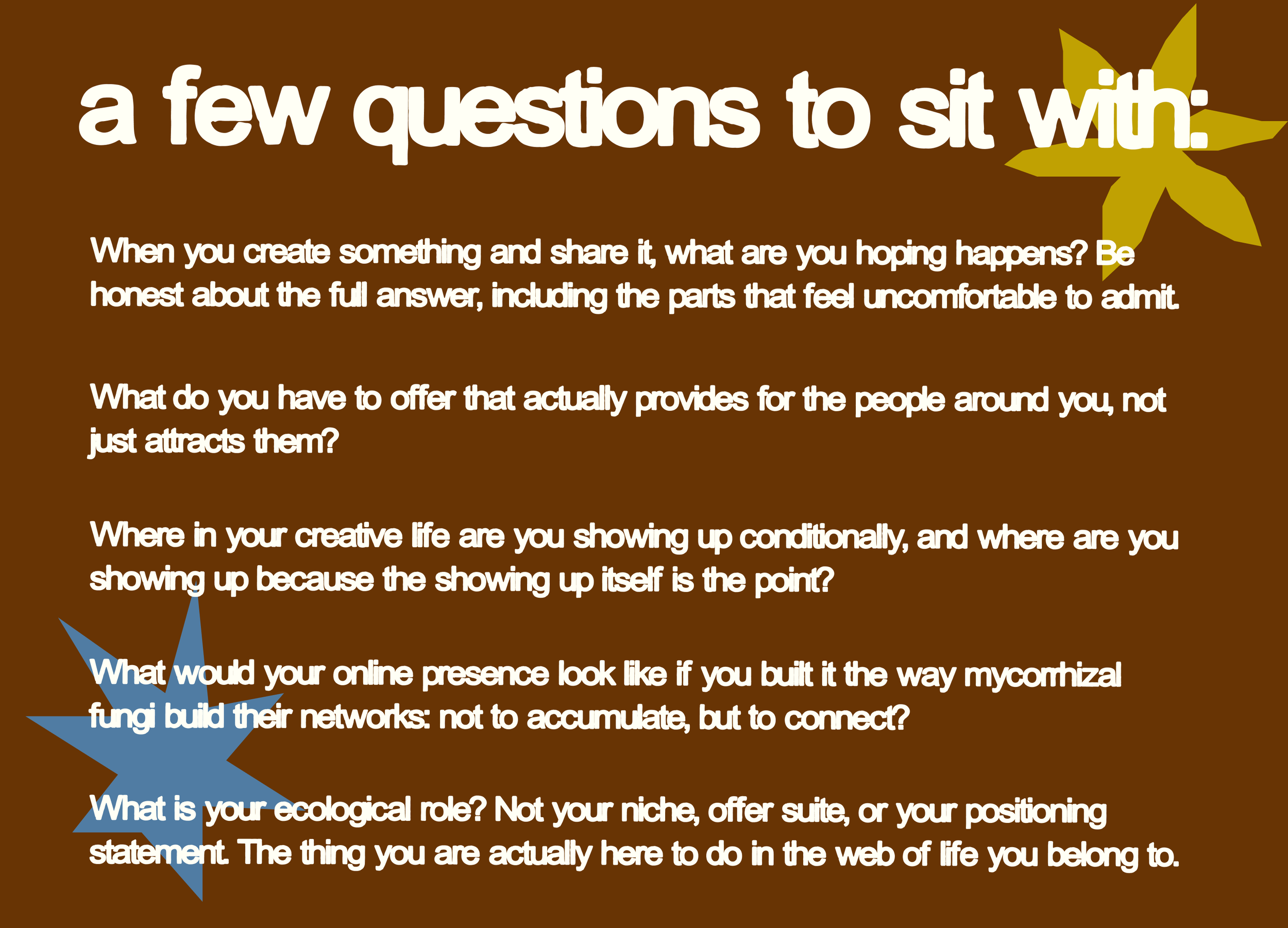
What would it mean to understand your gifts not as a product to be marketed, but as an ecological role to be fulfilled? What would it mean to show up in your creative work the way a mycorrhizal network shows up underground: not to acquire, but to connect, to carry, to feed?
This is the shift that changes everything, not just ethically, but practically, in terms of what kind of creative community and livelihood actually forms around your work. In the same spirit, Stop Saying Ethical and Meaning Nothing By It goes deeper on the gap between what we say we stand for and what we actually do.
The real problem with values-led marketing built on expectation
Most people in the values-led creative and business community are not showing up online to be manipulative. I see genuine sharing all the time: newsletters written with real care, work posted because people believe in it, and a consistent presence. After all, people want to be in a relationship with the people in their world.
And yet, underneath that sincere sharing, there is often a condition running. A scorecard is being kept, sometimes consciously, often not. Did it perform? Did anyone respond the way I needed them to? Was it even worth posting?
I am not exempt from this. I have deleted posts because they were not performing. I have felt the particular deflation of working hard on something, sharing it, and watching it land flat. The frustration is valid.
But here is what I have come to see: when the sharing becomes conditional on receiving something back, validation, engagement, proof that it is working, something in the relationship starts to hollow out. The giving is still happening. The conditions underneath it are what change things.
The people on the other side can feel that condition even when they cannot name it. They follow, but they do not trust. They consume, but they do not belong. They drift away not because your work is not good, but because the relationship was always slightly transactional underneath the warmth of it. People can sense the difference between being genuinely offered something and being the means to someone else's end.
This is what I mean by presence built on expectation. And it leads, almost inevitably, to the exhaustion of giving with one hand while counting with the other.

The ladder vs the web: two models for building a creative presence
Most of what gets called building a presence online is ladder logic dressed in the language of community.
The Ladder Model
The ladder has rules. You climb by accumulating followers, reach, authority, revenue, and status. Every rung you gain puts you above the rung you left. Someone is always above you, which means there is always further to go, always someone to outpace, always a reason the place you have reached is not enough yet.
The only relationships that matter on the ladder are the ones that help you climb. The ones that do not are friction. The ones below you are the audience. The ones above you are a goal.
Because a structure built on accumulation requires constant accumulation to stay standing, the moment you stop climbing, you start falling. The moment you rest, the gap widens. This is largely what creates the sense that you can never stop, never take a break, never pause without consequence.
The Web Model
The web works entirely differently.
In the web, there is no top and no bottom. There is no climbing because there is nowhere to climb to. There is only the question of whether you are showing up, whether you are connected, whether what you carry is moving through the network in ways that feed what needs feeding.
In the web, your value is not determined by how many people are below you. The mycorrhizal fungus deep in the soil is no less important than the tree it feeds just because it is underground and invisible to most. It is more important, in many ways, because the whole forest depends on what it does in the dark.
In the web, obscurity is not failure. A plant that feeds a single rare beetle, that pollinates a single rare flower, that produces a single seed that travels miles and becomes a forest, has not failed because it did not go viral. It has done exactly what it was here to do.
In the web, there is no competition because there is no scarcity. The abundance of one part of the system feeds the abundance of the whole.
The Practical Difference
On the ladder:
You post to grow your following
You measure your worth by your metrics
You show up when showing up serves a goal
You think about what you can get from the people who find you
In the web:
You share because you have something real to offer, and the sharing itself feeds something
You measure not by how many people follow you but by the quality of what passes between you and the people who do
You show up consistently, not because consistency is a growth strategy, but because a mycorrhizal network that only sends nutrients when it feels like it is not a network at all
You think about what the people who find you actually need and whether what you carry can meet that need
The ladder builds an audience. The web builds a community.
The ladder asks: how do I get more so that I can get ahead? The web asks: what does the living system around me actually need from me?
The ladder is a structure you maintain. The web is a relationship you tend.
And here is what ladders can never offer: when one part of a web is struggling, the rest of the web feeds it. When you are depleted, when your practice is in a season of winter rather than spring, when you have less to give than usual, the relationships you have built through genuine mutualism hold you. Not because anyone owes you anything, but because that is what a web of care does. It moves resources toward what needs them.
No one has ever been held like that by a ladder.
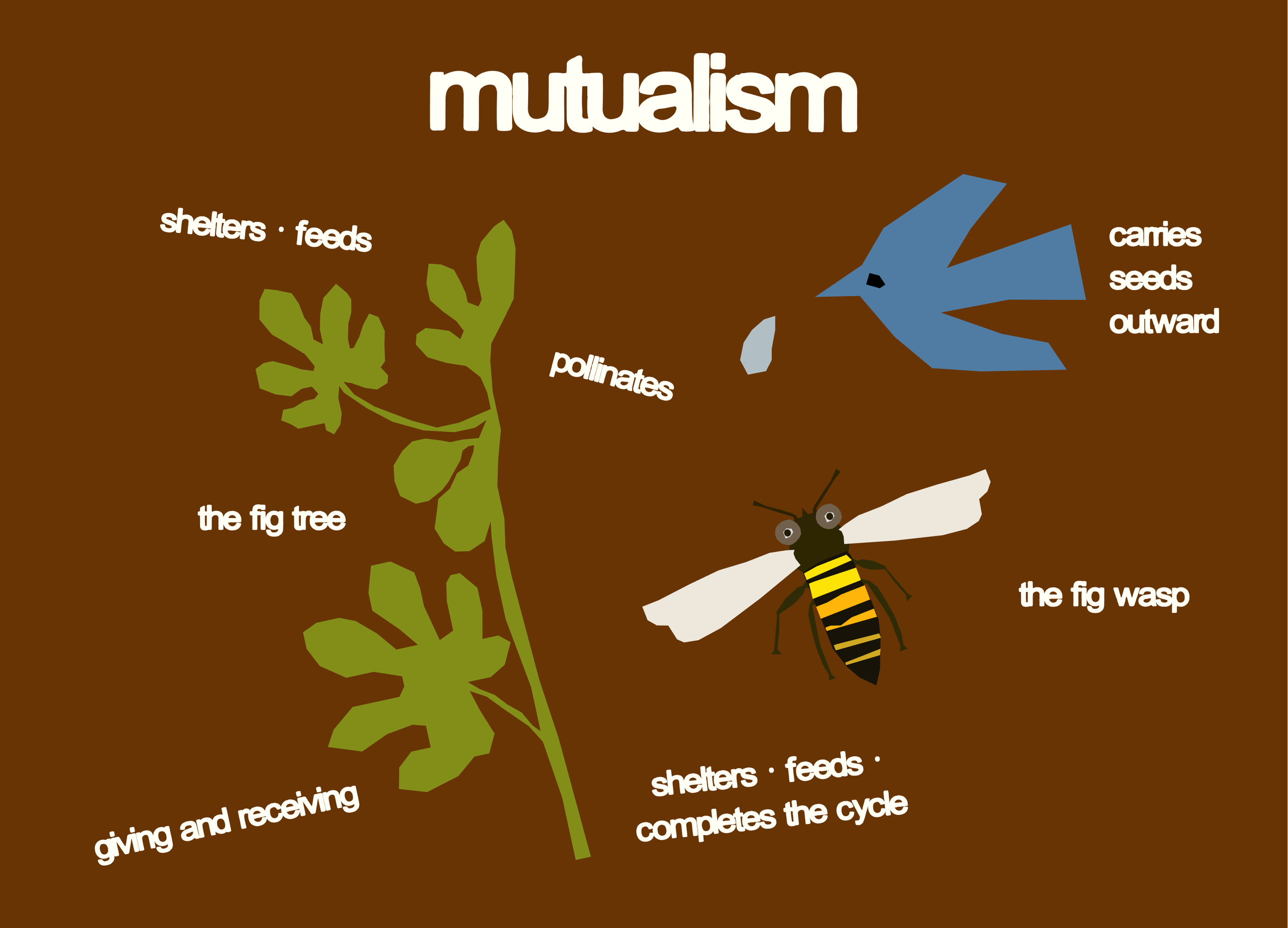
Your gifts are not a product. They are an ecological role.
Every person has gifts that are specifically, irreducibly theirs. Not just skills acquired through training, something deeper than that. A way of seeing, of making, of connecting, of caring that has been present since long before they had language for it. The thing they do that feeds the people around them almost without effort, the way a tree feeds its forest without trying to be a forest.
When you understand your gifts as an ecological role rather than a personal brand, the whole orientation of your creative work shifts.
You stop asking: how do I get more people to pay attention to me? You start asking: what does the web of life around me actually need from what I specifically have to give?
You stop asking: how do I stand out in a crowded market? You start asking: where am I most needed? Where does my particular way of seeing or making or caring fill a gap that nothing else fills?
Sharing your work becomes an act of ecological responsibility rather than self-promotion. Visibility becomes a way of making yourself findable to the people who need what you carry, not a metric to optimize. Your platform becomes a place of genuine exchange, where giving and receiving are so interwoven that the distinction starts to dissolve.
That is mutualism. That is what a creative practice rooted in gift ecology actually feels like from the inside. And it is the most sustainable way to build a livelihood in this moment, when everything built on extraction and accumulation is starting to show its fragility.
There are many ways to be essential: the Ecological Roles of Care framework
One of the frameworks I have developed alongside this thinking is the Ecological Roles of Care: nine roles that already exist in living systems and in the ways people are already showing up in their communities and their work.
The nine roles are:
Seed Planters — initiate what does not exist yet
Wayfinders — sense when it is time to shift direction
Decomposers — dismantle what has outlived its integrity
Sustainers — hold continuity and reliability when everything else is moving fast
Pathmakers — connect across differences
Regenerators — restore capacity and prevent collapse
Signal Boosters — redistribute attention and resources
Record Keepers — preserve truth and context
Protectors — set boundaries around harm
I built this framework because I kept watching people burn out trying to embody roles that were not actually theirs. Performing constant visibility when their real power was in the work they did in the background, which held everything together. Trying to be the loudest voice in the room when their gift was knowing exactly when to listen.
Every one of these roles is essential. None is more important than the others. The web needs all of them.
Common Ground: a practice space for building differently
This is the thinking that Common Ground is built around.
Common Ground is the practice space inside DoGoodBiz Studio where the studio's values become a living curriculum. It is built for creatives, founders, healers, and practitioners who are questioning the dominant frameworks of work and business, and who want support building something genuinely rooted in creative liberation, ecological thinking, and a kind of expression that expands what is possible rather than diminishing it.
Ready to tend a web instead of climb a ladder?
If what you have read here is landing as recognition rather than information, there are two ways to go deeper.
If you're looking for a space to practice this kind of creative conviction alongside others, Common Ground is built for that.
If you want one-on-one support, Creativity mentoring and thought leadership positioning are both available for people who are ready to do this work with a thinking partner alongside them.
Until next time,
Natalie Brite
Natalie Brite (they/them) is the founder and creative director of DoGoodBiz Studio: an ethical creative studio for conscious leaders and the movements they are building. With a background in fine art, philosophy, and sustainable development, Natalie works at the intersection of design, ecology, and collective care. Field Notes is their writing home: dispatches on creative ecosystems, ecological thinking, and what it means to build something genuinely rooted in care.
Portland, OR · Working worldwide · dogoodbiz.studio
