

Gifts & Purpose: How to Find What You're Here to Contribute
There is a question most of us carry within us, sometimes for years, sometimes for a lifetime: What am I here for?
We ask it after a job ends, a relationship fragments, or a season of life concludes, leaving us standing in the space between what was and what hasn't yet begun. We ask it when something we're doing feels shallow or pointless, when the work we're supposed to be proud of sits awkwardly in our chest, when we look around at the life we've built and feel the eerie sense that we are somehow still missing something.
We were taught to answer the question of what our purpose is with productivity in mind. With strategy. With a five-step framework for turning our passions into a revenue stream.
I want to offer something different.
The problem with how we've been taught to find our purpose
Before we can remember what our gifts and purpose actually are, we have to name what got in the way of knowing them in the first place.
Capitalism has taught us that our gifts are only valuable if someone will pay for them. That purpose is found at the intersection of what you love, what you're good at, and, always, what will make us the most money. This framing may seem helpful on the surface. It's practical. It's actionable. It gives us something to do with the question.
But it does something insidious underneath: it makes our gifts contingent. They are worth something only if they are worth something to someone else, in economic terms, right now. And so we begin to audit ourselves. We scan our inner world for what might be sellable or marketable. We try to turn the natural, unruly fact of who we are into a product.
In the process, we lose the thread.
Colonization compounds this severing in ways that run even deeper. The cultures and indigenous communities that held relational, land-based, communal understandings of gifts and purpose, the ones that understood giving and receiving as the architecture of a living system, not a transaction, were systematically dismantled. The knowledge that gifts are shared as a form of collective care, that purpose is rooted in reciprocity with community and land, that we are embedded in something larger than our individual achievement… this knowledge was suppressed, stolen, and replaced with exploitation and extraction. And thus, the balance of things began to suffer.
We inherited this wound. Most of us don't even know we're carrying it. We just know that something feels like it’s missing, that the frameworks we've been given don't quite reach the thing we're actually looking for or craving.

What nature knows that we've forgotten
I have learned more about gifts and purpose from paying attention to the living world than from any book on productivity or any course on finding your calling.
Watch a forest long enough, and you begin to understand something that no career framework could ever articulate clearly: every element of a living ecosystem has a role, and it fulfills that role not through effort or ambition or strategy, but simply by being what it is.
The mycelium network doesn't decide to feed the trees. It feeds the trees because that is its nature: to move nutrients, to connect, to communicate underground. The pollinator doesn't apply to be a pollinator. It follows its nature toward the flower, and in doing so, serves the whole system. The canopy tree doesn't withhold its shade until it finds the right market for shadow. It grows toward the light, and shelter is a natural consequence of being fully itself.
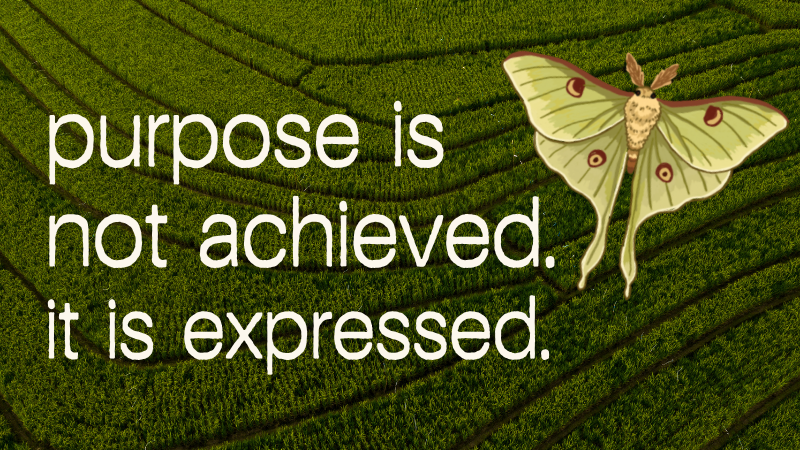
Purpose, in the living world, is not achieved. It is expressed.
And gifts, the things each element offers to the system, are not held back or rationed or priced. They flow. Freely, continuously, as a natural extension of what the thing simply is.
This is the actual architecture of living systems. Reciprocity, giving and receiving in continuous, unattached flow, is how ecosystems remain healthy, how they grow, how they survive disruption and return to balance. When one element stops contributing, when extraction replaces reciprocity, the whole system begins to degrade.
We are not separate from this. We are part of it. And, we each have our own unique part in supporting its balance.
What gifts actually are
Your gifts are not just your skills. They are not your qualifications, your portfolio, or the services you offer at a particular price point. They are something older and more instinctual than any of that.
Your gifts are the things you carry so naturally that you barely notice them. They are what people come to you for before you've advertised anything. They are what you do effortlessly that feels like work to someone else. They are the particular quality of attention you bring to a room, the specific way you hold someone's pain, the unusual angle from which you see a problem, the thing that makes people feel safer or clearer or more themselves in your presence.
Your gifts are not what you do. They are closer to how you are.
And here is the thing about gifts that capitalism most fundamentally obscures: they were never meant to be withheld until conditions were right. They were never meant to just be rationed, packaged, and sold. They were meant to be shared generously, naturally, as a continuous act of being in relationship with the world around you.
Sharing your gifts is as natural as breathing. It is not a brand. It is simply what happens when you stop trying to monetize yourself long enough to actually be the expression of your full self.
What purpose actually is
Purpose is not a destination you arrive at after enough self-reflection and vision boarding. It is not a grand mission statement or a legacy or a five-year plan.
Purpose is something you already are. It is present in you, whether you acknowledge it or not, the way the river's purpose of connecting and carrying is present regardless of whether the river has ever taken a course on finding its calling.
Your purpose reflects what you value, what you stand for, what you hope for, and what you ache over. It is the through-line in everything that has ever mattered to you. It doesn't have to be grand or flashy or legible to the culture of achievement. Your purpose might be quite simple. It might be deeply personal. It might be to raise a child with genuine care, to tend a piece of land, to be the person in every room who makes others feel less alone.
Purpose is not about anything other than the truth of who you are.
And it points always outward, not toward your personal success, but toward the community and the living world you are part of. When you live your purpose and share your gifts, you are fulfilling your role in the ecosystem. You are taking care of something beyond yourself. You are in reciprocity.
Three practices for remembering
These are acts of remembering. Take your time with them.
Practice one: The witness
Think about the people in your life: across time, across contexts. What have they always come to you for? Not what you've marketed yourself as, not what your job title says, but what people simply seem to know you carry.
Maybe they've always come to you when they're confused and need clarity. Maybe they come to you when they need to laugh, or to be seen, or to feel like their grief makes sense. Maybe they come to you because you always know what's actually happening beneath the surface of a situation.
Write it down. Don't edit it. These are the witnesses to your gifts… and they have often seen you more clearly than you've seen yourself.
Practice two: The ecological mirror
If you were an element of a natural ecosystem, such as a river, a mycelium network, a pollinator, a canopy tree, a tide, a decomposer, a seed, what would you be?
And what is the role of that element in the system it belongs to? What does it give? What does it receive? What would the ecosystem lose if it disappeared?
This question bypasses the capitalist frame entirely. There is no market for being a river. There is no revenue model for being mycelium. But there is a function, a relationship, a contribution, and locating yourself in that image often tells you something true about your gifts that no skills inventory ever could.
Practice three: Reciprocity
The earth gives us everything. Air, water, food, beauty, stillness, wildness, the particular quality of light at a certain hour. It gives without asking, continuously, as an expression of what it simply is.
Sit with that for a moment. What does the world give you that you receive most deeply? What fills you, restores you, grounds you?
And now: what do you feel naturally called to give back?
Not strategically. Not professionally. Not in exchange for anything. Just: what is the natural return? What does your presence contribute to the people, places and living systems around you when you are most fully yourself?
That is the beginning of your answer.
Gifts shared are not gifts diminished
There is a scarcity logic built into capitalism that says if you give something away, you lose it. That there is always the risk that someone else could still take your gifts. That your gifts have a finite supply and must be protected, rationed, saved for the right moment and the right price.
The living world disagrees.
The tree does not run out of oxygen. The river does not deplete itself by flowing. The mycelium does not lose its ability to communicate by communicating. In living systems, gifts shared are gifts that grow, that deepen the relationship, that strengthen the web, that make the whole more resilient.
When you share your gifts freely, allowing them to flow as a natural expression of who you are, you are not diminishing yourself. You are doing what living things do. You are in reciprocity. You are contributing to something that will, in turn, contribute back to you.
This is not naivety. You still get to have boundaries. You still get to choose where, how, and with whom you share. But the energy underneath the sharing, the spirit of it, is not strategy. It is not a transaction. It is the simple, natural act of being what you are, in relationship with a world that is doing the same.
This is what we're here for
Our studio does not exist to build empires or solely focus on optimizing personal brands or arrive at some final peak of achievement from which we can look down at everything we have accumulated.
We are here to contribute. To the people around us, to the communities we belong to, to the living world that holds all of us.
Our gifts are how we do that. Our purpose is the direction we take. And the real work, the lifelong work, is not to find these things from scratch but to remember them. To peel back the layers of conditioning and scarcity and performance that covered them over, and to find what was always there.
What was always there.
Waiting not to just be discovered, but to be lived.
Until next time,
Natalie Brite
Make it stand out
This essay is the foundation of Remembering Your Gifts: a workshop on purpose, ecology, and finding what you're here to contribute. If this resonated, the workshop goes deeper into the framework, into the practices, and into the company of others asking the same questions.
Remembering Your Gifts is a recorded class and interactive workbook that draws on ecological thinking, anti-capitalist frameworks, and the wisdom of the living world to help you reconnect with what you're genuinely here to contribute, outside the logic of profit, performance, and individual achievement.
This is not a class about building a personal brand around your purpose. It is not a framework for turning your gifts into a revenue stream. It is something more radical than that: an unlearning, and a remembering.
This is for you if:
You've felt the pressure to monetise everything you love and it's left you feeling hollow rather than fulfilled.
You're questioning the frameworks you've been given for success and purpose — and sensing there's something truer underneath.
You're drawn to ecological thinking, to anti-capitalist alternatives, to ways of being in the world that are rooted in care rather than extraction.
You already know, somewhere, that your gifts are meant to be shared — you just want help finding your way back to them.
