What Is Movement Messaging? How to Articulate What You're Actually Building
I didn't have a name for it for a long time.
From the very beginning of my work, through every iteration, every evolution, every new direction, I’ve always been driven by something underneath the surface of whatever I was making or offering. A philosophy. A set of beliefs about what was possible if we did things differently. A genuine vision for the world I wanted to participate in building.
I just didn't have the language to describe that as something distinct from "running a business."
I thought everyone felt this way. I thought every person building something independent was animated by a deeper why, was responding to the world around them, was making work that related to and grew from their actual beliefs about how things could be. I thought the work was always in conversation with something larger than the product or the service or the deliverable. I didn't start with a strategy for building a movement. I started with convictions. The movement was what happened when I refused to separate those convictions from the work.
It took years of watching my industry, watching what it was normalizing, what it was rewarding, what it was asking people to become, before I understood that what I was doing was actually different. And that the difference needed to be named.
This article is about that difference. About what movement messaging is, why it matters more than ever right now, and how to begin articulating the fuller thing you're actually building, not just the services you offer or the products you sell.
It's also a personal account of how I came to understand my own work in these terms, through watching the industry I'd chosen shape-shift around me in directions that didn't feel right, and through the gradual realization that the thing I'd always been doing had a name.
Let's start with what movement messaging actually is
Movement messaging is the practice of naming the shift your work is participating in clearly enough that the right people recognize themselves in it, and truthfully enough that it stays aligned to what you're actually doing.
It is not a tagline. It's not a brand voice document. It's not a mission statement workshopped in a strategy session and printed on a values poster.
Movement messaging is the language and expression that makes the underlying conviction visible.
It takes the beliefs that have been animating your work from the beginning, the ones you've acted from even when you couldn't fully articulate them, and gives them a form that other people can encounter, recognize, and move toward.
The word "movement" here doesn't necessarily mean a social movement in the political sense, though it totally can. It means something in motion. A shift in how things are understood or done, gathering momentum as more people participate in it. Your work might be a tiny but significant contribution to a shift, or it might be at the center of it. Either way, if your work is oriented toward something larger than a transaction, if you're trying to change something, name something, demonstrate something, you are building a movement, whether or not you've been calling it that.
Most messaging advice is built around persuasion, how to convince someone. Movement messaging is built around clarity, how to help the people who already feel the pull of what you're building understand why they feel it. That's a fundamentally different orientation. Persuasion is something you manufacture. Clarity is something you discover. And the discovery process, understanding what you're actually saying at the level beneath your offers, is the work that most conscious, values-led builders skip because they're too busy trying to figure out how to market what they already have.
What most industries get wrong and why it matters for your messaging
I've been developing my own work independently for a long time. Long enough to have watched my industry (as well as many other industries!) change dramatically… and not always in directions I felt were ethical, let alone caring.
What I witnessed, especially across the rise of social media and the personal brand era, was a kind of collective amnesia about why people got into this work in the first place. The incentives shifted toward visibility, engagement, follower counts, and viral reach. And a lot of people followed those incentives, often without even fully realizing they were doing it!
Brands started standing for nothing but aesthetics. Micro-businesses ran marketing campaigns with the same extractive urgency tactics as the corporations they claimed to be different from. Sole proprietors with genuinely important things to say flattened their entire perspective into content calendars and hot takes, optimizing for clicks rather than meaning.
I remember watching this happen and feeling a particular kind of disgust…not at the people, but at the conditions that made it feel necessary. The platform algorithms reward sensation over substance. The business advice that treated values as a liability, something to forget about or hide if it made you sound too political, too specific, too niche. The implicit message that if you weren't growing at scale, you were doing it wrong.
And underneath my disgust was something more troubling: the realization that this was being treated as normal practice. That it was apparently considered fine for a business, however small, however independent, however supposedly values-rooted, to stand for nothing other than its own success.
I had always done business differently, though I didn't always have language for why or how. I had always been driven by underlying philosophies rather than market trends. My work had always been in response to the world around me; to the challenges I'd personally faced, to the things I'd been able to grow through or change, to the dreams and hopes I carried for people and for the planet.
I never thought of my work as existing in a silo. A creative business isn't a neutral entity, after all. It makes choices about what it stands for and what it refuses. It either participates in the world's problems or tries to be part of addressing them. There is no version of doing this work that is above or outside of that.
What I was doing, and what I now understand as movement messaging, was refusing to separate the work from the convictions that drove it. My offerings are simply the vessel. They carry the mission. The work exists to fulfill the vision, not the other way around.
This is the inversion that movement messaging requires. Most businesses define their mission by what they sell: we sell brand design, therefore our mission is to help people with their brand design. Movement messaging insists on the opposite: the mission comes first, and the offerings are the vehicles through which you carry it out. The products and services are how the vision moves through the world. They are not the point.
The two ways most conscious leaders get this wrong
There are two common challenges when values-led folks try to articulate what they're doing, and they're almost exactly opposite each other.
Challenge 1: Shrinking the scope
The first challenge is underselling what you're actually building. You describe your work as a service or a product, because that feels safer, more legible, less presumptuous, when what you're actually doing is participating in a cultural shift. You say "I help x type of person achieve y and z" when the fuller truth is that you're demonstrating that your specialty and unique approach rooted in your values, mission, and vision, can actually work. Another example could be that you say "I teach creative writing" when what you're actually doing is helping people reclaim their voice in a world that has systematically told certain people their voices don't count.
This shrinking usually comes from a specific fear: the fear of sounding grandiose. Of overclaiming. Of being the person who announces they're changing the world when they're just selling a course.
But the problem with shrinking isn't humility, as humility is good! The problem is that when you understate the scope of what you're doing, you make it impossible for the people who are drawn to the bigger thing to find you. You attract people who need a service but not people who share the vision. And you end up building a client list that is satisfied with the work but not transformed by it.
Challenge 2: Overselling the ideology
The second challenge is the opposite: leading so hard with the vision and the politics that the practical entry point for new people disappears. The message becomes a manifesto, specific, passionate, meaningful, but it only reaches those who’ve already opted in to that way of thinking. Everyone else can feel that something is being asked of them before they're ready to be asked.
This often looks like: too much systems critique without enough personal recognition, too much theory without enough warmth, too much of the why without enough of the what-it-would-feel-like-to-work-with-you. The message is truthful, but it isn't an invitation. It's a declaration.
The sweet spot: where movement messaging actually lives
Movement messaging sits in the narrow realm between those two challenges shared above. It names the shift without being overly preachy. It's specific enough that the right people recognize themselves in it, and expansive enough that it feels like an invitation rather than a transaction or flat declaration. It carries the full weight of what you're doing without demanding that the reader agree with everything before they can walk through your doors.
Getting there requires two things most messaging advice skips entirely: genuine clarity about what you genuinely believe, and the willingness to say it in language that your people will recognize.
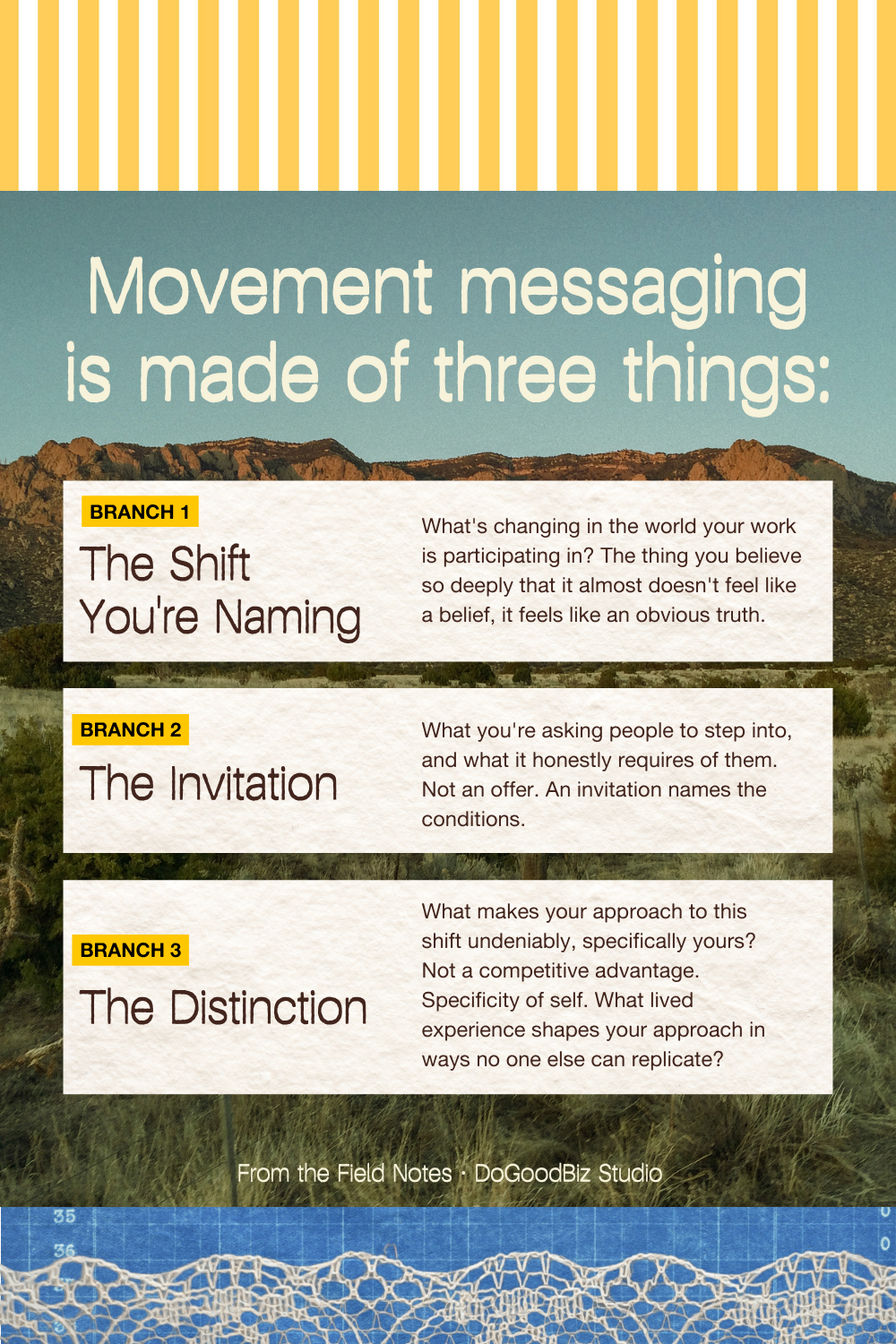
The three components of movement messaging
When I work with clients on movement messaging, as well as when I've worked on my own, I find that it's made up of three interlocking elements. These aren't steps in a process. They're things you discover in conversation with yourself, with your work, and eventually with the people who are drawn to what you're doing.
1. The shift you're naming
Every movement is built around a shift: something in how the world is understood or done that you believe needs to change. Not every movement is explicitly political, but every movement has a thesis about what's wrong with the current state and what's possible if something changes.
Your shift is probably something you've believed for a long time, so naturally that it almost doesn't feel like a belief… it feels like an obvious truth. That's usually the signal to look for. The thing that seems so evident to you that you're slightly baffled it isn't universal is often the core of your movement messaging.
Questions to help you find your shift:
What do you believe about your field or your work that most people in that field don't believe, or won't say out loud?
What would need to change in the world for your work to feel unnecessary? (The answer is often close to your thesis.)
What have you witnessed in your industry that you refuse to participate in, and why?
If your work succeeded completely, if the vision fully came to life, what would be different about how people relate to the thing you care most about?
For me, the shift I'm participating in is about how we understand the relationship between creative work, business, and the world. I believe that creative work is not separate from the ecological and social systems it exists within. I believe that how we build matters as much as what we build; that the process is the point, not just the product. I believe that a business can be rooted in gift economies, reciprocity, and genuine care for people and planet without sacrificing sustainability or quality. I am building within that shift and inviting others to build there too!
2. The invitation
Once you know the shift you're naming, the next element is the invitation: what you're asking people to step into, and what that step requires of them.
Most brands make offers. Movement messaging makes invitations. The difference is important. An offer says: here is a thing, and here is what it costs, and here is what you'll receive in return. An invitation says: here is something we could do together, here is what it's in service of, here is what it will require, and here is what becomes possible if you step in.
Invitations are harder to write than offers because they require you to be honest about what you're asking. For example, coming into DGB's work isn't just hiring a studio; it's agreeing to slow down and reconnect to yourself as well as the world around you, to have the uncomfortable conversations about what your brand is actually doing, to be honest about the gap between your values and your current presence. That's not a sales objection to overcome. It's a real condition of the work, and naming it upfront is part of the movement messaging.
3. The distinction
The third element is the distinction: what makes your particular approach to the shift different from everyone else working in the same general territory.
This is where movement messaging gets specific. There are lots of people who may be making a shift that is similar to the one you are anchoring into. What makes your version of that conversation distinct? What angle do you bring? What lived experience shapes your approach in ways that someone else's doesn't?
Your distinction isn't a competitive advantage in the conventional sense. It's not about being better than others in your space. It's about being undeniably, specifically yourself, because that specificity is what allows the right people to find you and trust you, and what separates genuine movement building from brand positioning.
My distinction, what makes my approach to this conversation mine specifically, comes from where my thinking is rooted. In ecology and animism. In anti-capitalist and decolonial frameworks. In my own experience as a queer person building work outside the dominant culture's expectations for what a creative business should look like or stand for. The ecological thinking isn't a metaphor for me. The liberation framing isn't a brand positioning choice. These are the actual frameworks through which I understand the world and make decisions about my work. That specificity is what makes the work recognizable as mine rather than as a genre.
How to begin developing your movement messaging
Movement messaging isn't something you develop in an afternoon. It's something you uncover over time, through writing, through conversation, through paying attention to what your clients say when they describe why they came to you, through noticing what you refuse and what you insist on and what you keep coming back to.
But there are starting points. Here is how I'd suggest beginning:
Start with what you refuse
Movement messaging often becomes clearest through negation before it becomes clear through affirmation. What is your work a response to? What have you watched happen in your industry, your community, or the field that you have specifically chosen not to participate in? The refusals often point directly at the shift you're naming.
Listen to what your people say back to you
If you have clients, readers, students, or community members… pay attention to how they describe your work when they're trying to explain it to someone else. They will often get closer to your movement messaging than you can from the inside, because they're describing the experience of encountering it, not the intention behind it. Some of the clearest articulations of my own work have come from clients describing it to a colleague, or from readers telling me what a piece of writing opened up for them.
Write the manifesto you'd never publish
Give yourself permission to write or create, just for yourself, the full-throated version of what you believe about your field and what you're doing about it. No sugar coating, no audience consideration, no concern about how it sounds. Just the actual convictions. Then look at what you wrote and ask: what in here is true enough to share? The publishable version will be a distillation of that, but the unpublished version is where the real material lives.
Let it be incomplete
The mistake most people make when they finally start articulating their movement messaging is trying to get it finished. This is definitely not about trying to be perfect! Movement messaging is never finished. It evolves with the work, with the world, with your own understanding of what you're doing. The goal isn't a perfect statement. It's a living one; honest about where you are now, and open to becoming more precise as the work continues.
Why movement messaging matters more now than it ever has
We are in a moment of profound noise. The volume of content, messaging, and brand communication in every field has reached a level where almost none of it is distinguishable from any other. AI can generate coherent, professional-sounding brand messaging in seconds. Design templates can produce polished visual identities on demand. The surface markers of a credible presence, a well-designed website, a coherent Instagram grid, a professional email newsletter are now available to everyone, sometimes even at zero cost.
This means that surface-level differentiation is over. If your brand positioning is primarily aesthetic, a particular color palette, a tone of voice, a visual style, it will be replicated within a product cycle. The only thing that cannot be replicated is genuine conviction, specific lived experience, and a clearly articulated perspective on something that actually matters.
Movement messaging is, among other things, a response to this moment. It insists on a kind of specificity that algorithms and templates cannot produce. A fully articulated movement message is almost impossible to copy because it's rooted in the specific human being who developed it, the specific experiences that shaped them, the specific community they've been in conversation with, and the specific refusals they've made over time.
The most sustainable brand differentiation in an AI-saturated content landscape isn't aesthetic. It's conviction. The things you've decided to stand for and the things you've decided to refuse, expressed clearly enough that the right people can find you.
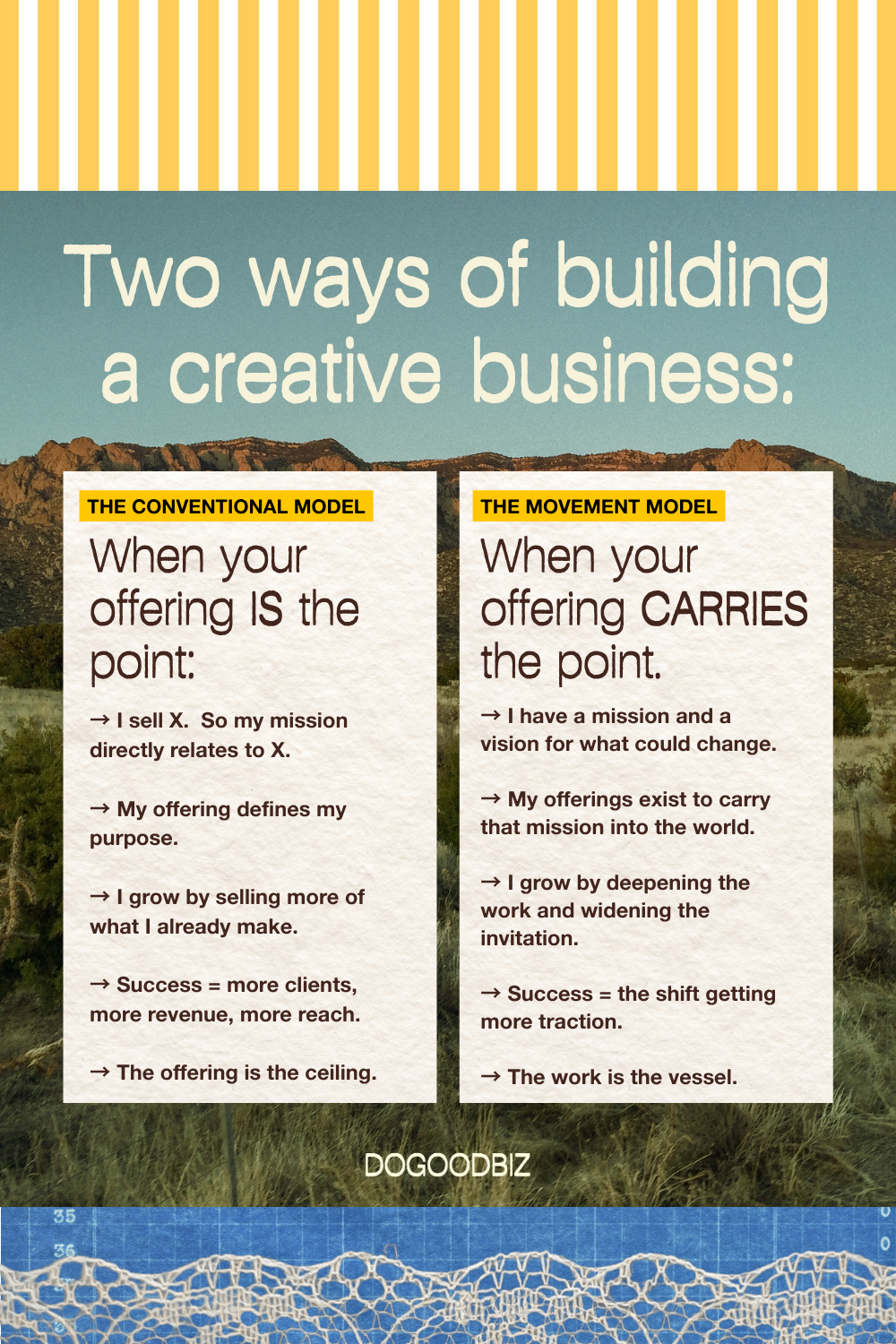
I built this studio on the premise that how you build a business is as important as what you build.
That the process is the point! Our values aren't a marketing strategy but a practice that shows up in every decision, every client relationship, every piece of work. That was a movement position before it was a brand position. And it's what has allowed the studio to stay rooted through years of industry shifts, trend cycles, and pressure to do things the way everyone else was doing them.
I've always done business differently. Not because it was strategic, but because it was the only way I could do it with integrity. The movement messaging, the language that names what I'm actually building, came later. But the conviction was always there, driving the work, shaping the choices, creating the conditions for the right people to find their way to it.
That's what I want for you. Not a better tagline. Not a more compelling brand story. But the clarity that comes from finally putting language around the fuller thing you've always been doing, and the courage to let that language be visible.
Ready to develop your own movement messaging?
If you recognize in your own work the gap between the depth of what you're building and the language you currently use to describe it, the starting point is simpler than it might seem.
Not a brand audit. Not a messaging workshop. Not a content strategy. A single honest piece of writing. Just for yourself. About what you actually believe, what you've refused, what the work is in service of, and what you hope becomes possible because you did it. That writing is the seed. Everything else, the public messaging, the service descriptions, the website, the content, grows from there. Movement Messaging is one of the core services within DoGoodBiz Studio, alongside Thought Leadership Positioning, Platform Strategy, and Content Ecosystem development. If you've been reading this and recognizing the gap between the depth of what you're building and the language you currently use to describe it, that's exactly what our work addresses.