

Why Every Creative Needs a Website (And How to Choose the Right One)
Imagine spending three years building an audience. You post and show up consistently on social media. You share your process, your work, your stories. People start to follow along. You grow.
Then the algorithm changes.
Your reach drops overnight. Posts that used to get seen by thousands now barely land in front of a few dozen. You spend more time creating content to feed the platform than you do making the actual work you love. And somewhere in the back of your mind, you know that none of it, not the followers, not the content, not the presence you've built, actually belongs to you.
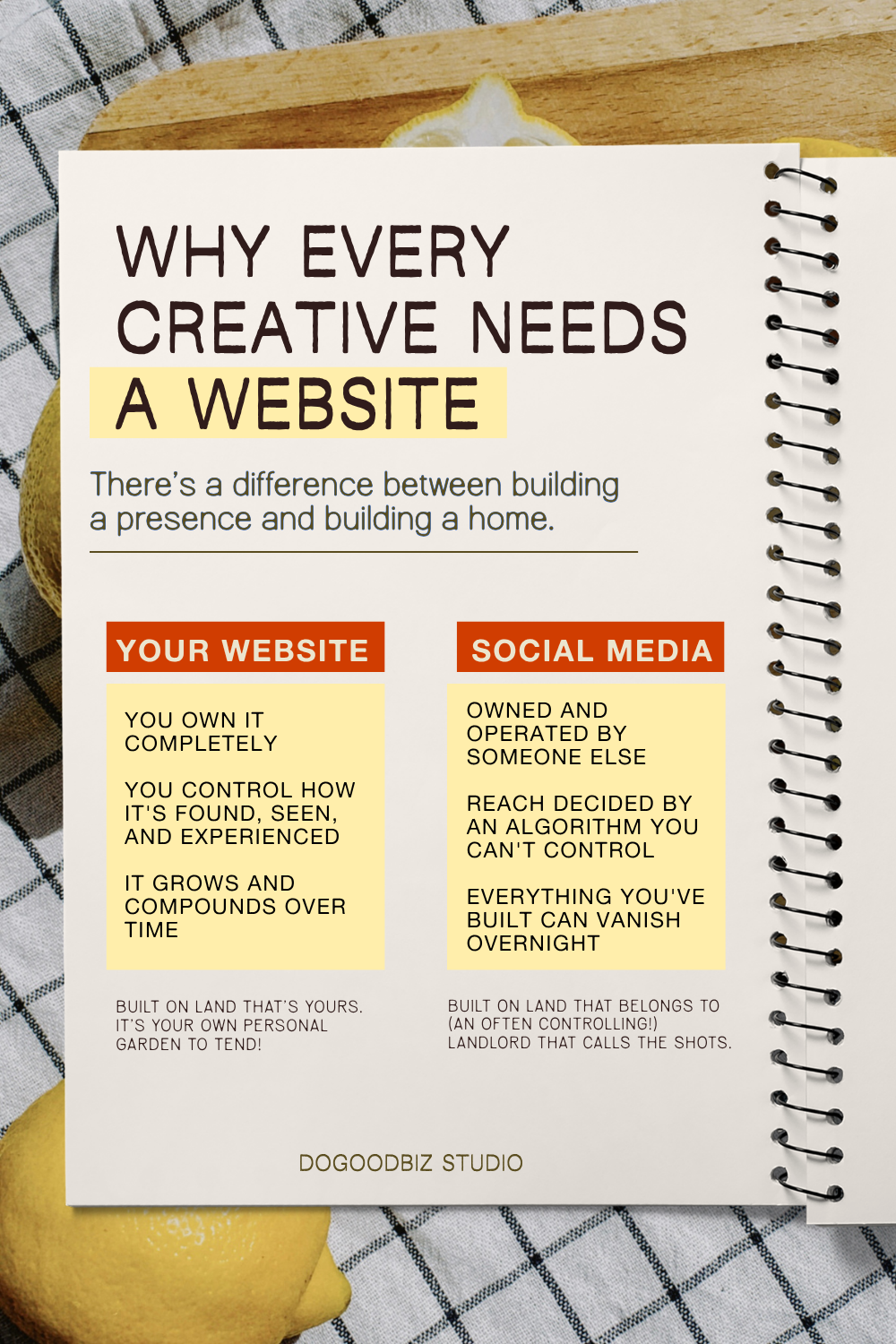
This is the reality for a staggering number of creatives right now. Writers, makers, artists, illustrators, photographers, potters, printmakers, people doing genuinely beautiful, meaningful work, who have built their entire digital presence on borrowed land. Social media platforms are rented land. Your website is the only corner of the internet you actually own.
A website isn't a luxury. It isn't something you build once you've "made it." It isn't a nice-to-have that you'll get to eventually. For a creative building a sustainable presence, a website is infrastructure as essential as a studio, a portfolio, or a business bank account.
This guide is for every creative who's been putting it off, every maker who's relying on a link-in-bio, every writer who's posting everything to Instagram and wondering why it doesn't feel like enough. We're going to talk about why a website matters more than ever, how to choose the right platform for where you actually are, and how to build something that works for you without becoming another thing you have to constantly maintain.
In this guide:
Why creatives resist websites and why those reasons don't hold up
What a website actually does that social media can't
Platform comparison: Linktree, Canva, Shopify, WordPress, and Squarespace
DIY vs. hiring someone and how to decide
Your website as a creative expression and brand
How a website reduces dependency on social media for good
Why Creatives Resist Getting a Website (And Why Those Reasons Make Sense, But Don't Hold Up)
Before we talk about what a website can do for you, let's name the reasons most creatives don't have one yet or haven’t prioritized managing one.
"It's too complicated."
This was maybe true ten years ago. It's genuinely not the case anymore. Website platforms have evolved significantly; you don't need to know how to code, manage servers, or understand technical infrastructure to build something beautiful and functional. The right platform for a creative lets you focus on your work, not on learning a new software system or skill. We'll get into which platforms actually deliver on that promise below.
"It's too expensive."
A quality website platform costs roughly the same per month as a few specialty coffees. If you're selling work, booking commissions, or offering services, your website will pay for itself with a single transaction. And if you're not yet at that stage, there are genuinely good free and low-cost options that don't require compromise on quality. The question isn't whether you can afford a website, it's whether you can afford not to have one.
"I already have Instagram / Youtube / Substack."
You have a presence on a platform someone else owns. That's meaningfully different from having a home base. You can be shadowbanned, restricted, hacked, or simply deprioritised by an algorithm update, and you have no say in it. You don't own your presence. You can't control how your work is displayed. You can't optimise for search. A social presence and a website are not interchangeable; they serve completely different functions.
"Linktree is fine for now."
Linktree is a tool for directing traffic somewhere. It is not a destination. It has no SEO value, no story, no visual identity, no archive of your work, no ability to capture an email address, no place for someone to spend time understanding who you are and what you make. "Fine for now" has a way of becoming a permanent placeholder. We've seen creatives use link-in-bio tools for years while their actual work goes undiscovered.
"I'll do it when I'm more established."
Your website is part of how you become established. The digital footprint you build over time through consistent content, SEO, an email list, and a portfolio that grows with your work compounds. Every month you wait is a month of potential search traffic, potential discovery, potential connections that don't happen. The best time to start was two years ago. The second-best time is now.
What a Website Actually Does for a Creative That Social Media Can't
Let's be specific about what changes when you have a website that's working.
It compounds over time
Social media content has a lifespan of hours, maybe days if you’re lucky. A well-written page on your website, such as a portfolio piece, a thoughtful blog post, or a service description, can continue driving traffic for years and years. Search engines index your content and surface it to people actively looking for what you do. This is compounding visibility: the work you do today keeps paying off long after you've moved on to the next thing.
It tells your full story
A social media profile gives you a grid, a bio, and a link. A website gives you architecture: a home page that orients visitors, an about page that shares your story with depth, a portfolio that contextualises your work, and a services or shop page that makes it easy to work with or buy from you. The difference between someone quickly swiping past your work and someone who genuinely understands and is interested in it is often a website.
It gives you a home base that belongs to you
Your email list, your portfolio, your offerings, your booking system… they all live somewhere you control. When a platform changes its algorithm, restricts your account, or simply stops being relevant, your website is still there. The relationships you've built through it via email subscribers, repeat visitors, returning clients… those are yours to keep.
It makes discovery possible outside your existing audience
Most social media platforms show your content primarily to people who already follow you (or people like them). Search engines show your content to people who have never heard of you but are actively looking for what you do. A creative who makes handmade ceramics in Portland and has a website with thoughtful, keyword-aware content can be found by someone in New York searching for exactly that. Social media alone can't do this for you.
It lets people take action without friction
Buy your print. Book a commission. Sign up for your newsletter. Download your zine. All of this can happen directly on your website, without the friction of DMing you, clicking away to another platform, or navigating multiple apps. The fewer steps between a visitor's interest and an action, the more often they'll take it.
Choosing the Right Platform: An Honest Breakdown
This is where a lot of creatives get tripped up, not because the options are confusing, but because the advice flying around online is often driven by affiliate commissions, personal preference, or a one-size-fits-all perspective that doesn't account for where you actually are in your creative business.
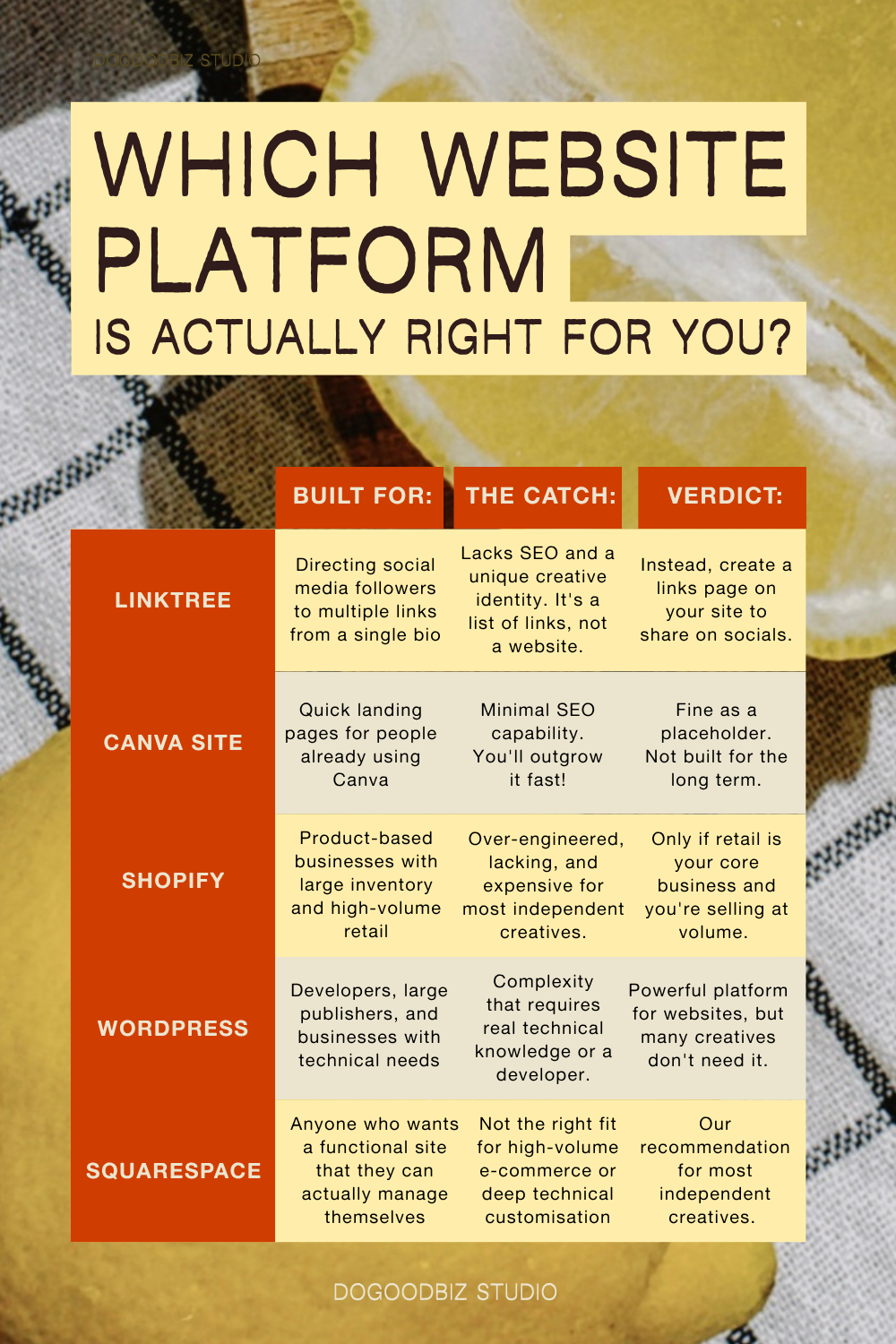
The right platform is the one that matches your goals, your technical comfort level, and the kind of work you do. Here's an honest breakdown of the most common options:
Linktree (and other link-in-bio tools)
Instagram's workaround, not a website
Built for: Directing followers to multiple links from a single social media bio. Fine as a temporary traffic tool.
Not ideal for: Creatives who need a real online presence. Has no SEO value, no story, no archive, no email capture, and no customization that reflects your creative identity. It's a signpost, not a destination.
Bottom line: Use it as a supplement to a real website, never as a replacement. If this is currently your only online home, this article is for you.
Canva Websites
Design tool moonlighting as a website builder
Built for: Quick, visually presentable landing pages for people who already use Canva for design work and want something simple and fast.
Not ideal for: Creatives building a serious, long-term digital presence. Canva websites have very limited SEO capability, no real content management system, minimal customization beyond templates, and no path to grow with your business. You'll outgrow it quickly, and rebuilding costs more time than doing it right the first time.
Bottom line: A short-term solution that creates long-term rework. If you're testing an idea or need something up in a day, it's fine. If you want a website that will serve you for years, choose a dedicated platform.
Shopify
Built for e-commerce. Exceptional at it, and not much else.
Built for: Product-based businesses with significant inventory, complex shipping needs, multiple sales channels, and a primary business model built around high-volume online retail.
Not ideal for: Most independent creatives, makers, and writers. If you sell some products alongside services, a portfolio, and written content, Shopify will feel like an over-engineered, overpriced solution for your actual needs. The monthly cost is higher, the learning curve is steeper, and the blogging and content capabilities are significantly weaker than those of dedicated website platforms.
Bottom line: Only if retail is the core of your business and you're selling at volume. For most creatives, even those with a shop, a platform with integrated e-commerce is a better fit.
WordPress
The internet's most powerful and most demanding website platform
Built for: Developers, large content publishers, businesses with technical resources, and anyone who needs deep customization and is willing to invest significant time in learning and maintenance.
Not ideal for: Most independent creatives building their first or second website. WordPress's power comes with genuine complexity: plugin management, security updates, hosting decisions, theme compatibility issues, and a steeper learning curve than any other option on this list. Without technical knowledge or a developer to support you, it can become a source of ongoing frustration rather than freedom.
Bottom line: Only if you have technical resources, a developer relationship, or a specific need that only WordPress can meet. For most creatives, the complexity isn't worth the flexibility.
Squarespace
Built for creatives. The right balance of design, function, and manageability.
Built for: Creatives, writers, makers, photographers, coaches, small studios, and service providers who want a beautiful, functional website they can actually manage themselves without needing to be a developer.
Not ideal for: High-volume e-commerce businesses that need Shopify-level inventory management, or organisations that need deep technical customisation that only WordPress can provide.
Bottom line: Our recommendation for most independent creatives. It offers excellent design templates, solid SEO tools, integrated e-commerce, blog functionality, email capture, scheduling, and a management experience that lets you update your own site without creating dependency on a developer. It's what we typically build on at DoGoodBiz Studio because it stays manageable after we hand it over.
Platforms like Substack are excellent for writing and building a readership, and we're enthusiastic users ourselves. But they're publishing platforms, not websites. They're a powerful part of a creative ecosystem, not a replacement for a home base. The best approach: use Substack or a newsletter platform for your writing and community, and link it to a website that houses your full story, portfolio, and offerings.
DIY vs. Hiring Someone to Build It: How to Decide
Though we are a studio that develops websites for folks, we are not going to tell you that it’s absolutely non-negotiable to hire someone to build your website for you.
The honest answer is: it depends on what you actually need, what your time is worth, and how confident you are in your own creative direction.
When DIY makes sense
If you're early in your creative business, still clarifying your offerings and direction, and working with a limited budget, DIY is a reasonable place to start. Modern platforms like Squarespace make it genuinely achievable to build something clean, functional, and professional without a designer. The key is choosing a platform that's designed for this, not one that requires technical knowledge to manage.
DIY also makes sense if you enjoy the process of building and want to stay closely involved in how your digital presence evolves. There's real value in understanding how your website is built and works, as it makes you more independent and less vulnerable to being held hostage by someone else's availability.
When hiring someone makes sense
If your time is better spent making your work than building or maintaining a website, hiring someone is often a much smarter investment. A good web designer doesn't just make things look great; they think strategically about how your site is structured, how visitors move through it, how your content supports your goals, and how your brand is expressed consistently across every page.
Hiring also makes sense when you've outgrown a DIY site and need something more sophisticated: better SEO structure, a more complex offering, a portfolio that does justice to work you've spent years refining.
The dependency problem and why it matters
Here's something we feel strongly about within our studio: regardless of who builds your website, you should be able to edit and update it yourself if you desire to.
We've seen too many creatives trapped in a situation where their website is held by a developer who charges for every small change, takes weeks to respond, or disappears entirely. Your website is a living thing; it needs to be updated as your work evolves, your offerings change, and your story deepens. If you can't make those changes yourself, you've created a dependency that will cost you time and money indefinitely.
When we build websites at DoGoodBiz Studio, we always teach our clients to manage their own sites after handover if we are not going to be managing it for them. You shouldn't need us to change your bio, add a new service to your suite, or update your prices. That's your site; you should be able to use it.
Website management as an ongoing option
That said, not every creative wants to manage their own website, and that's a completely valid choice. If you'd rather spend your time on your work than in a website editor, ongoing management is a service worth investing in. The key difference is that it should be a choice, not a necessity born from a site that's too complicated to touch.
We offer website management, ongoing updates, and strategic support for clients who want that, alongside full website builds and training for those who want to take it from there themselves. The right approach is the one that keeps you in your zone of genius.
Your Website as Creative Expression: Why Your Brand Matters
Here's something that gets overlooked in most "how to build a website" conversations: your website is a creative piece of work.
The colors, the typography, the photography, the way you write about your work, the order in which you present things… all of it communicates something about who you are and what you make before a visitor has read a single word. For a creative, this matters enormously. Your work already has a visual language, an emotional register, a point of view. Your website should reflect all of that.
This is the difference between a site built from a template chosen for convenience and a brand built intentionally around your creative identity. Both can be functional. Only one of them will make someone feel something… and for creatives, that feeling is often what converts a browser into a buyer, a follower into a fan, a first-time visitor into a long-term supporter.
Your color palette and overall aesthetic style are communicating your aesthetic before anyone reads your about page.
Your typography signals whether your work is playful or serious, handmade or refined, experimental or grounded.
Your portfolio sequencing or offer suite tells a story about your skills, your depth, and your creative evolution.
Your writing voice, how you describe your work and yourself, either creates connection or distance.
You don't absolutely need a full brand identity before you launch a website. But you do, at the minimum, need to make intentional decisions about how your work is presented because those decisions shape how it's perceived. A website that looks like it could belong to anyone will be forgotten. A website that looks unmistakably like you will be remembered.
How a Website Reduces Your Dependency on Social Media
This is the part that changes everything for creatives who are exhausted by the content machine.
The pressure to post constantly, to show up on every platform, to be discoverable in a feed that resets every few hours, it's not sustainable. And it's especially corrosive for creatives, because the mental bandwidth that goes into content creation is often the same bandwidth that goes into making the actual work. You can't be in deep creative flow and simultaneously optimising your Instagram strategy. Something always suffers.
A website shifts the equation in three specific ways:
1. It creates traffic that doesn't require constant input
A well-structured website with thoughtful content attracts search traffic organically without you having to post anything. A portfolio page for your creative work, an offerings page or shop to feature your skills and expertise, an about page that tells your story, a blog post about your process or your point of view… these pages get indexed by search engines and continue surfacing to new people long after you've moved on to the next project. This is what we mean by a sustainable digital presence: it works while you're creating, while you're resting, while you're living your life. You don't need to be a full-time content creator. You need a home base that works for you while you focus on the work you actually love.
2. It gives you a home base that social content can point to
Instead of social media being the destination, it becomes the signpost. A post on Threads or Instagram that points to a new portfolio piece, a new blog post, or a new offering is doing real work… It's driving people somewhere they can learn more, buy something, or get in touch. Your social presence and your website become complementary rather than competing for the same role.
3. It builds a digital footprint that compounds over time
Every page you add, every piece of content you publish, every product you list, every testimonial you add… it all compounds into a digital presence that grows more valuable over time. Two years from now, the website you build today will be driving traffic and creating opportunities that social media posts from two years ago never could. This is the long game that most creatives aren't playing, and it's the one that creates genuine sustainability.
We work with creatives who are tired of feeling like they have to be marketers first and makers second. A well-built website doesn't eliminate the need for any marketing effort, but it dramatically changes the quality of that effort. Instead of chasing reach on someone else's platform, you're building something that belongs to you, grows with you, and reflects the depth of your work in a way that a caption and a grid of images never quite can.
Your Website Is the Most Sustainable Investment You'll Make in Your Creative Business
If you've made it to the end of this guide, something in it landed for you. Maybe you've been putting off a website for a while, and this gave you the push. Maybe you have one that you've outgrown, and you're ready to rebuild it properly. Maybe you're somewhere in the middle… a Linktree and a vague sense that you need something more.
Wherever you are, the next step is simpler than it probably feels. You don't need to figure out everything before you start. You just need to choose the right platform for where you are right now, be intentional about how your work is presented, and build something you can actually manage and grow.
Your creative work deserves a home that's as thoughtful and distinctive as the work itself. Not a template chosen in a hurry. Not a platform that doesn't fit your needs. Not a dependency on someone else's algorithm for your visibility.
A website that's genuinely, durably yours.
Ready to Build Something That Reflects Your Work?
At DoGoodBiz Studio, we design brand identities and Squarespace websites for creatives, writers, makers, and purpose-driven small businesses. Whether you're starting from scratch, rebuilding something that's outgrown itself, or looking for support managing what you already have, we'd love to talk.
→ Explore our Branding & Web Design services
Not sure where to start? Reach out, and let’s figure out a good place for you to begin!
