

Why Creative Ecosystems Matter More Than Personal Brands
In this article:
What Is a Creative Ecosystem?
Why Personal Brand Culture Fails Creatives
Nature's Model: Creative Ecosystems, Not Empires
What It Means to Build a Creative Ecosystem
Creative Ecosystem vs. Personal Brand
Creative Ecosystems in Practice
How to Build Your Own Creative Ecosystem
Why Creative Ecosystems Matter Now
What Is a Creative Ecosystem? How Do You Build One That Lasts
For months now, I’ve been spending more time with my hands in the soil… pulling weeds, observing which native plants thrive next to each other, sketching garden layouts in the evenings with dirt still under my fingernails. I started gardening because I wanted to grow more of my own food and get to know the native plants that belong here in the Pacific Northwest. But somewhere along the way, I realized I wasn’t just learning how to tend a garden.
I was learning how to grow a body of work.
A business.
A creative life.
The longer I’m outside, the clearer it becomes: nature has never worked the way modern business culture tells us to work. Nature moves through relationship, reciprocity, seasonality, interdependence, slowness, and diversity. And witnessing that up close made me question something I had assumed for years:
What if we’re not meant to build personal brands as empires?
What if we’re meant to build creative ecosystems?
Building a creative ecosystem also means moving toward a human-first way of doing business… one that centers care, autonomy, and long-term resilience over optimization and control.
A creative ecosystem is a living network of relationships, practices, and systems that support your creative work sustainably over time… built on reciprocity, seasonality, and interdependence rather than constant output and extraction. It's the alternative to building a personal brand as an empire. If you've searched "what is a creative ecosystem," you probably already sense that the standard advice, grow fast, scale everything, build your personal brand, isn't quite right for the kind of work you're doing. A creative ecosystem is the alternative: a nature-inspired model for building a body of work that's sustainable, relational, and built to last. Here's what it means, why it works, and how to start.
Why Personal Brand Culture Fails Creatives
Much of today’s creative and small business advice is rooted in what I think of as empire thinking, even when it’s dressed up as authenticity or self-expression.
The underlying logic looks like this:
grow fast
scale endlessly
dominate a niche
maximize output
prioritize efficiency
outperform the competition
In personal brand culture, you become the product. Your personality, your vulnerability, your visibility, your consistency… all extracted and optimized for attention. This logic is colonial at its core. It treats people, land, and creativity as resources to be mined rather than living systems to be in relationship with. This pressure to constantly perform and stay visible is deeply tied to funnel-based marketing models… something we explore further in our work on ethical marketing as an ecosystem rather than a funnel.
We see the consequences everywhere:
burnout disguised as ambition
homogenized brands following identical formulas
creatives pressured to be constantly visible
businesses scaling beyond their capacity
communities replaced by audiences
ecosystems replaced by monocultures
Like monoculture crops, these systems may look productive for a while, but they are fragile. They collapse under pressure. Creativity cannot survive under constant extraction. Connection cannot grow in isolation. And no living thing thrives in a monoculture, including you.
Nature’s Model: Creative Ecosystems, Not Empires
In the garden, monocultures are weak. Variety creates resilience. Plant calendula near tomatoes, and the soil improves. Grow yarrow, and pollinators arrive. Introduce native plants and suddenly birds, insects, fungi, and microorganisms flourish too. Nothing grows alone. Everything grows because of everything else. A creative ecosystem works the same way. Reciprocity isn’t just a value … it’s a practice, and it’s central to what we call value-first marketing, where usefulness and trust come before extraction or conversion.
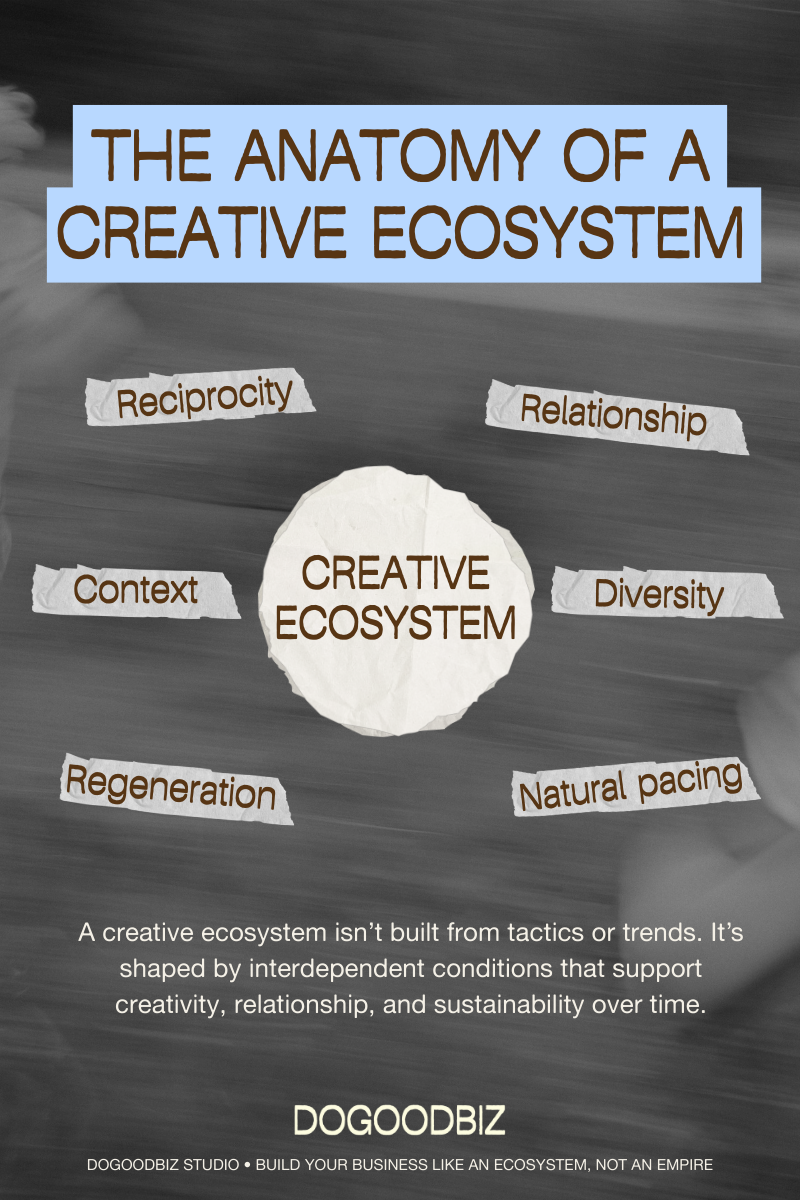
It’s built on:
reciprocity instead of extraction
relationships instead of hierarchies
diversity instead of uniformity
context instead of one-size-fits-all advice
slowness instead of speed
regeneration instead of depletion
The ecosystem model shifts the central question from:
“How do I scale?”
to:
“What conditions support life, creativity, and sustainability… for me and the people around me?”
This is how nature works. And it’s how our creative work wants to work, too.
What It Means to Build a Creative Ecosystem
Building a creative ecosystem means tending to a living network of relationships, rather than extracting value from a single identity or platform.
It means understanding that:
your creative energy has seasons
your work has roots and cycles
you thrive through interdependence, not isolation
your business has a climate and a rhythm
rest is not a pause in productivity, it’s part of the process
reciprocity is a strategy
slowness is a form of intelligence
When you build a creative ecosystem, you’re not managing a machine. You’re stewarding something alive. This way of working aligns deeply with our broader practice of human-first business, where care, autonomy, and sustainability are built into the structure, not added later as self-care fixes.
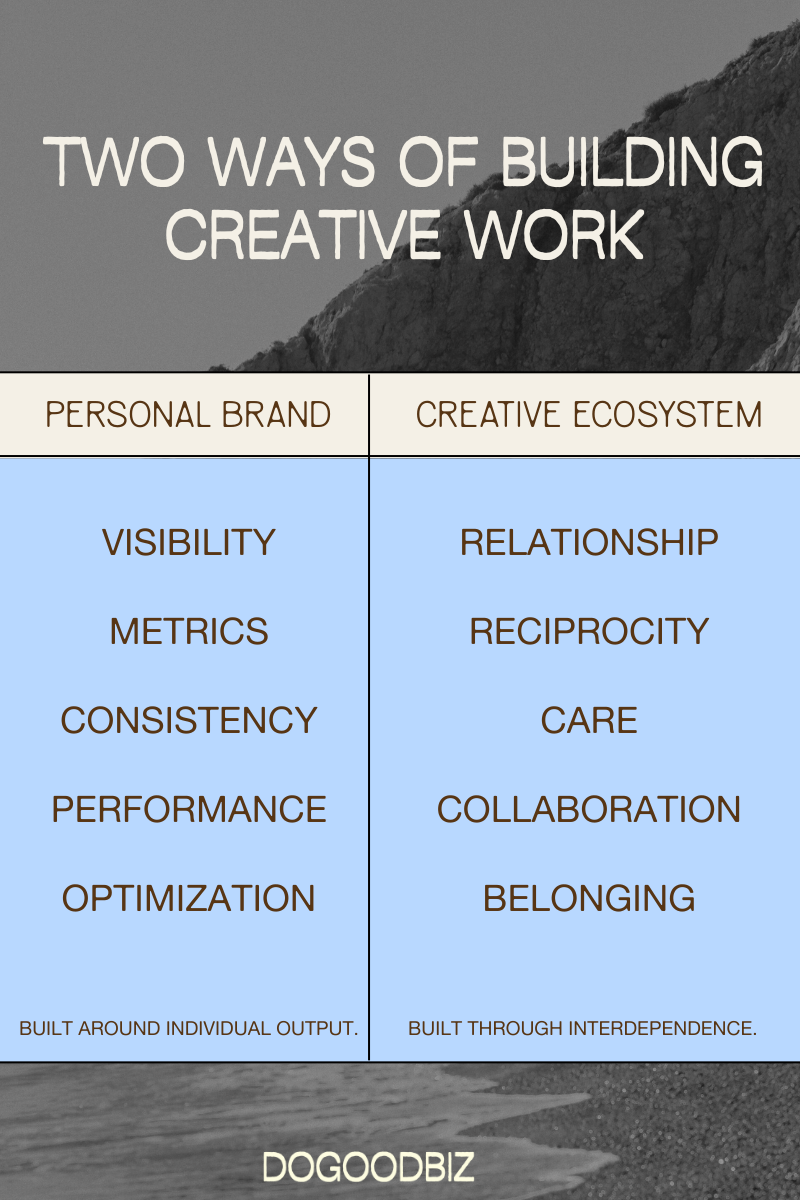
Creative Ecosystem vs. Personal Brand: What's the Difference?
The difference isn't just philosophical; it shows up in every decision you make about how you work, what you build, and what you measure. Neither of these is inherently wrong, but only one of them is designed to last.
| Personal Brand | Creative Ecosystem | |
|---|---|---|
| Central question | How do I scale? | What conditions support life and creativity — for me and everyone around me? |
| Model | Empire | Garden |
| Growth goal | Bigger, faster, more | Deeper, steadier, more resilient |
| Relationship to audience | Broadcast to followers | Reciprocity with community |
| Relationship to output | Constant production | Seasonal rhythm |
| Measures success by | Reach, followers, revenue | Alignment, sustainability, relationships |
| Relationship to rest | A pause in productivity | Part of the process |
| Relationship to change | Pivot to stay relevant | Compost and regenerate |
| What it builds | An audience | A community |
| What it feels like | A performance | A practice |
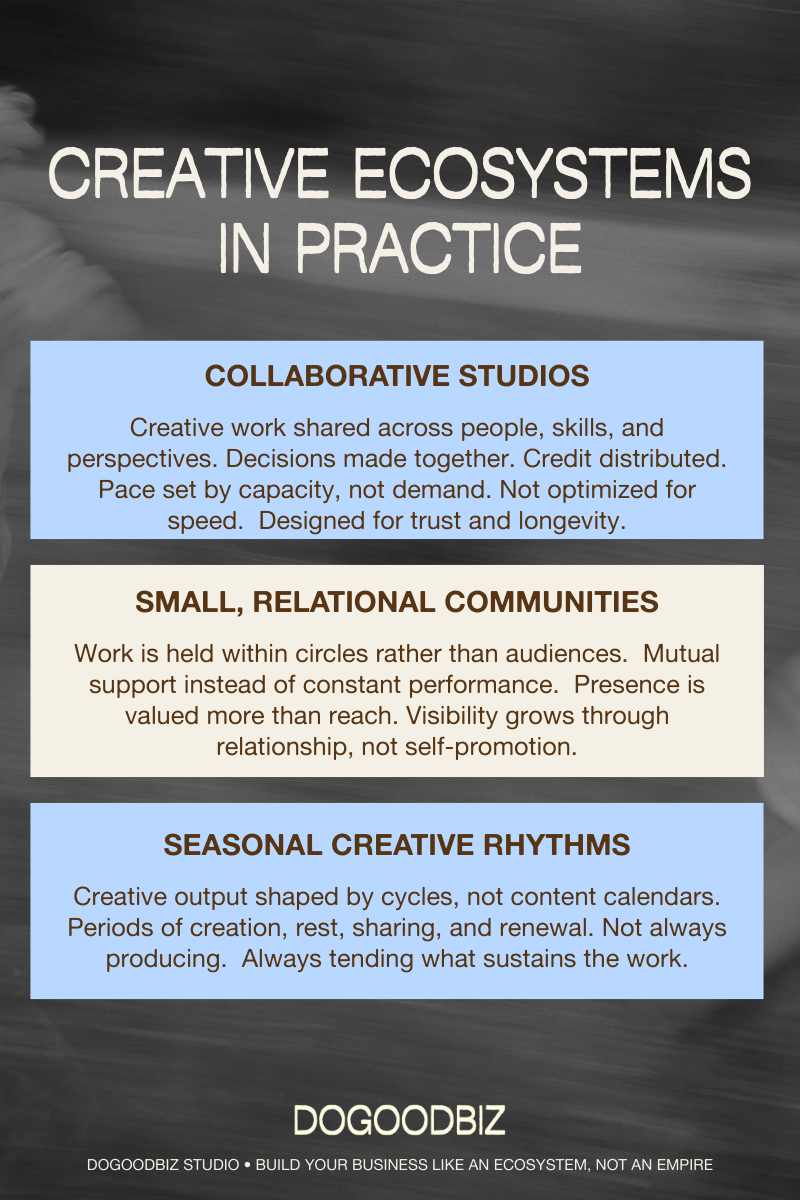
Creative ecosystems already exist all around us, often quietly.
A design studio that collaborates deeply, works slowly, and prioritizes aligned relationships over mass production.
A coach or healer who serves fewer clients at a time to offer whole-person support instead of surface-level fixes.
A slow fashion brand that moves with seasons, not trends, and builds reciprocal relationships with makers and buyers.
An artist or illustrator who releases work in seasonal drops, trusting their community without feeding constant content cycles.
These businesses aren’t chasing dominance. They’re cultivating belonging. And belonging lasts longer than attention.
How to Build Your Own Creative Ecosystem
Creative ecosystems don't require perfection. They require care. These aren't steps to complete in order; they're practices to return to, the way you'd return to a garden across seasons.
Here are a few foundational practices:
1. Honor Your Seasons
Every ecosystem moves through cycles of germination, growth, fullness, decay, and rest… and so does your creative work. Notice which parts of the year feel generative and which feel slow, and stop fighting the slow ones. A launch that flops in January might thrive in September. A creative project that stalls in winter might bloom in spring. When you map your own rhythms instead of forcing a borrowed schedule, your work stops feeling like a constant uphill climb and starts feeling like something you can actually sustain.
2. Support Your Soil
Your energy, health, relationships, and creative capacity are the foundation from which everything else grows. Before you optimize a funnel or redesign your website, ask what your soil needs. Rest. Nourishment. Time away from screens. Relationships that give as much as they take. A business built on depleted soil will keep collapsing no matter how good the strategy is, and no amount of productivity hacking fixes a foundation that isn't being tended.
3. Diversify for Stability
In nature, monocultures are fragile. A field of a single crop wipes out entirely when conditions change… but a diverse ecosystem finds its footing because something always adapts. In your creative work, this might mean multiple income streams, multiple formats, multiple ways your audience can find and support you. Diversity isn't about doing more. It's about building a system that doesn't collapse when one element shifts.
4. Root Into Values
Values act as nutrients; they feed every decision quietly, in the background, without needing to be reinvented each time. When you know what you stand for, you have a filter: does this opportunity, collaboration, or offer align with the ecosystem I'm building? Values make saying no easier, make saying yes more intentional, and create the kind of consistency that audiences recognize and trust, even when your work changes shape.
5. Cultivate Community, Not Audiences
Community is reciprocal. Audiences are extractive. An audience is a number. A community is a relationship. Audiences are built through broadcasting, community is built through reciprocity, conversation, and genuine care for the people inside it. This might mean a smaller newsletter that you actually write to people, a local gathering instead of a viral campaign, or simply responding to messages as if they matter, because they do. Community is slower to build and far harder to lose.
6. Compost What No Longer Serves
One of nature's most important processes is decomposition; the clearing away of what has died so that it can feed what comes next. In your creative ecosystem, this means permitting yourself to let things go: an offer that no longer fits, a platform that drains more than it gives, an identity you've outgrown. Composting isn't a failure. It's the ecosystem doing exactly what it's supposed to do: cycling energy back into the soil so something new can grow.
7. Let “Enough” Be Enough
Not every season produces fruit, and a garden that's always harvested eventually goes barren. Some seasons are for tending, not producing. Some years are for consolidating, not expanding. Practicing enoughness, genuinely deciding that what you have and what you're making right now is sufficient, is one of the most radical and difficult things a creative business owner can do in a culture that equates worth with output. But it's also one of the most protective things you can do for your ecosystem's long-term health.
Why Creative Ecosystems Matter Now
When you stop building a personal brand as an empire and start tending a creative ecosystem, something profound shifts. You stop performing for algorithms. You stop contorting your work to please trends. You stop measuring your worth by output. You stop feeling perpetually behind.
Business becomes:
relational
sustainable
grounded
restorative
community-centered
alive
And in doing so, you quietly resist systems that taught you to exhaust yourself for visibility or validation. Your work becomes a contribution, not a commodity. Your creativity becomes a relationship, not a resource. Your business becomes a place of belonging rather than a hierarchy.
Ready to Map Your Own Creative Ecosystem?
If you found yourself nodding along or felt something loosen in your chest at the idea of building something relational instead of extractive, that recognition is worth paying attention to.
At DoGoodBiz Studio, Creative Ecosystem Mapping is one of the core ways we support creatives and small business owners who are ready to move beyond the personal brand model. We help you see how your content, platforms, offers, audience, and creative energy actually connect and design a system that supports your work instead of draining it.
What you walk away with is a custom ecosystem map, a sustainable marketing roadmap, and the clarity to move forward without the overwhelm of trying to hold it all in your head.
Not sure if it's the right fit for where you are right now? That's exactly what the first conversation is for. Fill out our inquiry form, tell us a little about what you're working on, and we'll help you figure out the right kind of support together.
Creative Ecosystem Mapping is part of our Tend & Grow ongoing partnership for leaders whose work is already moving and needs strategic support to sustain it.
Until next time,
Natalie Brite — DoGoodBiz Studio
Read next:
What Is a Community-Based Business Model? — The structural side of building a business rooted in reciprocity rather than extraction.
Ethical Marketing Is an Ecosystem, Not a Funnel — What it looks like to apply ecosystem thinking to how you show up and market your work.
Value-First Marketing — A responsible content strategy rooted in usefulness and trust over conversion.
