

Ecological Business Design: An Alternative to Corporate Growth
Over the years, I’ve watched small businesses slowly be trained to behave like corporations. Not just in how we market, but in how we think. How we structure our work. How we treat ourselves and others. How we relate to money. How we decide what “success” even means. We’re told this is how you become professional. That this is the price of legitimacy.
And the message is consistent:
If you want to survive, you need to get bigger. Be more visible. Do more with less. Push through the exhaustion. Monetize everything. Turn your creativity, your care, and your capacity into output.
Something about this doesn’t just feel hard… it feels wrong. This way of working asks us to contort ourselves into systems that were never designed to care about people, creativity, or the planet. And yet we’re told this is the only way to be taken seriously.
Meanwhile, the evidence is everywhere. Small businesses are quietly closing. Folks are burning out and blaming themselves. Creative work drained of joy and meaning. Relationships thinning. Communities fractured. The earth is under strain. Corporate greed no longer hidden… just baked into the structure.
When ecological thinking starts showing up in business spaces, it makes sense that many of us feel a pull toward it. We’re hungry for something that doesn’t destroy us. Something that feels more human. More grounded. More alive.
But here’s the risk we don’t talk about enough:
If ecological thinking becomes just another trend (another aesthetic, another brand angle, another way to sell) it loses its power.
And worse, it becomes absorbed into the very systems it was meant to challenge.
Ecological thinking isn’t a vibe. It isn’t a leaf logo or a soft color palette. It isn’t language you sprinkle onto a sales page. It’s a sustainability framework. Because living systems already know something business culture refuses to admit: Systems that ignore limits eventually collapse.
Corporate Logic Is Anti-Ecological by Design
Corporations are not designed to sustain life. They are designed to accumulate power.
Their structures depend on things like:
Constant growth, regardless of cost
Taking more than they give back
Decisions made far away from the people affected by them
Treating people as replaceable roles instead of humans
Turning communities into audiences, leads, or “markets”
And yet, small businesses are quietly encouraged to copy these same models… just with fewer resources and less protection.
We’re taught to:
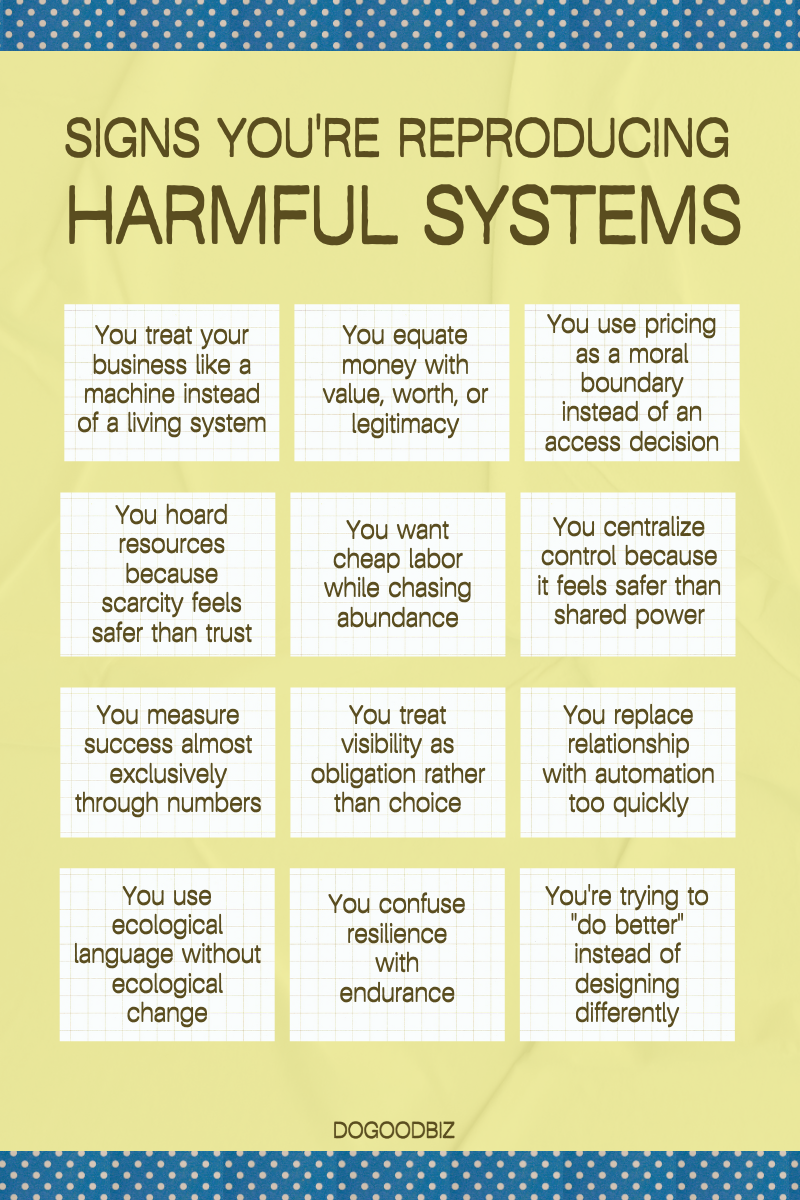
Push past our bodies and call it discipline
Treat rest like a reward instead of a requirement
Hoard money because it’s the only safety net we’re offered
Stay visible even when we’re exhausted or resentful
Structure our work so everything depends on us at the top
Trade relationships for efficiency and call it “being professional” or “building community”
Measure success by growth, reach, and output… even when the system feels brittle and joyless
This is corporate logic, absorbed at a human scale. If this type of corporate structure destroys ecosystems, it will eventually destroy people, too. No amount of “green” branding can change that.
How We’ve Been Trained to Run Our Work Like Corporations
Most harm in small businesses doesn’t come from bad intentions. It comes from imitation, and from never being taught that there is another way.
We reproduce corporate behavior in subtle, everyday ways:
Treating ourselves like a productivity tool instead of a living body
Expecting our creativity to keep producing without rest, care, or recovery
Holding onto money tightly “just in case,” even when it starves the system
Keeping all decisions on our own shoulders because letting go feels risky
Chasing numbers and reach while relationships slowly thin out
Making choices that look good instead of ones that feel aligned
Praising ourselves for pushing through, even when we’re exhausted
This is how collapse happens. Not all at once. Not in a dramatic crash. But quietly… through exhaustion, isolation, and systems stretched past what they were ever meant to hold.
When work can’t rest, when care is treated as optional, when everything depends on overextension, systems lose their ability to adapt.
Ecology reminds us of something essential here:
Collapse isn’t a moral problem. It’s a structural failure.
Living Systems Survive Through Relationship, Not Domination
In ecology, nothing survives on its own. Everything is shaped by relationships.
Forests survive because:
What’s taken is eventually returned
Signals of stress are listened to instead of ignored
Growth slows when the conditions aren’t right
Different roles support one another instead of competing
No single part gets to take everything and leave the rest depleted
What’s “used up” becomes food for something else
Breakdown leads to change and reorganization, not blame or failure
This is how living systems stay alive over time… not through control, but through responsiveness.
And yet, there is no infinite growth in nature. There is balance. Regeneration. Response. So when we apply ecological thinking literally to business, not symbolically, the core question changes.
Not: How do I grow this as fast as possible?
But:
What does this system need to stay alive in these conditions?
That question alone disrupts corporate logic.
Ecological Business Design as a Response to Current Times
Ecological thinking is not soft. It’s not passive. It’s not neutral. And it’s definitely not a branding exercise. It’s a direct response to instability, crisis, and the concentration of power.
In moments of political, economic, and environmental upheaval, living systems don’t become more rigid. They become more relational. They invest in what helps them survive turbulence, not what looks impressive from the outside.
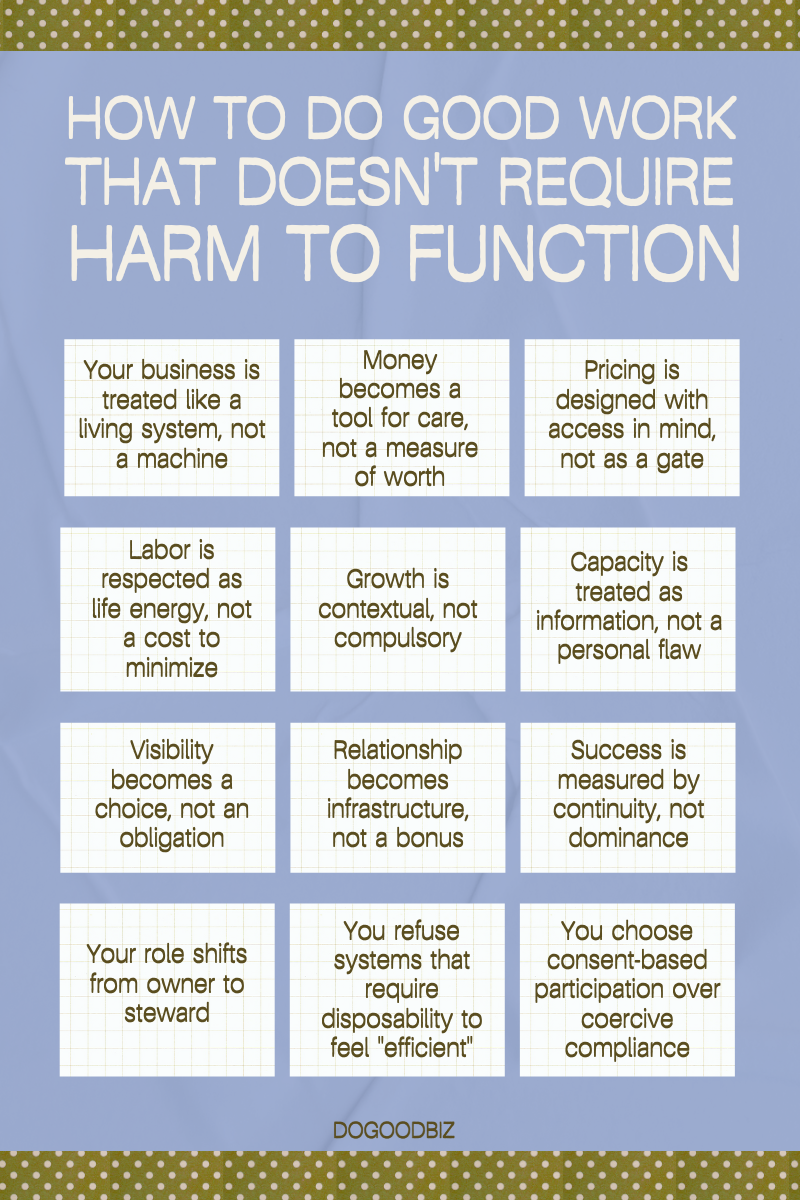
Ecological businesses prioritize things like:
Choosing work that can be sustained year after year instead of chasing constant expansion
Protecting nervous systems, bodies, and relationships rather than glorifying urgency
Letting “this is working” be sufficient instead of endlessly moving the goalposts
Designing for trust, collaboration, and care rather than control or hierarchy
Fixing what’s frayed instead of abandoning people, offers, or systems the moment they require care
Responding to real conditions instead of forcing rigid plans to hold
This means refusing to build success on structures that quietly require burnout, extraction, or harm to keep going.
Six Structural Interruptions to Business as Usual
→ Interruption 01: AwarenessName the system you’re already inside
Corporate thinking thrives when it goes unnamed. That’s why the first interruption isn’t action… It’s seeing.
When you pause long enough to notice how corporate logic has shaped your decisions, rhythms, and definitions of success, you create a crack in the system. You stop assuming the way things are is the way they have to be.
Awareness asks:
What model am I unconsciously following?
Where did I learn that speed equals success?
What parts of my business feel conditioned, compulsive, or fear-driven?
What’s being extracted, and from whom?
What’s being replenished?
What circulates, and what gets stuck?
Where does this system rely on unpaid or invisible labor?
What would fall apart if I stepped away for a month?
You can’t change a system you’re still mistaking for reality. And this is where ecological thinking can easily become a trend… when we skip this step and jump straight to language, visuals, or values without actually examining the structure underneath.
→ Interruption 02: SeasonalityStop forcing growth in the wrong conditions
Corporate culture treats every season as a growth season. Ecology knows better.
In real life, seasons look more like this:
Growth: visibility expands, offers are shared, energy is outward and generative
Stabilization: income holds steady, systems are refined, boundaries get clearer
Repair: burnout is addressed, capacity is renegotiated, what’s unsustainable is reworked
Dormancy: output slows, creativity rests, nothing new is forced
Composting: old offers, identities, or strategies are let go so something else can emerge
Every one of these seasons is necessary. Collapse happens when we try to treat repair like growth, dormancy like failure, or composting like a personal mistake.
Honoring seasonality interrupts urgency, and urgency is one of corporate culture’s strongest weapons.
→ Interruption 03: Capacity Let limits become design information
Corporate culture teaches us to override limits. Ecology treats limits as guidance. This interruption moves you out of self-blame and into systems thinking. Instead of asking how to push harder, you begin asking what needs to change structurally so harm isn’t required to keep going.
Ask yourself:
What am I maintaining that requires me to override my body?
Where am I running on adrenaline instead of support?
What am I holding together with adrenaline?
What depends entirely on my overextension?
What would need to change for this work to be sustainable at a human scale?
What work is being held together by me alone?
Capacity isn’t a personal flaw; it’s ecological data.
→ Interruption 04: Circulation Release the grip of hoarding and scarcity
Corporate systems collapse when resources stop flowing… yet we’re taught to hoard money, energy, attention, and power as a form of protection. Ecological systems survive through circulation.
This interruption reframes money, visibility, and labor as flows rather than trophies or proof of worth.
Ask yourself:
Where does money enter?
Where does it leave?
Where does it get stuck?
Who bears the cost when resources don’t move?
Where does circulation feel nourishing?
Where does it feel fear-driven?
Circulation interrupts scarcity thinking, and scarcity is what keeps people compliant inside harmful systems.
→ Interruption 05: Relationships Rebuild connection where extraction taught isolation
Corporate logic isolates by design. It teaches us to see people as roles instead of humans; audiences, leads, users, labor, “resources.” It flattens relationships into transactions and treats efficiency as more valuable than trust. When connection slows things down, corporate logic frames it as friction. As inefficiency. As something to automate away.
Small businesses absorb this quietly. We stop checking in because it feels like “extra.” We centralize decisions because collaboration takes time. We replace conversation with systems. We prioritize reach over intimacy. We treat collaboration as leverage instead of care. Over time, this erodes the very thing that makes small businesses resilient in the first place: relationships.
Relationships ask:
Who does this system actually serve in practice, not just in intention?
Where is connection being sacrificed for speed, scale, or control?
Who absorbs the cost when care is deprioritized?
What would it look like to protect trust over reach?
Ecological systems don’t survive despite relationships… they survive because of it. Relationship is how information travels. How care circulates. How stress gets shared instead of concentrated. How systems sense when something is wrong and adapt before collapse. This interruption asks you to stop treating relationships as a “nice-to-have” and start treating it as core infrastructure.
→ Interruption 06: StewardshipShift from ownership to responsibility
Stewardship asks you to recognize that nothing you’re building exists in isolation… and nothing ends with you. Every decision sends ripples outward: into nervous systems, labor conditions, communities, land, culture, and future possibilities you won’t fully see or benefit from directly.
In this frame, success is no longer about extraction or domination. It’s about continuity. About whether what you’re building can be held, adapted, repaired, and carried forward without requiring harm to sustain it.
Stewardship asks:
What am I responsible for sustaining, not exploiting?
Who and what will this system affect long after I benefit from it?
What needs care, repair, or protection, not growth?
What does leadership look like when it’s rooted in responsibility rather than control?
Stewardship means refusing to build systems that only function through depletion. It means designing work that can be tended, adjusted, and shared without collapsing under its own weight. And that is something corporate logic can never offer. Stewardship interrupts domination. And domination is the root of extraction.
A Different Way of Doing Business
Ecological thinking isn’t a strategy you adopt when it’s fashionable. It’s what emerges when people can no longer pretend that the old models are working.
When systems prioritize speed over health, accumulation over care, and dominance over relationship, collapse isn’t a surprise… it’s the expected outcome. And we are living inside that reckoning now. Economically. Ecologically. Politically. Personally.
This is why ecological thinking can’t be reduced to an aesthetic, a trend, or a buzzword slapped onto business-as-usual. The moment it becomes a brand identity instead of a practice, it loses its power. Corporations are excellent at absorbing critique and turning it into marketing. Ecological thinking asks us to do the opposite: to let critique actually change how we build, decide, and relate.
The question this work keeps returning us to isn’t how to win, how to grow, or how to optimize.
It’s this: What would it look like to build work that can stay alive… without requiring harm to function?
That question doesn’t demand purity. It doesn’t require perfection. It asks for honesty, responsibility, and a willingness to design differently, even when it’s slower, quieter, or less rewarded by dominant systems. Choosing ecological thinking isn’t about opting out of ambition. It’s about opting out of collapse as the cost of doing business.
And it’s not something you do alone.
How We Support This Work at DoGoodBiz StudioOur Studio exists for people who are done trying to out-corporate corporations… and who know, deep down, that the old models aren’t just exhausting, they’re harmful.
Our role is to support you in translating ecological thinking into real structures so your business can stay alive without requiring burnout, self-betrayal, or harm to others.
In practice, that means we help you:
Design your business as a living system, not a growth machine, mapping how energy, labor, money, creativity, and care actually move through your work
Clarify limits, capacity, and seasons so your offerings, timelines, and expectations align with real human constraints
Build marketing and creative ecosystems that circulate attention and energy instead of extracting from you or your community
Right-size visibility, offers, and income in ways that support continuity, not constant escalation
Create structures that uphold people, planet, and integrity, not just optics or output
This is stewardship, the ongoing practice of tending what exists so it can continue without collapse. If you’re feeling the pull toward something more sustainable, more humane, and more honest than business-as-usual, that’s exactly the work we’re here to support. Reach out at anytime to chat about ways we can work together!
