

What Creative Liberation Means (And Why It Matters for Creatives Today)
Over the past several months, I’ve been quietly rebuilding my relationship with DoGoodBiz Studio from the inside out.
Not just the visuals or the language, but my relationship with my own creativity. I’ve been moving slowly. Carefully. Like someone brushing dust off a painting that had been stored away for too long. And as I did, something uncomfortable became clear: I had been censoring myself in ways I didn’t fully recognize.
Not because anyone explicitly told me to, but because I had absorbed the rules. Rules from the design world. Rules from online business culture. Rules from a society that rewards conformity and smooth edges.
Rules like:
Don’t be too political.
Stay on trend.
Keep it professional.
Don’t take up too much space.
Make it palatable.
These weren’t just branding rules. They were cultural rules; ones that quietly teach us which kinds of creativity are safe, profitable, and acceptable.
Creative liberation begins when we start pulling those rules up by the roots.
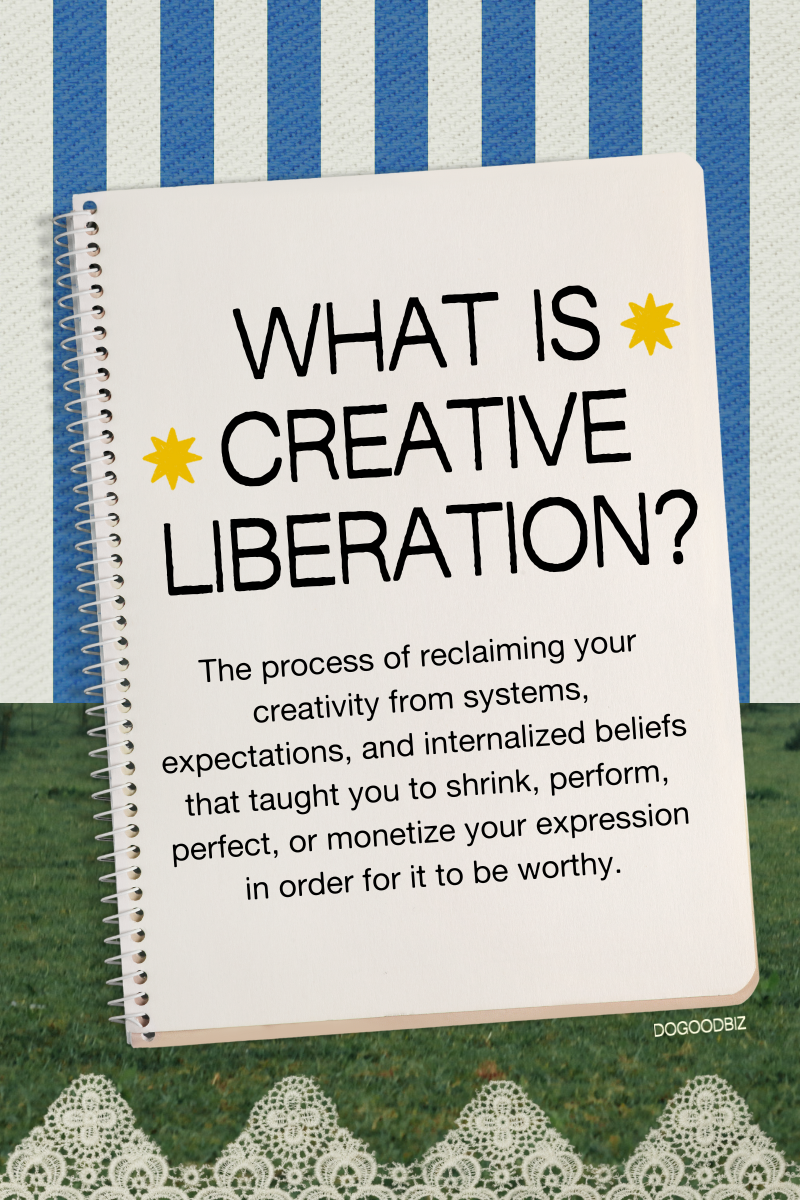
What Is Creative Liberation?
Creative liberation is the process of reclaiming your creativity from systems, expectations, and internalized beliefs that taught you to shrink, perform, perfect, or monetize your expression for it to be worthy.
It is a return to the part of you that creates because it feels alive to do so.
Creative liberation looks like:
creating without asking permission
making imperfectly, but intentionally
trusting what wants to come through—even when it defies logic
letting yourself be nonlinear, intuitive, strange, contradictory, or unpolished
reclaiming imagination from systems that seek to control or extract it
This isn’t rebellion for rebellion’s sake.
It’s a homecoming.
A remembering.
A refusal to let systems that profit from silence dictate the shape of your creativity.
Creative liberation often begins when we stop forcing ourselves into false binariesabout identity, productivity, success, or how a business “should” look.
If this resonates, you may want to explore Non-Binary Thinking: A Guide to Creative Liberation in Your Small Business, where I unpack how rejecting binary frameworks opens more humane, flexible ways of working.
Why Creative Liberation Matters (Personally and Politically)
Creative freedom is not just a personal desire; it’s a political one.
Today, creative expression is shaped and constrained by:
algorithms and visibility economies
virality culture and performance metrics
perfectionism and productivity pressure
capitalist systems that equate worth with output
branding rules designed to homogenize expression
These pressures don’t land equally.
Creative constraint is amplified if you are:
queer or trans
disabled or chronically ill
BIPOC
neurodivergent
navigating class, immigration, or safety barriers
Not everyone inherits the same permission to experiment, rest, or be visible. Creative liberation matters because it challenges the idea that creativity must be tidy, monetizable, neutral, or productive to matter. When you reclaim your creative voice, you’re refusing systems that attempt to flatten identity, imagination, and possibility. That refusal ripples outward.
The Cage We Inherit (And Often Don’t See)
Most of us learned to be creatively small long before we knew what we were giving up.
We absorbed messages like:
Be realistic.
That won’t pay the bills.
Don’t be too much.
Stay in your lane.
No one wants to see that side of you.
Some were spoken aloud. Most were implied. Over time, they layered themselves over our creativity like dust on a window… distorting what we could see, narrowing what felt possible, convincing us the safest path was the smallest one. This conditioning doesn’t just mute our art. It reshapes our identity. Creative liberation begins when we realize the cage was constructed, and anything constructed can be dismantled.
How Creative Liberation Actually Works
Creative liberation is not a moment. It’s a practice.
It asks you to notice:
when you self-censor
when you shrink or over-edit
when you follow rules you didn’t choose
when performance overrides presence
when trends replace truth
And instead of tightening control, you soften.
You ask: Who taught me this rule?
Then you loosen it.
One expectation at a time. One inherited belief at a time. Unlearning is vulnerable work…but it’s also where creative energy begins to move again. Many creative blocks aren’t a lack of discipline or clarity; they’re the result of invisible constraints we’ve internalized. In Escape the Creative Constraints, I explore how creative freedom directly impacts marketing, visibility, and resonance… especially for small, values-led businesses.
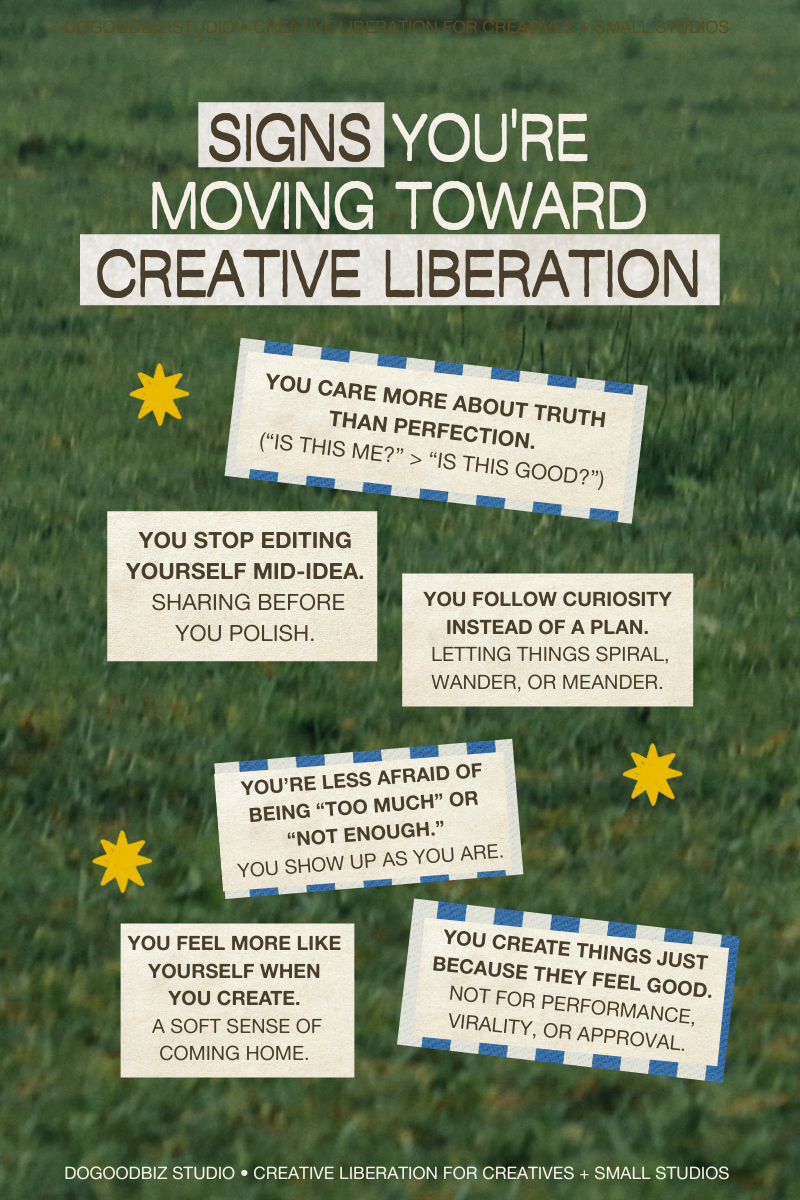
Signs You’re Moving Toward Creative Liberation
Creative liberation doesn’t arrive all at once. It shows up quietly.
You may notice:
You stop asking “Is this good enough?” and start asking “Is this true?”
You feel drawn to experimentation rather than outcomes
You follow ideas that don’t lead anywhere “useful”
You stop apologizing for your perspective
You catch yourself mid-self-edit and choose to continue
You create for joy, not approval
You feel more like yourself
These moments are small, but they’re brave.
Practices That Support Creative Liberation
These aren’t tactics to check off a list. They’re invitations…
Nonlinear play
Let creativity wander without forcing direction.
Gentle noticing
Observe where you compromise creative truth—without shame.
Creative refusal
Break a rule on purpose. Make the messy version.
Community and witnessing
Creative liberation expands when it’s seen and shared.
Rewilding rituals
Walks. Drawing. Movement. Collage. Silence. Gardening. Let nature reset your rhythm.
Each practice helps you remember who you were before creativity became a performance. Creative liberation isn’t just about expression; it’s also about survival. Our Field Guide to Creative Survival offers grounding reflections for navigating uncertainty, burnout, and the emotional realities of creative life without abandoning yourself.
Creative Liberation in Business (Why It Matters for Small Studios)
Creative liberation doesn’t stop at art. It reshapes how you work.
Especially if you are:
a one-human studio
a solopreneur
a coach, healer, or creative service provider
an artist or designer
a small team resisting burnout
Creative liberation supports:
sustainable, anti-extractive business models
intuitive marketing that doesn’t rely on constant output
offerings aligned with your real capacity
work rhythms that honor your body and nervous system
long-term creative longevity
When you stop performing, you create work that lasts. Work with integrity. Work that feels like home. Creative liberation doesn’t live in isolation, it’s shaped by the systems we build around our work. In A Regenerative Path to Creativity and Business: How to Cultivate Your Own Creative Ecosystem, I explore how designing for interdependence, care, and longevity supports both creativity and livelihood over time.
You Were Never Meant to Be Contained
Creative liberation isn’t a strategy. It’s a reclamation.
If your creativity feels caged, start small:
Name the bars.
Break one rule.
Let one idea be messy.
Try one tiny rebellion.
You don’t need to earn creative freedom. You just need to return to it.
If You’re Building a Business Rooted in Creative Liberation
If this article resonated, you don’t have to hold it alone.
At DoGoodBiz Studio, we work with creatives, small studios, and values-led business owners who are ready to stop performing and start building work that actually fits their lives. We support people in reconnecting with their creative voice, designing ethical and care-rooted ecosystems, and developing marketing and business structures that don’t rely on burnout or self-betrayal.
If you’re curious about what working together could look like, you’re welcome to explore our services or reach out. There’s no pressure here, just an open invitation to begin in a way that feels right. And if you’re craving a more tactile, slow, and reflective way to sit with these ideas, you might appreciate The Creative Season Almanac: Digital Workbook for Conscious, Sustainable Creativity, created as a companion for creatives unlearning pressure and returning to their own rhythms.
Until next time…
Natalie Brite | DoGoodBiz Studio
