

Working Like Nature: Transform Your Work with Sustainable and Regenerative Practices
Every time I step into the forest, something shifts in me. Or maybe “shift” isn’t quite right. It’s more of a remembering. A remembering that I am part of a larger web of life. That moss and lichen have been collaborating for centuries to make this moment possible. That the pace of the natural world, the pace my body feels most at home in, is nothing like the artificial pace of capitalism.
“I cannot learn about nature without learning about myself. And every time I leave a hike and re-enter the human-made world, it takes longer and longer to adjust back into the headspace that capitalism expects me to be in. Because this world wasn’t designed for nature. And therefore, it wasn’t designed for us.”
This realization is why I’ve become obsessed with a question:
What would our work look like if we modeled it after nature?
What if our creativity stretched and rested with the seasons?
What if our businesses were built like ecosystems, diverse, relational, adaptive, rather than empires?
What if regeneration, not extraction, was our benchmark of success?
This article is the start of that exploration. Let’s begin with where the disconnect began.
The Deep Disconnect Between Human Work and Natural Rhythms
Before industrialization, before quarterly reports, burnout culture, and inbox fatigue, human work was woven into the rhythms of the land. Many Indigenous communities across the U.S. and beyond continue to embody these relationships, modeling a way of working that is reciprocal, cyclical, and deeply ecological.
Examples of nature-aligned work you’ll never find in a corporate playbook:
The Three Sisters method (corn, beans, squash) — a brilliant model of interdependence and mutual nourishment.
Zuni waffle gardens — sunken beds shaped to conserve water in arid climates, reflecting intimate knowledge of natural cycles.
Lakota buffalo stewardship — taking only what was needed, honoring the animal, and ensuring long-term ecological balance.
These practices don’t romanticize nature. They collaborate with it.
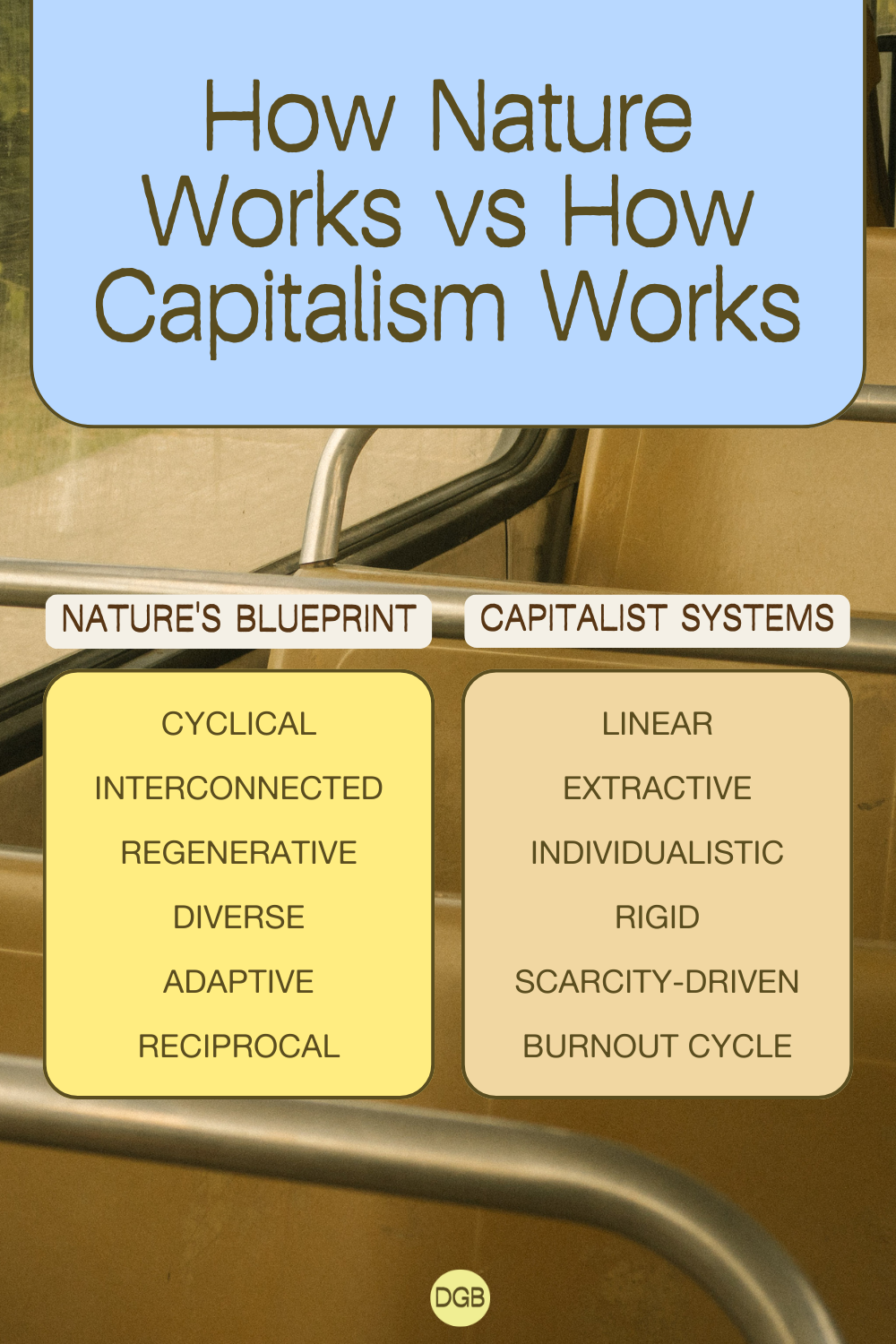
Contrast that with modern work culture: fast-paced, linear, extractive, obsessed with growth for the sake of growth.
It is the difference between tending a garden and strip-mining the land. And most of us can feel that difference in our bones.
Nature-Based Ways of Being vs. Artificial Constructs
In nature:
Everything moves in cycles.
Rest is necessary.
Diversity strengthens the whole.
Nothing grows all year long.
Nothing exists in isolation.
In capitalism:
Productivity is worshipped.
Rest is framed as laziness.
Individualism is a survival strategy.
Growth (at all costs) is the goal.
Extraction is normalized.
No wonder so many of us feel burnt out, disembodied, disconnected from ourselves and each other. We’re living inside systems that violate the natural laws of life. And when we push ourselves beyond our natural limits, we mirror the overharvesting, overworking, and overextracting that is destroying ecosystems worldwide.
Learning From Nature’s Blueprint
Nature is a masterclass in sustainable design.
A few examples of nature’s “systems thinking” at work:
Forests share resources through underground fungal networks (mycorrhizae).
Oceans cycle nutrients in loops that sustain entire marine ecosystems.
Pollinators and plants collaborate in mutually beneficial exchanges.
Nothing is wasted — what dies becomes food for what grows next.
Nature is diverse, adaptive, relational, and regenerative. The opposite of a quarterly-profit mindset. When we orient our work around these principles, something profound begins to shift… not just in our businesses, but in ourselves.
What Does It Mean to Work Like Nature?
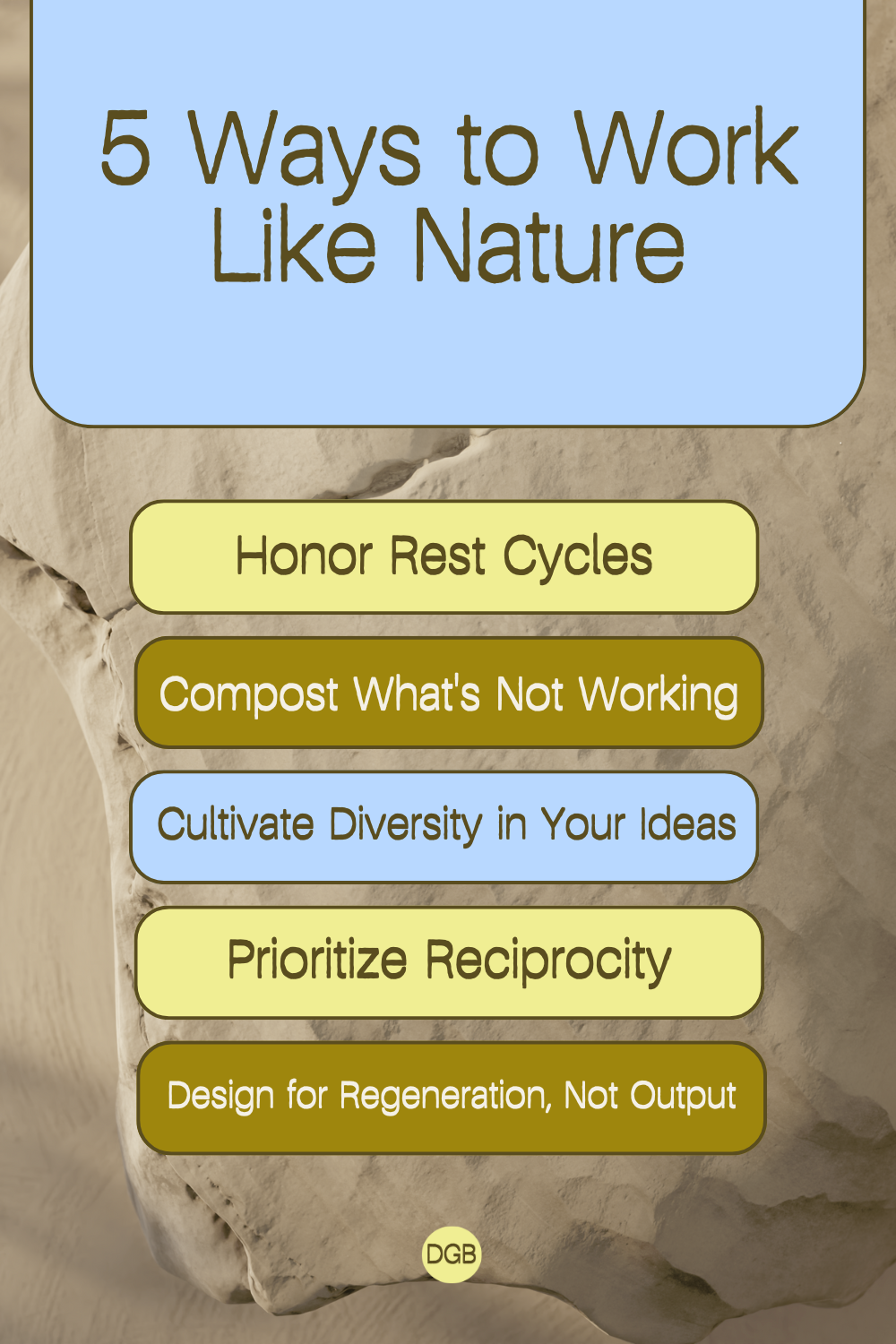
Working like nature means structuring your creativity, productivity, and business with ecological principles:
1. Work in cycles, not straight lines
Honor seasons of growth, experimentation, rest, and pruning.
2. Value diversity
Your skills, ideas, collaborations, and offers thrive when they’re not monocultures.
3. Build in reciprocity
Give back where you take.
Make your work regenerative, not extractive.
4. Prioritize relationships over output
Interdependence is a strength, not something to “outgrow.”
5. Let creativity compost
What doesn’t work isn’t waste; it becomes soil.
These are not just metaphors; they are practical, sustainable business strategies.
What Does It Mean to Work For Nature?
It’s not enough to adopt nature’s rhythm; we also need to protect it.
Working for nature means:
choosing sustainable tools, systems, and platforms,
reducing digital and physical waste,
aligning offerings with your values,
supporting environmental and community projects,
designing work that supports life—not burnout, depletion, or harm.
Your personal well-being is part of this, too. You are nature. When you heal your relationship to work, you are participating in ecological repair.
Why Now? The Urgent Call to Reclaim Our Nature
We’re facing overlapping crises:
climate collapse
burnout epidemics
community fragmentation
creative depletion
political and social instability
These aren’t separate issues; they stem from the same root:
We’ve forgotten that we are part of a living planet.
Reconnecting with nature’s principles allows us to:
restore balance
slow down when the world speeds up
root our work in meaning
regenerate our energy
rebuild community
create work that lasts
This isn’t optional anymore. It’s survival. For us, and for the Earth.
Where does your work currently mirror nature, and where does it mirror capitalism?
And what could shift if even one part of your workflow became more cyclical, relational, or regenerative?
This is how ecosystem thinking begins: with small choices that realign us with what is real, alive, and sustainable.
Until next time,
Natalie Brite
DoGoodBiz Studio
Similar Reading:
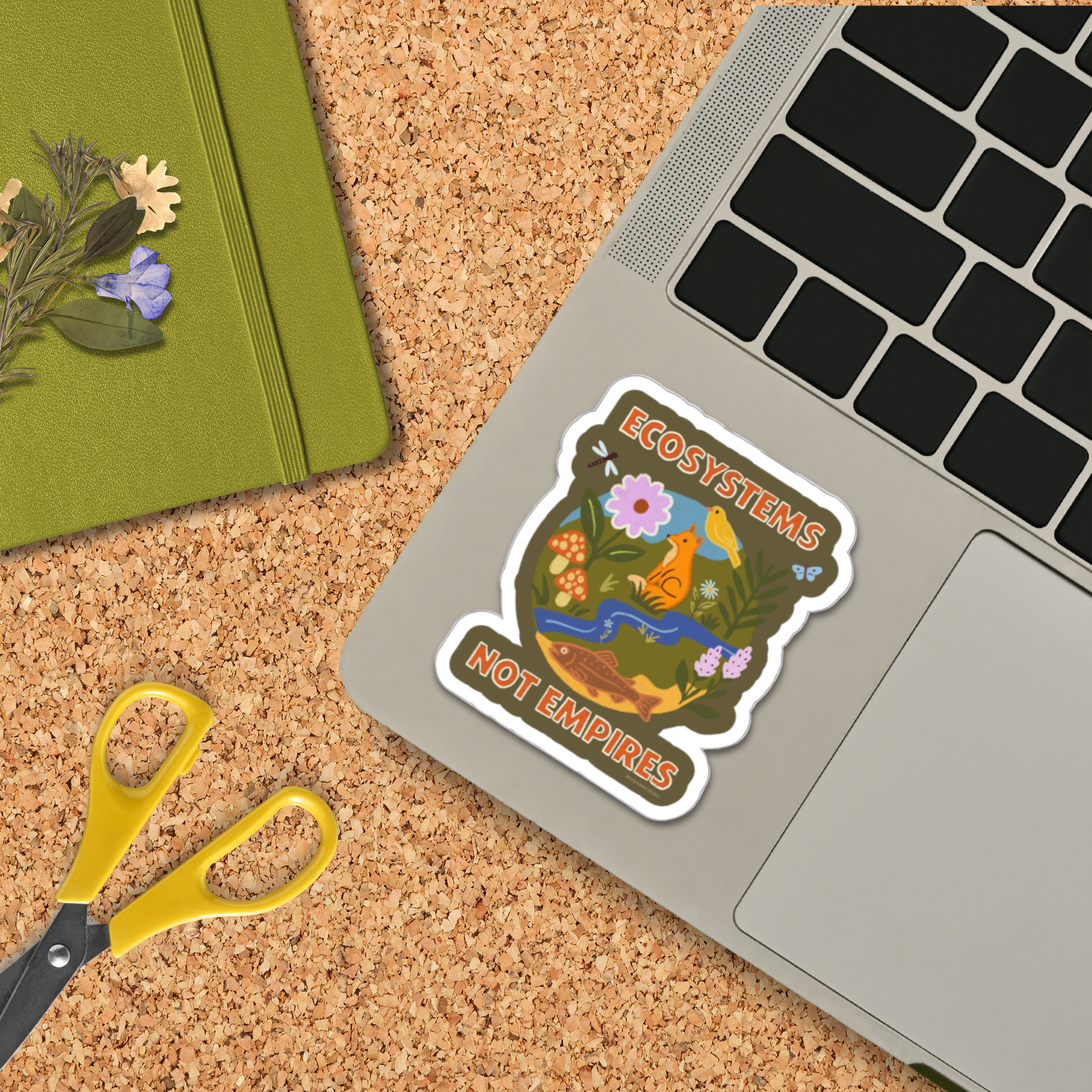
For the laptop, the water bottle, the notebook cover, the bumper… anywhere you want to make it quietly clear where you stand.
This sticker is for people who got into business because they believed it could be done differently. Who measures success in something wider than revenue. Who are tired of pretending profit and ethics are in conflict.
Wear it like a signal to the people who will understand exactly what it means.
• Durable vinyl | Waterproof & weather-resistant
• Available in multiple sizes | Dishwasher safe
• Matte or glossy finish options
• Printed on demand | Ships from the US