

How to Run a One-Person Marketing Team (Without Burning Out)
Most advice for running a marketing team of one boils down to the same three things: plan more, automate more, pick fewer platforms. All true. None of it explains why you can do everything right, stay perfectly organized, batch every post, and still feel like marketing is slowly wearing you down.
Here's what that advice misses: the problem usually isn't your system. It's that you're running marketing that fights your actual nature. Fourteen different types of marketing exist beyond social media, and the right combination for you depends on who you actually are, not on which platforms are trending or which “best practices” article you read last.
This is a guide to figuring that out, so the marketing department of one you're already running can actually work for you specifically.
Marketing Is Bigger Than Social Media
Most solo marketers default to reducing “marketing” to social media. It becomes the only lever they know how to pull, and when it doesn't work, or it drains them completely, they assume they're bad at marketing rather than using the wrong channel for who they are.
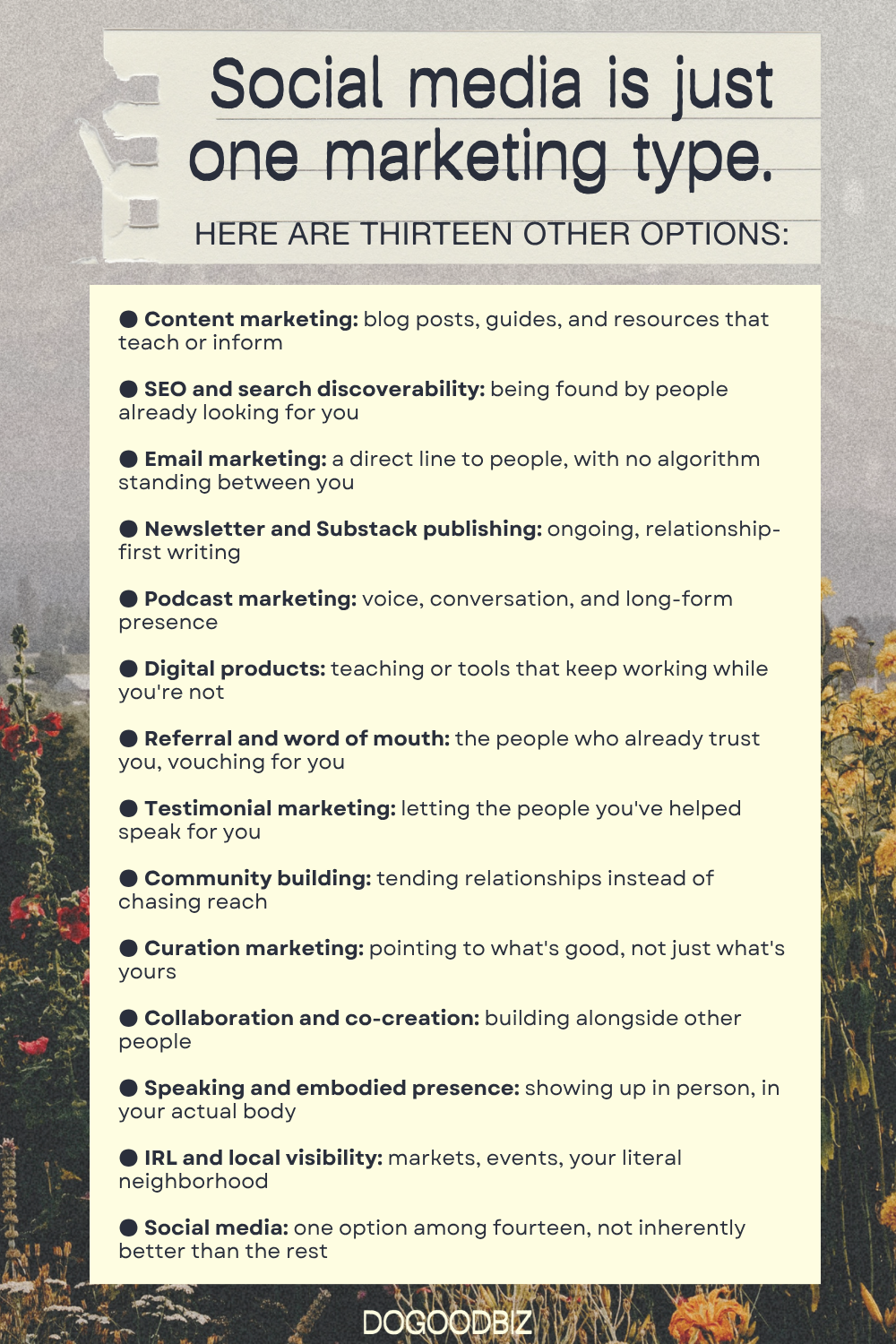
Social media is one option. There are thirteen others:
● Content marketing: blog posts, guides, and resources that teach or inform
● SEO and search discoverability: being found by people already looking for you
● Email marketing: a direct line to people, with no algorithm standing between you
● Newsletter and Substack publishing: ongoing, relationship-first writing
● Podcast marketing: voice, conversation, and long-form presence
● Digital products: teaching or tools that keep working while you're not
● Referral and word of mouth: the people who already trust you, vouching for you
● Testimonial marketing: letting the people you've helped speak for you
● Community building: tending relationships instead of chasing reach
● Curation marketing: pointing to what's good, not just what's yours
● Collaboration and co-creation: building alongside other people
● Speaking and embodied presence: showing up in person, in your actual body
● IRL and local visibility: markets, events, your literal neighborhood
● Social media: one option among fourteen, not inherently better than the rest
Fourteen options, and you're one person. You were never meant to run all of them. You're meant to find the two or three that actually align with your unique, creative style of expression.
The Challenges of Solo Marketing (And How to Overcome Them)
Before diving into strategies, let’s address the most common challenges solo marketing teams of one face so you can tackle them head-on with smart solutions.
Limited Time & Resources
Unlike large companies with dedicated marketing teams, you have limited hours in a day and a restricted budget. This means you need to prioritize efforts that bring the highest return on investment (ROI).
Solution: Focus on high-impact platforms and automate as much as possible (more on this later).
Too Many Responsibilities
Marketing is just one part of running your business. You’re also responsible for client work, finances, product development, and operations. Juggling everything can be overwhelming. A value-first marketing approach can help narrow those priorities, focusing on what actually serves your community rather than what the algorithm rewards.
Solution: Set clear marketing priorities based on your business goals, so you don’t waste time on low-impact activities.
Keeping Up with Marketing Trends
The digital landscape changes fast. One moment, a platform is thriving… next, it's irrelevant. Solo marketers often struggle to stay updated.
Solution: Follow a few trusted marketing blogs or experts and implement only relevant updates. You don’t need to chase every trend.
Maintaining Consistency
Marketing works best when it’s consistent, but creating new content regularly can feel like an impossible task when you're managing everything alone.
Solution:Use content batching, editorial calendars, and scheduling tools to stay ahead without daily scrambling.
Find Your Role Before You Pick Your Channels
Our Ecological Roles of Care framework names nine roles across three clusters:
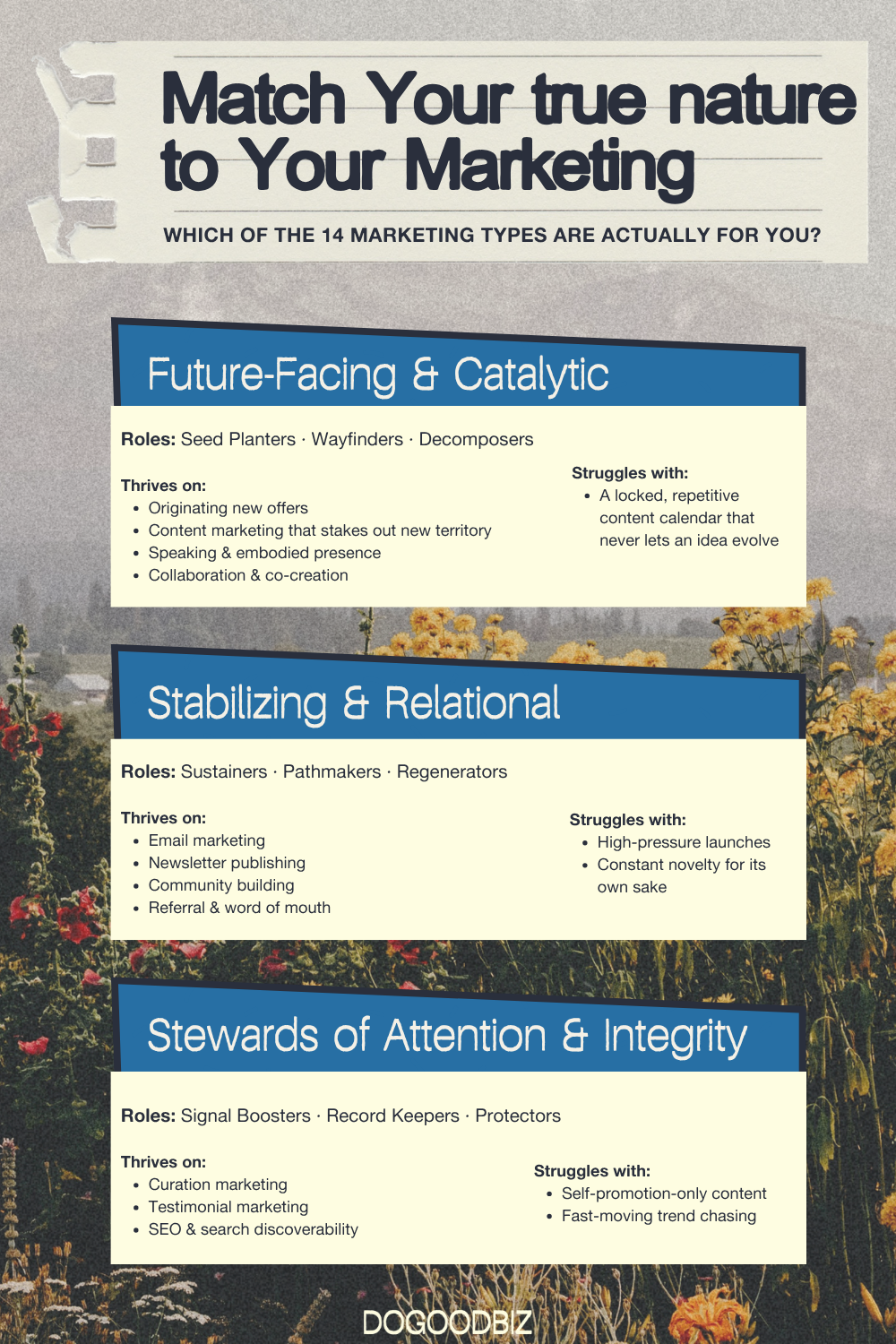
The future-facing and catalytic (Seed Planters, Wayfinders, Decomposers)
The stabilizing and relational (Sustainers, Pathmakers, Regenerators)
And the stewards of attention and integrity (Signal Boosters, Record Keepers, Protectors)
Every person carries a primary role, the one they return to by default, a secondary role that's accessible but takes more effort, and a tertiary role that's more of an edge than a place to live.
If you don't already know your role, that's the place to start; this guide assumes you're bringing it with you. What matters here is what happens next: the right marketing approach follows from your role. It isn't a generic playbook. A Sustainer forcing constant novelty and high-energy launches will burn out running the exact strategy that made someone else's business take off. A Signal Booster building a presence centered only on self-promotion will feel misaligned no matter how well it performs. Your role isn't a personality quiz result. It's the actual shape of how you're built to show up, and it's the fastest way to stop guessing at what your one-person department should be doing.
Matching Your Role to Your Marketing
A few starting patterns, by cluster. These aren't rules, they're a place to begin noticing what's already true for you:
Future-facing and catalytic (Seed Planters, Wayfinders, Decomposers) tend to thrive on originating new offers, content marketing that stakes out new territory, speaking and embodied presence, and collaboration or co-creation. Tend to struggle inside a locked, repetitive content calendar that never lets an idea evolve.
Stabilizing and relational (Sustainers, Pathmakers, Regenerators) tend to thrive on email marketing, newsletter publishing, community building, and referral or word of mouth. Tend to struggle with high-pressure launches and constant novelty for its own sake.
Stewards of attention and integrity (Signal Boosters, Record Keepers, Protectors) tend to thrive on curation marketing, testimonial marketing, and SEO or search discoverability, building something durable and findable. Tend to struggle with self-promotion-only content and fast-moving trend chasing.
Instead of picking one social platform and one owned platform because that's the advice everyone gives, pick one channel your role makes sustainable and one channel that builds equity over time: an owned list, a body of search-findable content, a referral network. The specific platform matters far less than whether the channel fits how you're actually built to show up.
A Simple Structure, Built Around Your Role
None of this means you skip structure. It means the structure should flex around your role instead of ignoring it. A Sustainer tends to do well with a steady, locked editorial rhythm they can rely on. A Seed Planter or Wayfinder tends to do better with a looser quarterly direction and room to follow what's actually alive. A Signal Booster or Record Keeper tends to do well batching curation and case-study content ahead of time, since it doesn't require them to be “on” in the moment it goes out.
Whatever your rhythm, the same basic scaffolding still helps: a quarterly direction, a monthly plan, and a weekly list of what's actually due. The difference is you're no longer forcing a structure that was built for someone else's role. You're building the lightest structure that holds your actual one.
How to Effectively Manage Marketing as a Solo Marketer
Now that we’ve identified the key challenges, let’s explore exactly how to structure your marketing team of one for efficiency and impact.
Choose Your Core Marketing Platforms
Not every platform is worth your time. Choose one social media platform and one owned media channel (like a blog, podcast, or email list).
Example:
If your audience engages most on Instagram, pair it with blogging to drive long-term organic traffic.
If you serve a professional audience, focus on LinkedIn + email marketing.
Key Tip: Let data drive your decision. Check where your audience already spends time, and focus there.
Create a Simple, Repeatable Marketing Plan
Don’t reinvent the wheel every month. Instead, follow a structured approach:
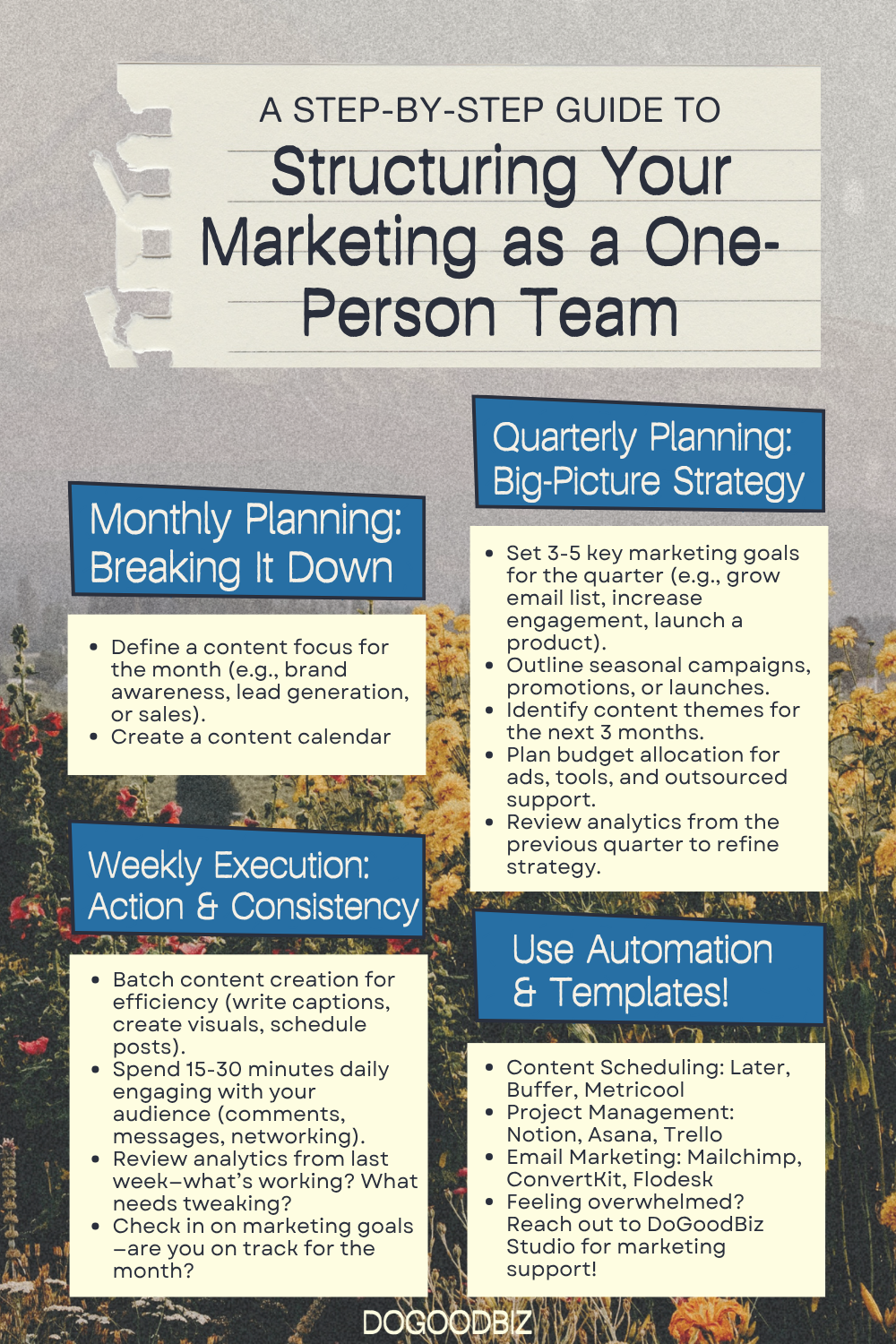
Quarterly Planning: Set high-level marketing goals (e.g., increase email subscribers, boost engagement, drive sales).
Monthly Strategy: Define the content themes, promotions, or product focuses for the month.
Weekly Execution: Plan tasks like content creation, social media engagement, and email sends.
Pro Tip: Use Notion, Trello, or Asana to keep track of your content calendar and marketing tasks.
Batch Your Content Creation
If you’re creating content daily, you’re burning time. Instead, batch your work:
Writing Days: Draft multiple blog posts, emails, or captions at once.
Design Days: Create all visuals for the month in one session.
Scheduling Days: Upload and schedule content in advance.
Key Tip: Use Later, Buffer, or Meta Business Suite to schedule social media posts in bulk.
If you're not sure which platforms are worth your time, our guide to content lifespans breaks down exactly how long content lives on each platform, useful for a one-person team deciding where to invest.
Use an Editorial Calendar to Stay Organized
An editorial calendar helps you plan and maintain consistency. It's also worth considering whether some of your marketing could go analog, lower volume, higher connection, and less dependent on daily output.
Outline content themes for the next 3-6 months.
Set deadlines for blog posts, social posts, and emails.
Leave space for timely or trending content.
Best Tools for Editorial Calendars: Google Calendar, Notion, Airtable.
Automate Repetitive Tasks
Time is your most valuable asset. Use automation to reclaim your hours:
Social Media Scheduling: Later, Buffer, or Metricool.
Email Marketing Automation: Mailchimp or Flodesk for automated welcome sequences.
Content Recycling: Use Missinglettr or SmarterQueue to repurpose old content.
Pro Tip: Automate without losing human touch—schedule posts, but make time to engage genuinely with your audience.
Know When to Outsource or Get Support
At some point, marketing will take up more time than you have. When that happens, consider:
Hiring a virtual assistant for content repurposing or scheduling.
Working with a content writer for blog posts.
Getting a marketing consultant to refine your strategy.
Thinking of outsourcing? If you'd rather not handle marketing solo anymore, reach out to us at DGB Studio, we can help!
When Running This Alone Stops Being Sustainable
Knowing your role and matching it to the right channels solves the strategy problem. It doesn't solve the capacity problem. There are still only so many hours in a week, and a one-person marketing department is still one person. This is exactly what Marketing Ecosystem Management, part of our Tend & Grow partnership, exists for: not a generic retainer that hands you a content calendar and disappears, but an ongoing partner who knows your actual role and builds your marketing ecosystem around it, the monthly and quarterly strategic planning, the platform oversight, the honest read on what's working, without you being the one holding all of it alone.
If you've read this far and already know exactly which channels are yours, but don't have the hours to run them all, reach out and let's talk about what that could look like.
DoGoodBiz Studio offers full-service marketing management for small businesses ready to hand off the overwhelm… sustainably, values-led, and without the burnout. See our marketing support or reach out directly to inquire today. DoGoodBiz Studio offers ongoing marketing ecosystem management for small businesses ready to hand off the overwhelm. Explore Tend & Grow →
Until next time,
Natalie Brite - DoGoodBiz Studio
Read next:
Content Lifespans: A Guide to Sustainable Content Marketing — How long content actually lives on each platform, and where to invest your limited time.
Marketing That Makes People Feel Something: A Case for Going Analog — A lower-volume, higher-connection alternative to the constant content treadmill.
Value-First Marketing — How to build a content strategy around what your community actually needs rather than what performs.
Common Questions:
-
Consistency, not frequency. A realistic solo presence means choosing two or three platforms and repurposing one piece of content across them, rather than trying to be everywhere daily.
-
Yes, more sustainably than social, in most cases. A short list of core sends, automation for onboarding, and content batched ahead of time means email doesn't require the daily presence social does.
-
Fewer tools than most advice suggests. A scheduling tool, an email platform, and one place to store ideas and drafts cover most of what's needed. Tools added beyond that usually end up managing the marketer more than the marketing.
