

What Is Analog Marketing? A Guide for Values-Led Brands
There's something about holding a handwritten note. The weight of the paper. The unique handwriting. The quiet fact that someone took the time.
No Instagram caption has ever made me feel that way.
I've been thinking about this for a while now… how marketing evolved, or maybe unraveled, into a constant scroll of content designed to hold attention for a split second before something else takes its place. As a creative and a business owner, I've felt the exhaustion of it. The pressure to produce. The anxiety when a post doesn't perform. The creeping question of whether any of it is actually building anything real.
Analog marketing is a different answer to that question. Not a nostalgic retreat. Not an anti-technology stance. But a deliberate choice to return to what actually makes people feel something and build from there.
This guide is for values-led brands, conscious creatives, and small business owners who want a marketing approach that's rooted in human connection rather than algorithmic performance. We'll cover what analog marketing actually is, why it works, and how to weave it into a strategy that feels sustainable and aligned with who you are.
In this guide:
What analog marketing actually means (and what it doesn't)
Why it works: the science and the soul of it
15 analog marketing tactics (offline and online)
The Analog Blend: how to integrate it without starting over
What this looks like specifically for values-led and ethical brands
This is the definitional guide to analog marketing. For a deeper exploration of why it matters for values-led brands specifically, read Marketing That Makes People Feel Something.
What Is Analog Marketing?
Analog marketing is any marketing approach that prioritizes depth of human experience over speed and scale. It draws on the physical, sensory, and relational qualities of connection, touch, presence, intimacy, and craft, whether it happens offline or online. The name comes from audio technology: analog signals carry the full, continuous wave of sound, while digital compresses it into data points. Something is always lost in the compression. Analog marketing is the full wave.
Analog marketing isn't about going backward. It's about reconnecting with what makes us human.
It's not exclusively offline marketing, though it often includes physical elements. And it's not anti-digital; it's about bringing the qualities of human connection that digital platforms tend to flatten back into the foreground, wherever your marketing lives.
We've written more about the emotional and sensory roots of this shift here. Analog marketing pairs naturally with a value-first marketing approach; both prioritize genuine connection over algorithmic performance.
What analog marketing is not
It's worth clearing this up, because the term sometimes gets conflated with things it isn't:
It's not just print marketing. Print can be analog in spirit, but analog marketing is a philosophy, not a format.
It's not old-fashioned. Some of the most resonant analog approaches- personal video messages, intimate virtual gatherings, and handwritten digital content- are entirely contemporary.
It's not inefficient. Analog approaches often have higher retention, stronger emotional response, and better word-of-mouth than high-volume digital tactics.
It's not incompatible with digital. The most effective analog marketing strategy today is a blend, using digital platforms to deliver analog warmth and connection.
Why Analog Marketing Works: The Science and the Soul
We're wired for sensory experience
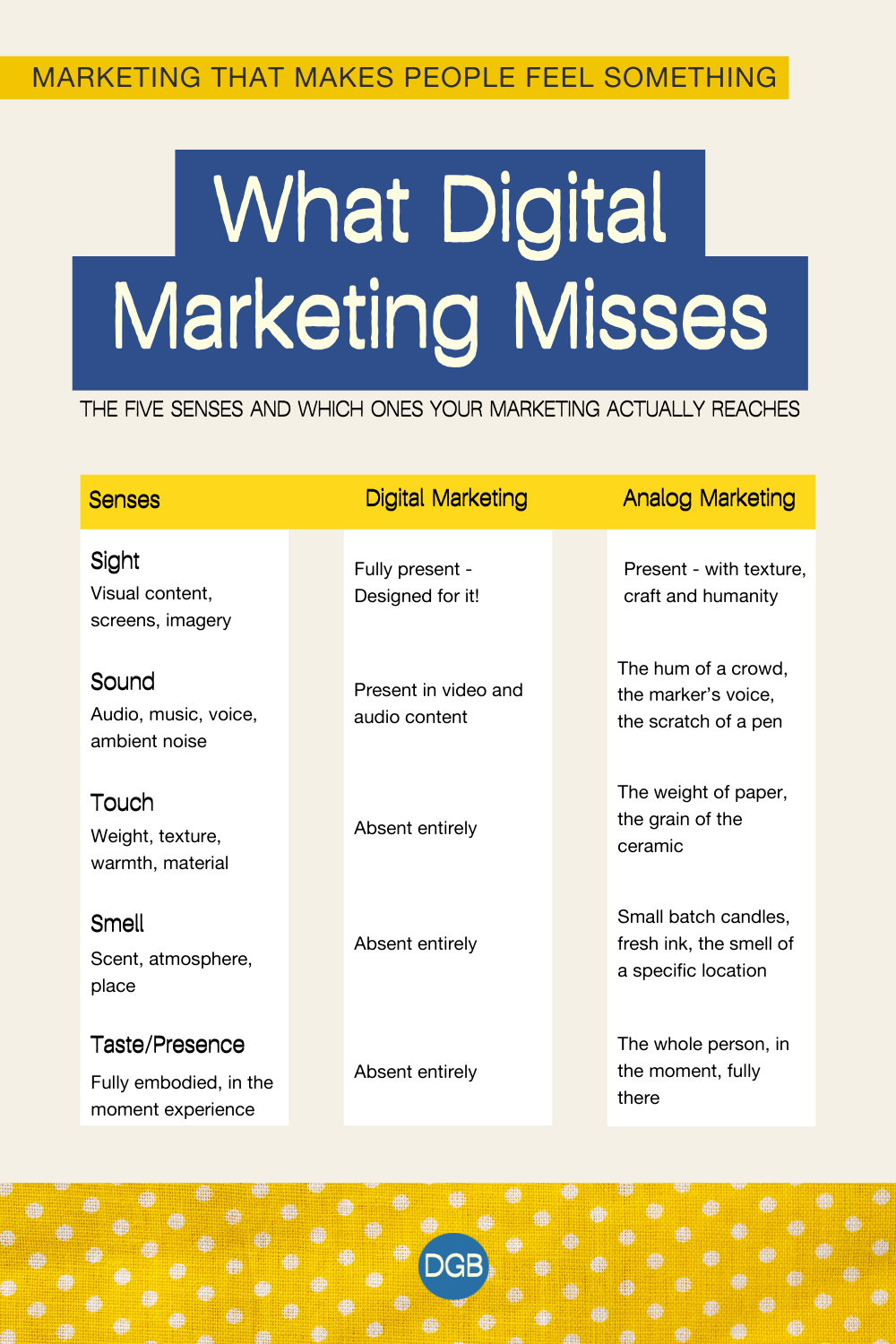
As human beings, we experience the world through touch, smell, sound, sight, and taste. Digital marketing operates almost entirely in two of those dimensions: sight and, sometimes, sound. Everything else gets stripped away.
This matters more than it sounds. Research in multi-sensory marketing has consistently shown that engaging more senses leads to stronger emotional memory, higher trust, and more durable brand associations. When someone runs their fingers across a textured business card, or unwraps a thoughtfully packaged order, or receives a handwritten note, something gets encoded that a well-targeted ad simply cannot replicate.
The body remembers what the algorithm forgets.
Digital fatigue is real and growing
The average person encounters thousands of digital marketing messages per day. The brain's response is predictable: filter, skim, scroll, dismiss. Even well-crafted content gets flattened by sheer volume.
Analog touchpoints arrive in a different register. They're unexpected. They're physical. They ask something of the recipient… a moment of attention, a pause. That ask, when honored, creates disproportionate goodwill.
There's also the exhaustion that many values-led business owners feel on the creation side. The pressure to be constantly visible, constantly producing, constantly performing for platforms that change their rules overnight. Analog marketing offers a way to step off that treadmill, not completely, but meaningfully.
It's especially aligned with values-led brands
If your brand stands for care, community, ethical business, or human connection, analog marketing is philosophically coherent in a way that paid ads and viral content often aren't. Your medium becomes part of your message.
A brand that talks about slowing down but markets entirely through urgency-driven social media posts has a credibility gap. Analog touchpoints close that gap. They demonstrate the values you hold rather than just stating them.
This is what a creative ecosystem actually looks like in practice… all the parts of your presence in conversation with each other, rather than competing for your attention.
15 Analog Marketing Tactics for Values-Led Brands
These are divided into two groups: offline tactics that bring physical warmth and presence, and online tactics that bring the analog spirit into digital spaces. Most brands will find their blend somewhere across both.
OFFLINE TACTICS
1. Handwritten Notes & Letters
Go beyond the email thank-you. A handwritten note to a new client, a loyal customer, or a collaborator costs almost nothing and creates an outsized impression. The time it took is visible in the ink, and that visibility is the point. Use recycled paper, keep the message genuinely personal, and don't try to scale it into a system. The handwriting is the signal.
2. Zines & DIY Publications
Self-published zines have a long history as a voice for counterculture and community, a form that resists mainstream media by being unmediated, personal, and made by hand. For a values-led brand, a zine can carry your story, your principles, your process, or your creative thinking in a format that feels deliberately outside the algorithm. Distribute them at local shops, maker markets, community spaces, or tuck one into every physical order. Physical content like zines also has one of the longest lifespans of any marketing format, something we explore in our guide to content lifespans.
3. Thoughtful, Tactile Packaging
If you ship physical products, the unboxing is a marketing moment. Textured paper, hand-stamped elements, a small dried flower, a personal note tucked inside- these details are noticed and remembered. They're shared. They signal that a human being made and packed this with care. That signal compounds into loyalty and word-of-mouth.
4. Pop-Up Events & In-Person Gatherings
An intimate workshop, a maker's market table, a community open studio, these bring people into contact with your brand through the full richness of in-person experience. They're also how communities form. The relationships built at an in-person event often outlast any digital campaign, and the stories people take away from them spread organically.
5. Local Collaborations & Partnerships
Team up with aligned local businesses, creatives, or organizations. Co-hosted events, cross-promotions, bundled offerings, and community projects, these expand your reach through relationships rather than advertising. They also root your brand in a specific place and community, which is a powerful differentiator in a world of faceless digital brands.
6. Flyers, Posters & Creative Print Media
There's something quietly radical about a beautifully designed flyer on a coffee shop bulletin board, it exists in physical space, it's not algorithmically suppressed, and it's seen by the people who inhabit a particular community. Don't underestimate it. Pair striking, values-aligned design with authentic messaging and let it live in the world.
7. Workshops & Skill Shares
Offer something you know to people who want to learn it. A creative workshop, a behind-the-scenes tour, a skill share session. This positions you as a generous member of your community, deepens relationships with existing customers, and introduces new people to your work through the most powerful marketing there is: direct experience.
ONLINE TACTICS THAT CARRY ANALOG WARMTH
8. Share the Tactile, Behind-the-Scenes Process
Document the hands-on parts of your work. Sketching, packaging, building, writing. Show the texture of your materials, the mess of the process, the moment before the finished thing. Let people hear the scratch of pen on paper. These moments create intimacy… the feeling that your audience is with you, not just receiving your output.
9. Handwritten Content Shared Digitally
Photograph a handwritten note, a sketched idea, a journal entry. Share it in your newsletter or on social media. The handwriting itself communicates something: that a person made this, took their time, and thought carefully. It reads as the opposite of content-marketing content. In a sea of designed posts, a photograph of a handwritten page is disarming and memorable.
10. Personal Video Messages
Instead of a mass email to a list, send a personal video to a new client, a long-time supporter, or someone who's just made a meaningful purchase. Unscripted, warm, looking directly at the camera. This is disproportionately powerful for the effort it takes, and almost no one does it.
11. Intimate Virtual Gatherings
Design an online event that mimics the warmth of an in-person gathering. Encourage people to show up with tea, a candle, and something to write with. Send a downloadable worksheet or a digital care package beforehand. Create a setting, not just a Zoom link. The setup signals: this is a real thing, and you are a real person in it.
12. Sensory-Focused Product Content
If you sell physical goods, show the sensory experience. Close-up textures, slow-motion movement, and the sound of your product in use. Let people feel it through the screen. This is especially powerful for craft goods, food, stationery, clothing, or anything where the physical reality of the object is part of its appeal.
13. Downloadable Zines & Printable Resources
Offer a beautifully designed zine, guide, or print-at-home resource as a free download or paid item. When someone prints it, it enters their physical world. It sits on a desk, travels in a bag, gets dog-eared. It becomes a tangible artifact of your brand that no digital ad can become.
14. Moodboards, Illustrations & Handcrafted Visual Content
Use illustration, hand-lettering, collage, or hand-drawn visual content in your marketing rather than, or alongside, stock photography and designed graphics. These communicate that a person made something. They carry personality. They differentiate you visually in a way that template-based content can't touch.
15. Interactive Storytelling
Guide your audience through a story rather than broadcasting information at them. Share audio clips, narrative arcs, multi-part journal entries, or illustrated essays. Create the feeling of sitting with someone and being told something real. This is content as conversation; one of the most analog things you can do in a digital space.

The Analog Blend: A Framework for Integration
Most values-led brands won't go fully offline. The goal isn't to abandon what's working digitally… It's to find the points where analog warmth can enter and deepen the experience. The goal isn't to replace your digital marketing. It's to find where the human disappeared, and put it back.
Here's a simple framework we use with clients:
Find the Cold Spots: Where in your current marketing does the human disappear? Where does it feel transactional, automated, or hollow? These are the points where analog warmth would land hardest.
Add Warmth: Choose one or two analog elements to introduce into those cold spots. A handwritten note in orders. A personal video for new subscribers. A behind-the-scenes photo instead of a designed post. Start small and notice what resonates.
Make It a Ritual: Once something works, make it consistent. A monthly handwritten note round. A quarterly zine. A regular intimate gathering. Rituals compound over time; they become part of what people associate with your brand.
This approach doesn't require a budget overhaul or a complete content strategy reinvention. It requires attention to your audience's experience, to the texture of your own marketing, and to the moments where a handwritten word or a personal video could do more than a hundred designed posts.
What Analog Marketing Looks Like for Values-Led Brands Specifically
If your business is built around ethical principles, environmental care, community over competition, anti-hustle culture, accessibility, reciprocity, analog marketing isn't just a tactic. It's a philosophical fit.
Here's why that matters: the medium carries a message of its own. When a brand talks about slowing down and being human-centered but markets entirely through urgency-driven social media, there's a dissonance that conscious audiences feel, even if they can't name it. Analog touchpoints close that gap. They demonstrate your values rather than just stating them.
Practical starting points for values-led brands:
Replace one promotional email per month with a personal note (handwritten and photographed, or written in genuine first-person) about something you're actually thinking about.
Create one piece of printable content (a resource, a reflection, a small zine) and offer it as a gift to your community.
Host one intimate gathering, in person or online, per quarter. Design it to feel like a conversation, not a webinar.
Introduce one tactile element into your packaging or delivery process, even if you primarily sell digital services. (A beautifully designed welcome PDF. A handwritten first-project note.)
Use illustration, hand-lettering, or handwritten elements in your visual content at least once a month.
A note on sustainability
Analog marketing's physical elements (printed materials, packaging, direct mail) carry an environmental footprint worth being thoughtful about. If environmental care is a core value of your brand, choose recycled papers, soy-based inks, and local printers where possible. Consider offsetting physical mailings with a donation or a tree planting. And remember that the digital analog tactics on this list (personal videos, handwritten notes shared photographically, intimate virtual gatherings) carry none of those concerns while delivering similar warmth.
Building a Marketing Ecosystem That Feels Human
Analog marketing works best when it's not a separate strategy bolted onto an existing digital one, but when it's woven into a coherent marketing ecosystem where every element supports the others.
That means your analog touchpoints connect back to your digital presence. Your zine has your website on it. Your handwritten note mentions your newsletter. Your in-person event links to your online community. And your digital content carries the warmth and texture of your analog practice.
When all of these elements are in conversation with each other, when your brand feels the same whether someone encounters you at a maker's market, in a newsletter, or on your website, that's when marketing stops feeling like a task and starts feeling like an extension of who you are. Let your marketing feel like a conversation, not a pitch.
This is what we work toward at DoGoodBiz Studio: marketing ecosystems that are sustainable, human-first, and coherent, where the values at the center of your work are visible in every touchpoint.
If you're interested in exploring what that could look like for your brand, we'd love to talk.
Ready to Build Marketing That Feels Like You?
If this resonated, if you're tired of marketing that doesn't feel like you, or you're looking for a more sustainable, values-aligned approach to visibility, this is the work we do.
We help values-led brands build marketing ecosystems rooted in human connection, not just content calendars.
Whether you're building from scratch or looking to bring more coherence and warmth to what you already have, we work with you to design a system that feels sustainable… for you, and for the people you're trying to reach.
If you want help building a marketing approach that feels this human and this sustainable, Tend & Grow is our ongoing creative partnership for exactly that.
The Future is Collective
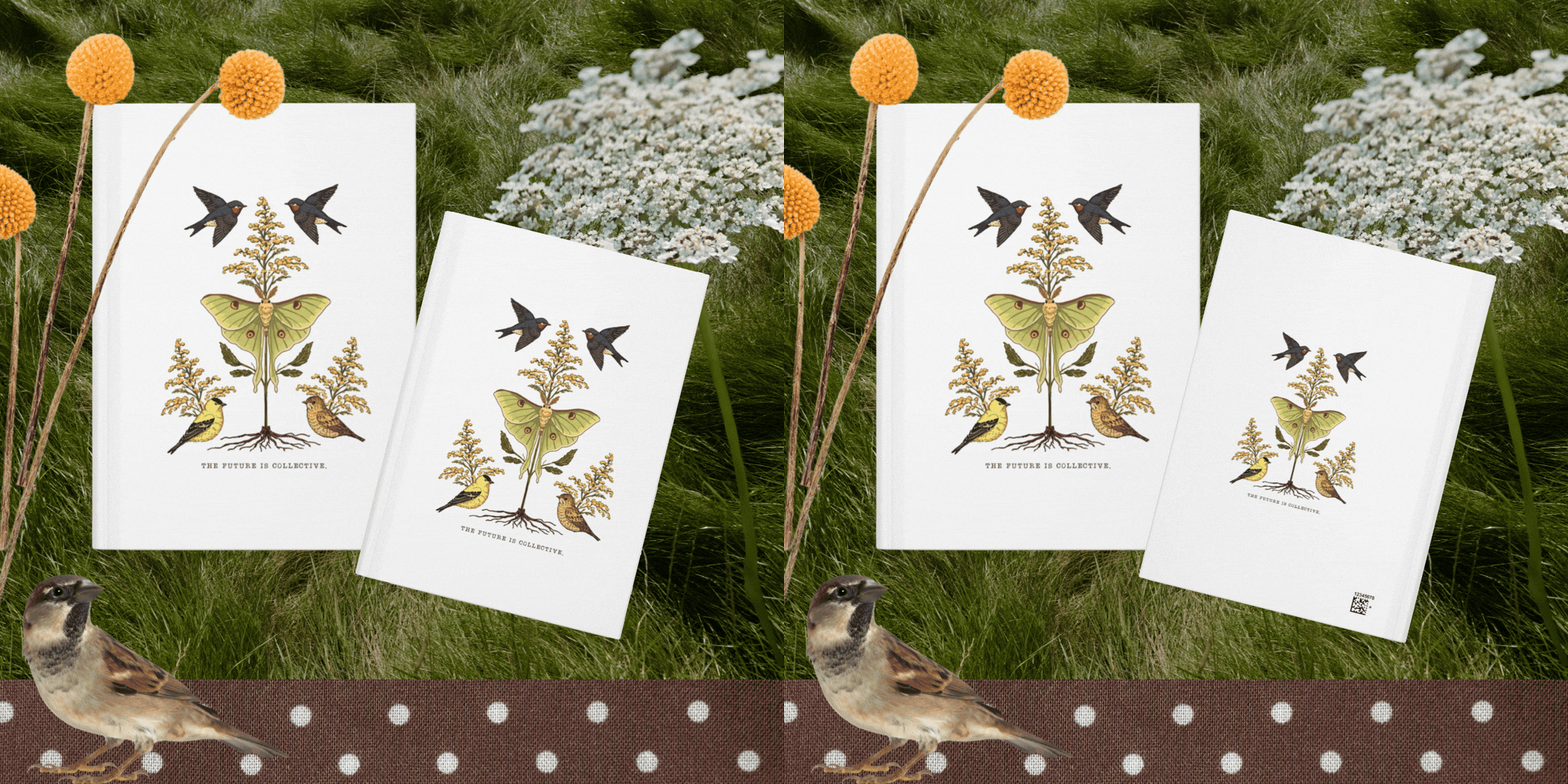
There's something about moving a thought from your head to your hands, intentionally, without a screen, that changes what the thought becomes. If you want to try it, the Slow Down & Write journal in The Creative Camp was made specifically for this kind of thinking.
Read next:
Value-First Marketing: Ethical, Sustainable Content Strategy — Where usefulness and genuine connection come before conversion.
Why Creative Ecosystems Matter More Than Personal Brands — All the parts of your presence in conversation with each other rather than competing for your attention.
Content Lifespans: A Guide to Sustainable Content Marketing — Which platforms are worth your time and how long your content actually lives there.
