

What Is Thought Leadership (And Why Values-Led Creatives Are Positioned to Lead)
There's a version of "thought leadership" that makes most values-led creatives want to leave the room.
It's the LinkedIn version. The one where you post a hot take every morning, build a personal brand around your face, optimize your content calendar for engagement, and call what you're doing "leadership" because it gets you more followers.
If that's thought leadership, you may not want anything to do with it. For our studio, we understand and think suspicions around thought leadership are completely valid.
But here's what that version has stolen from you by making the term so unappealing: the actual thing. The practice of sharing ideas that move your field forward. Of naming what others haven't named yet. Of writing and speaking and showing up in public with the full weight of what you've learned, not to build an audience, but because the conversation needs what you have to contribute. The people who most need to be shaping conversations (the healers, the community builders, the ethical practitioners, the movement makers) are often the ones who find 'thought leadership' language the most repellent. So they stay quiet. And the wrong voices fill the vacuum.
This article is an attempt to take the term back. To look at what thought leadership actually is when you strip away the personal brand machinery, and to make the case that values-led creatives aren't just capable of leading it, they're the ones best equipped to.
Let's start with what thought leadership actually is
The term was coined in 1994 by Joel Kurtzman, editor of Strategy + Business magazine. He used it to describe thinkers whose ideas were changing how their industries understood themselves, not people promoting their personal brand, but people doing genuinely original thinking that moved fields forward. That original definition is worth holding onto.
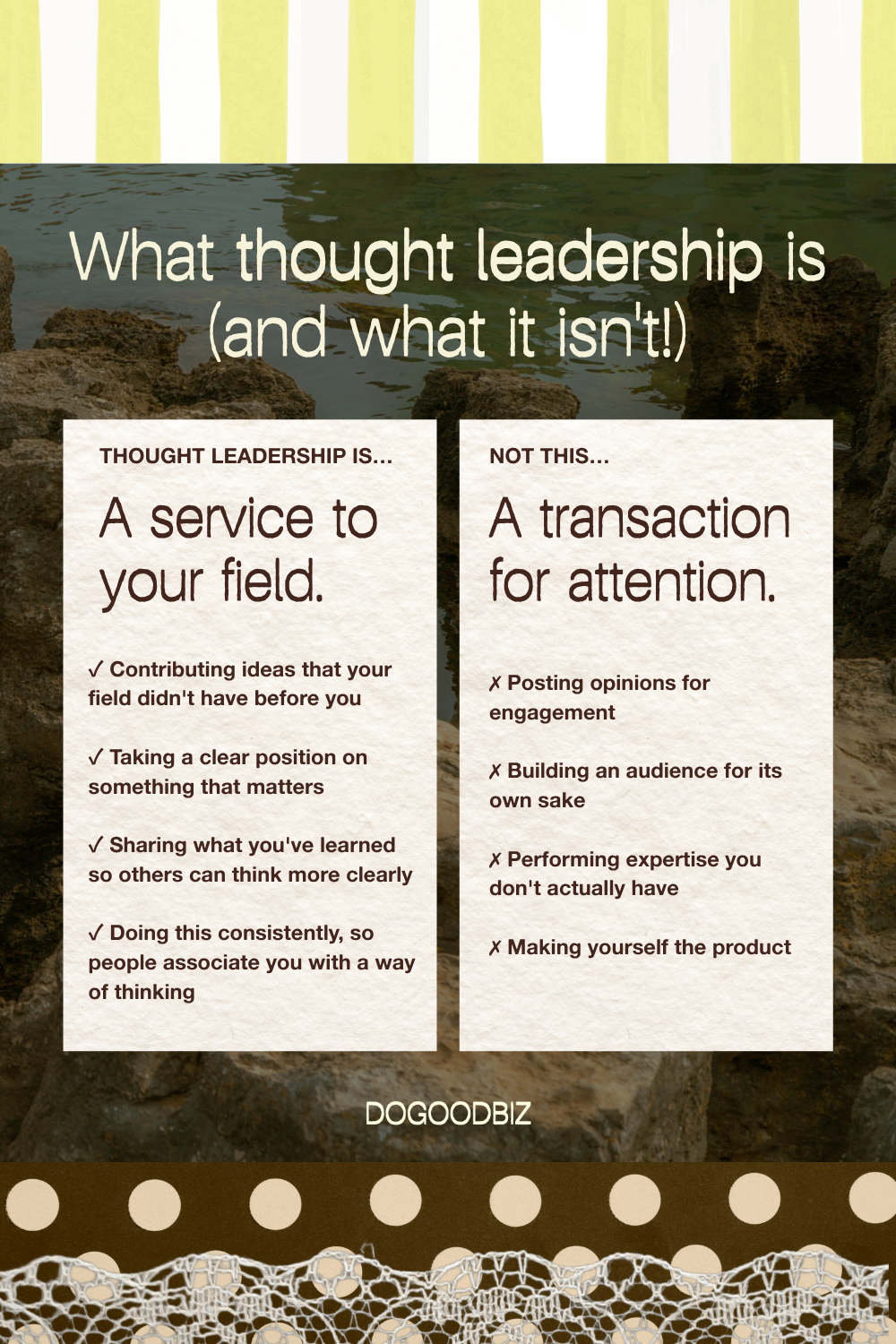
Thought leadership, in its actual meaning, is:
Contributing ideas that your field or community didn't have before you contributed them
Taking a clear, defensible position on something that matters to the people you serve
Sharing what you've learned in a way that helps others think more clearly, act more wisely, or see something they couldn't see before
Doing this consistently, over time, so that people come to associate you with a particular kind of thinking
What it is not:
Posting opinions for engagement
Building an audience for its own sake
Performing expertise you don't actually have
Making yourself the product
The difference matters enormously. One is a service: something you offer to your field because you have something worth contributing. The other is a transaction: something you perform in exchange for attention.
Values-led creatives, almost by definition, are oriented toward the first model. You got into this work because you had something to contribute. The practice of thought leadership, properly understood, is just the intentional expression of that.
Why the loudest voices are the most noticed right now
There's a reason the public discourse in most creative fields is dominated by people whose ideas are mediocre but whose marketing is excellent. And it's not because they're smarter or more experienced. It's because they were willing to do something that some creative people aren’t: show up in public, consistently, before they were certain.
This creates a visibility gap, and it has real consequences. The practitioners with the deepest knowledge of what communities actually need, the designers who understand the relationship between aesthetics and ethics, the educators who've been doing regenerative work for decades… they're often absent from the conversations that are actively shaping their fields.
Meanwhile, people with confident, simple, scalable answers are everywhere. And because they're everywhere, they shape what "everyone knows", even when what they're saying is thin.
Silence isn't neutral. When you don't share what you know, you cede the conversation to whoever is willing to talk, and they may not share your values, your depth, or your commitment to doing work that is in the best interest of people and the planet.
This is not an argument for performative posting. It's an argument for showing up, with your actual thinking, in the places where it can do the most good. For values-led creatives, that's not a hustle, it's a responsibility.
Why values-led creatives are specifically positioned to lead
The conventional thought leadership playbook is built around expertise as a competitive advantage. You know more than your audience, so they should listen to you. That model is already starting to break down, especially since AI can now produce competent-sounding expertise on almost any topic in seconds, which means the value of expertise-as-content is in structural decline.
What can't be replicated is perspective. The particular combination of lived experience, hard-won learning, values, relationships, and way of seeing that makes your thinking yours. That's what values-led creatives have in abundance, and what the dominant thought leadership model has actively discouraged, because it's harder to scale.
Your work already lives at the intersection of ideas and practice
Most conventional thought leaders are either practitioners who don't think, or thinkers who don't practice. Values-led creatives, such as a brand designer, a somatic practitioner, a community organizer, or an educator, are doing both simultaneously. Your ideas are tested in the real world, with real people, over time. That's a form of credibility that's increasingly rare.
You work with the complexity that everyone else is trying to simplify
The dominant culture of content creation rewards clickbait. Hot takes. Three-step frameworks. Lessons that fit in a carousel. One size fits all approaches. Values-led creative work is constitutionally opposed to that kind of flattening because you know that the real answer to most meaningful questions is "it depends," and that the nuance is where the actual wisdom lives.
That's not a liability. As people become increasingly fatigued by thin content and confident-but-wrong takes, the demand for genuine complexity and nuance is growing. You're already oriented toward the thing that's becoming more valuable.
Your values are your differentiation, not a liability
The most common fear among values-led creatives about becoming more visible is that their politics, their ethics, and their unwillingness to work with certain clients or promote certain ideas will shrink their audience.
The opposite is often true. In a landscape of interchangeable expertise, values are the most powerful differentiator available. Not because they're a marketing strategy, but because they attract exactly the people you're built to serve and repel exactly the people you're not. That's not shrinking your audience. That's sharpening it.
The values-led thought leadership advantage
What the conventional model can't replicate about your positioning:
Perspective rooted in practice: Your ideas have been tested with real humans in real situations. That's different from ideas tested in theory or in a content calendar.
Willingness to hold complexity: You already know the real answers aren't simple. That honesty is increasingly rare and increasingly valuable.
Values as filter, not feature: You attract clients who share your ethics and repel those who don't, which means your audience, while smaller, is far more aligned.
Relational credibility: You've built trust with real communities over time. That's not follower count. It's something more durable.
Skin in the game: You're not sharing ideas about ethical work. You're doing ethical work. There's a different quality of conviction in that.
What thought leadership actually looks like for values-led creatives
Here's the important reframe: thought leadership doesn't have to look like what you've seen it look like. It doesn't have to be a podcast, or daily LinkedIn posts, or a speaking circuit. Those are distribution channels, not the thing itself.
The thing itself is: having something to say and saying it, in the places where it will reach the people who need to hear it.
For values-led creatives, that might look like:
A Substack newsletter that goes out when you have something worth saying, not necessarily even on a schedule
A single long-form essay per month that makes a clear, original argument about something in your field
Showing up to speak on a panel or at an event because you disagree with the dominant perspective being shared there
Writing a piece that challenges a widely-held assumption in your industry, and publishing it somewhere your ideal clients will read it
Building a body of work over the years that demonstrates a consistent, coherent perspective, even if none of it goes viral
What all these have in common is intentionality. You're not posting to fill a content calendar. You're contributing when you have something to contribute, in the form that serves the idea best.
The slow build is the durable build
The conventional thought leadership model is optimized for growth: more followers, faster, now. The values-led model is optimized for depth: the right people, who stay, who trust you, who become clients, collaborators, and advocates over time.
These produce very different results in year one. They produce very similar results in year five, except that the slow build is made of actual relationships, and the fast build is made of an audience that will leave the moment you stop optimizing for them. You don't need a massive audience. You need the right audience because people who trust you specifically because of the things that make you different from everyone else in your field. That trust is built by saying true things, consistently, over time.
The specific fears that keep values-led creatives silent, and what to do with them
"I don't want to seem like I'm promoting myself."
This is the most common one, and it's worth sitting with. There's a real critique embedded in it; the discomfort with the kind of self-promotion that puts the self at the center, that treats your audience as a resource to be extracted. That critique is valid.
But there's a version of sharing your thinking that isn't self-promotion; it's contribution. The distinction is in the orientation: are you sharing because you have something to offer, or because you want something from the audience? The former is thought leadership. The latter is marketing.
If you're genuinely oriented toward contributing something of value, you can trust that the visibility will follow as a byproduct, not as the goal.
"I'm not sure my ideas are original enough."
Most ideas aren't original in the sense of never having been thought before. They're original in the sense of this person, with this experience, in this particular field, connecting these particular dots in this particular way. That specificity is what makes an idea worth reading, not its novelty in the abstract.
You don't have to say something nobody has ever said. You have to say something true, in your voice, from your experience, for your people. That's enough.
"I'm afraid of being wrong in public."
You will be. And it will be fine, and in fact good, because the willingness to be wrong in public is one of the things that makes thought leadership trustworthy rather than performative. The people whose ideas you most respect have all been publicly wrong about something. What made them worth trusting was not that they were always right, but that they engaged seriously with the question and updated when the evidence required it.
What your field needs is not more certainty. It needs more honest, rigorous, publicly conducted thinking. You being willing to do that, including being wrong sometimes, is a service.
"I don't have time for this on top of everything else."
The honest answer here is that thought leadership done well doesn't require a lot of time; it requires a different relationship with the thinking you're already doing. Every practitioner has more ideas than they share. The work is noticing which ones are worth developing, and developing them in a form that others can engage with.
One piece of original writing per quarter that says something true and specific about your field is more impactful than daily posts about nothing in particular. Start there.
How to start practically, without the overwhelm
If this is landing for you and you want to move toward more visible thought leadership in your field, here's a simple starting framework:
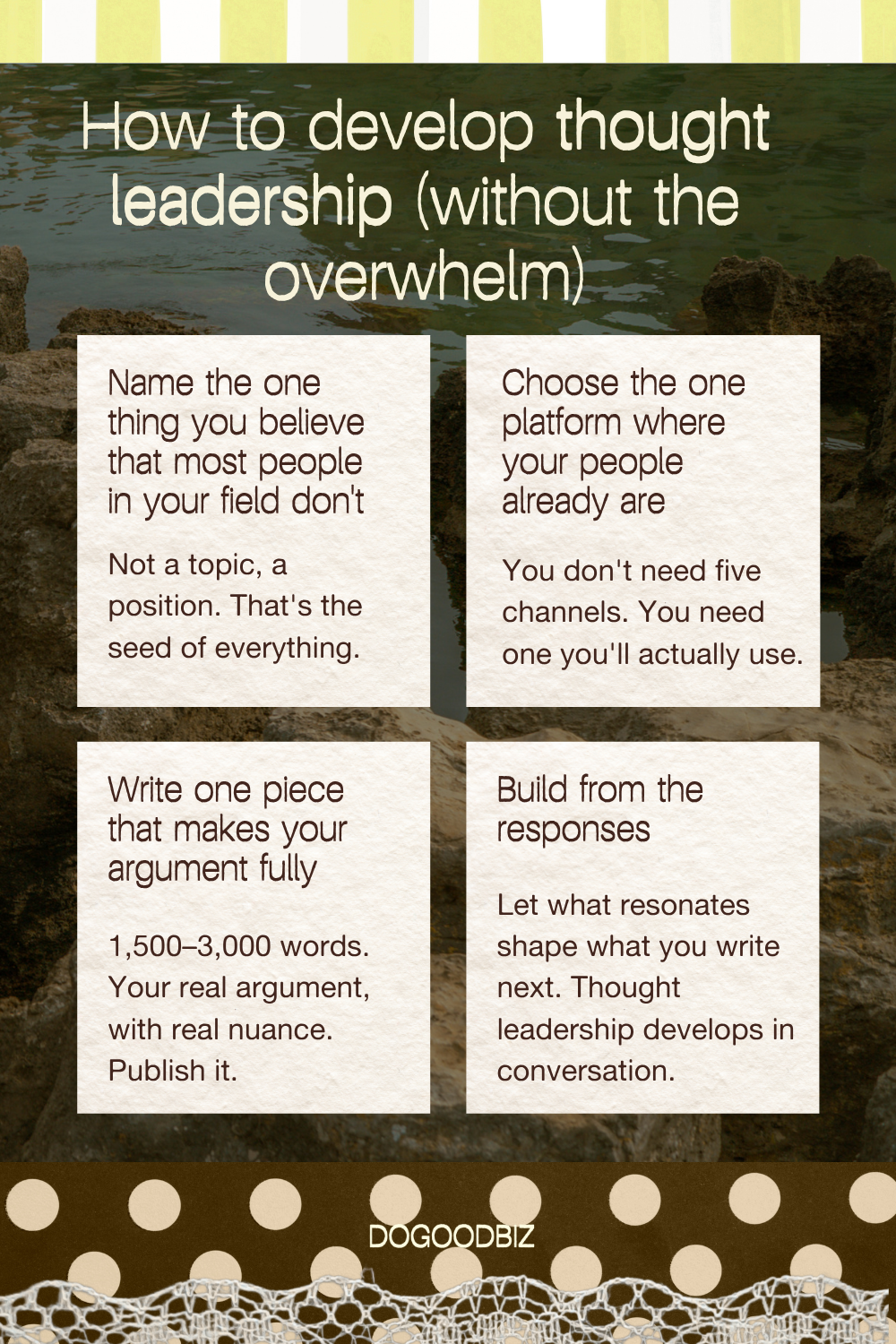
Step 1: Name the one thing you believe that most people in your field don't
This is the seed. Not a topic, a position. Not "I work with ethical brands" but "the way most creative studios think about brand strategy is actively harming their clients' communities, and here's why." That's a thought leadership position. Find yours.
Step 2: Choose the one platform where your people already are
You don't need a podcast, a newsletter, a blog, and a LinkedIn strategy. You need one place where you can show up consistently with something worth reading or listening to. For most values-led creatives, a newsletter is the highest-leverage choice because it's yours, it's not subject to algorithm changes, and it reaches people who opted in specifically to hear from you.
Step 3: Write one piece that makes your argument fully
Not a hot take. A real piece (1,500 to 3,000 words) that makes your actual argument, with real evidence and real nuance. Publish it. Share it once in the places you already show up. See who responds.
Step 4: Build from the responses
Thought leadership develops in conversation. The responses you get to that first piece will tell you which parts of your thinking resonated, which parts need more development, and what questions your people actually have. Let the conversation shape the next piece.
Questions to find your thought leadership position
What do you believe about your field that most of your peers don't?
What do your clients most consistently misunderstand before they work with you, and what's the real answer?
What is the dominant narrative in your industry that you think is wrong, incomplete, or actively harmful?
What have you learned from ten years of practice that you wish someone had told you at the beginning?
What's the conversation your field needs to be having that it isn't?
The bigger argument: this is what the moment actually requires
We're in a period where the volume of content is increasing exponentially while the quality of thinking in that content is declining sharply. AI can generate an article that sounds knowledgeable on almost any subject in seconds. The result is a landscape where the surface-level markers of credibility (coherent sentences, organized structure, confident tone) have become worthless as signals of actual expertise.
What this means for you is that the things that have always differentiated good thinking from bad thinking, genuine experience, intellectual honesty, willingness to engage with complexity, consistent values over time, are becoming more valuable, not less. The signal-to-noise ratio is collapsing everywhere except in the work of people who are doing something real and saying something true about it.
AI has made confident-sounding expertise cheap. What it can't make cheap is the genuine thought: ideas rooted in real practice, shared by someone with actual skin in the game, from a perspective shaped by real values and real relationships. That's what you have. That's what thought leadership, in its truest form, is.
The values-led creative community is full of people with important things to say who are saying them only in private, or only to their immediate clients, or only at conferences where the attendees already agree. The cost of that silence isn't just to your business, it's to the broader discourse.
The conversations about ethical design, about community-centred business models, about what it means to build something sustainable, about the relationship between creative work and ecological wellbeing, these conversations are happening. They need the voices of people who have been doing this work, thinking about it seriously, and building practices around it.
That's you. Whether or not you call it thought leadership.
A final note on the word itself
If "thought leadership" still carries too much of the LinkedIn energy, the personal brand machinery, or the self-promotional anxiety, you don't have to use it.
Call it what it actually is:
Contributing to the conversation
Sharing what you've learned
Writing for your field
Speaking up about the things that matter
Whatever you call it, the practice is the same: having something worth saying, and saying it in public, with enough consistency that the people who need to hear it can find you.
Your field needs your thinking. Your potential clients need to know you're the kind of person who thinks this way. And the world is better with more values-rooted, community-centered, ethically-grounded voices in the public conversation.
That's not a personal brand strategy. That's a contribution to something larger than yourself. Which, if we're being honest, is probably what you got into this work to make in the first place.
Ready to build your thought leadership presence?
We love helping leaders grow their reach and deepen their impact through thought leadership strategy, Blog and content ecosystem development, speaking presence, and movement messaging. If you're ready to be more visible in a way that feels genuinely like you, let's talk.
→ Start a conversation at dogoodbiz.studio/inquire
