

Community building vs. networking: why contribution beats extraction
You get invited to a local event. Maybe it's a meetup for a hobby you're passionate about, a gathering to support a local initiative, or a market you're really excited to check out. You walk in, and before you've even said hello to anyone, you're scanning the room. Who's here? What do they do? How can this benefit me?
Or it happens online instead. You join a community group for something you really care about, and within five minutes you're skimming profiles instead of reading posts. Sizing up who has the audience, who has the presence, who's worth a follow back.
You catch it. You put the phone down, or you don't let the question "so what do you do" leave your mouth, and you choose to ask something else instead. This is the difference between networking and community building, and it shows up in the smallest moments, long before it shows up in your business.
I know these scenarios from both sides. A while back, I got invited to a gathering by someone I knew casually. There were twenty-something people in the room, and I knew exactly one of them. I walked in ready to meet people. What I found instead was competitive. Superficial. Every single conversation started the same way. "So what do you do?" I quickly felt like I was being weighed and measured. Nobody was actually curious about me. They were sizing me up, and I could feel it happening in real time. I was a stranger in that room, and it showed. I got left out of conversations. Talked past. Examined for whether I'd earned a spot at their table. I didn't feel welcome. I didn't feel safe. I felt like I had to perform a version of myself just to be allowed to stay in the conversation.
That room called itself a community. It wasn't one.
A few years ago, I brought the topic of community building to my therapist. What it actually is. What it's supposed to feel like. I was in the middle of some hard conclusions about my own blood relatives at the time, and it forced a realization I couldn't avoid: I had never actually known what it felt like to belong. Not to a family. Not to a genuine community. Being genderqueer and non-binary added another layer to that. Plenty of spaces built around "community," especially the ones organized around womanhood, left me feeling like I was on the outside. I've sat in rooms that called themselves inclusive and still felt invisible in them. That kind of exclusion can often teach you that belonging comes with conditions.
So when I say I've spent years working to understand what real community feels like, I mean that literally. I didn't have a reference point for the thing I wanted to experience. And that work didn't stay personal. It bled into everything else, including the parts of my life that called themselves professional.
I left this type of extraction system many years ago. The way of connecting with folks that turns every conversation into a pitch and every person into a lead. I've taken a different approach on purpose. Ecological. Values-led. Intentional. But leaving didn't erase the conditioning underneath it. Capitalism teaches us to size people up before we even say hello. So does supremacy culture, with its worship of productivity and urgency and worth measured by output. That instinct is training, doing exactly what it was designed to do, showing up in rooms that call themselves something else. Sizing people up. Asking, underneath everything, what can this do for me, because we were taught that's how worth gets calculated. Ours and everyone else's.
The pressure creeps in. The comparison. The performing. You leave the system to build something free of these dynamics. The system finds you anyway. You don't get to leave the operating system just by changing your job title or the language you use. You have to actually replace it. Most of us never do. We just move the extraction logic into a nicer room.
A brief history of networking (and why it matters)
I find it important to mention that networking didn't start as an innocent practice that got complicated somewhere along the way. History matters, and origins of concepts matter.
Networking originally started as a form of exclusion. Just look at the "old boy network," which traces back to Britain in the late 1800s, where schools known as Eton and Harrow used their school ties to funnel each other into government and business positions their families already controlled. This was a form of networking, where specific people within the network benefited greatly, as they had more access to power and resources due to who they were.
In 1970, the company known as Xerox had a progressive affirmative action hiring program for its time, yet its Black employees were still shut out of the informal networks of mentorship and information their white colleagues relied on to actually get promoted. So they built their own. Xerox's National Black Employee Caucus, formed that year, is credited as the first official employee resource group in the country. It spread from there: the Bay Area Black Employees group in California, the "Corporate Few" in DC starting in 1972, a first conference for all Black Xerox employees in 1973.
A decade later, in 1980, journalist Mary Scott Welch published "Networking: The Great New Way for Women to Get Ahead," after researching an article on the best companies for women and finding, instead, an entire underground of women at places like Exxon, GE, NBC, and Newsweek trading information and support with each other because no old boy network would do it for them. Her book is credited with the first use of "network" as a verb, and with sparking an entire women's networking movement.
These examples that trace the origins of the concept of networking are forms of survival. A workaround built by people the system they found themselves in was never designed to include, because nobody was going to open the doors for them otherwise.
Somewhere between then and now, networking got stripped of that original context and was rebranded as a virtue in itself. In 2002, Tim Sanders wrote the line "your network is your net worth" in his book Love Is the Killer App. In 2013, Porter Gale turned that exact line into a book title, and the phrase went fully mainstream from there.
Relationships, reframed as an asset class, are no longer a response to exclusion but a personal strategy for people, regardless of whether they'd ever actually been shut out of anything. Once that framing takes hold, it doesn't matter whether you're in a boardroom or a backyard barbecue. The question underneath every interaction becomes the same one the old boy network was built to ask in the first place: what can this do for me?
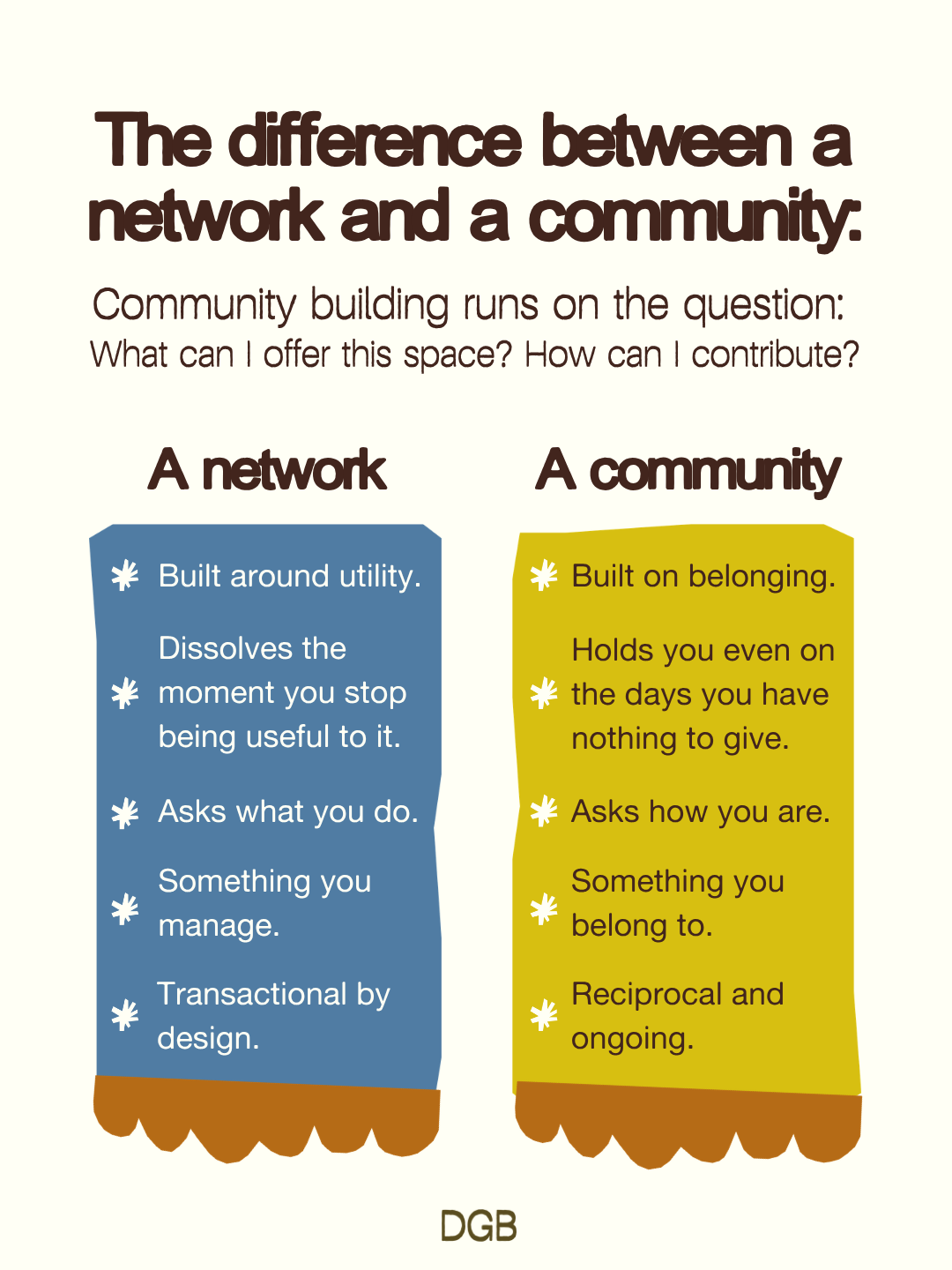
Community building vs. networking: what's actually different
Community building runs on a different question. Not what can this do for me. What can I offer this space? How can I contribute?
Sounds like a small shift. It isn't.
This distinction matters for everyone, but it matters most for the people networking was never built to include in the first place. If you've spent your life being sized up in rooms, for your race, your gender, your body, your class, your name, you already know networking's real function. It sorts people into worth having and not worth the time, and it always has. Community works differently. It doesn't ask you to prove you belong before it lets you in. Belonging isn't the prize at the end of a performance. It's the starting condition.
Capitalism trains us to treat everything as a resource, including each other. Every relationship gets a return-on-investment attached to it, whether we notice or not. The damage from that isn't just personal, some vague ache you're supposed to solve alone. It's collective. A culture that teaches people to extract from each other instead of belong to each other doesn't just produce lonely individuals. It produces a culture that's forgotten how to hold anyone up. This is what happens to any system, ecological or social, when everything is optimized for extraction, and nothing gets reinvested in the whole.
What community building looks like in practice
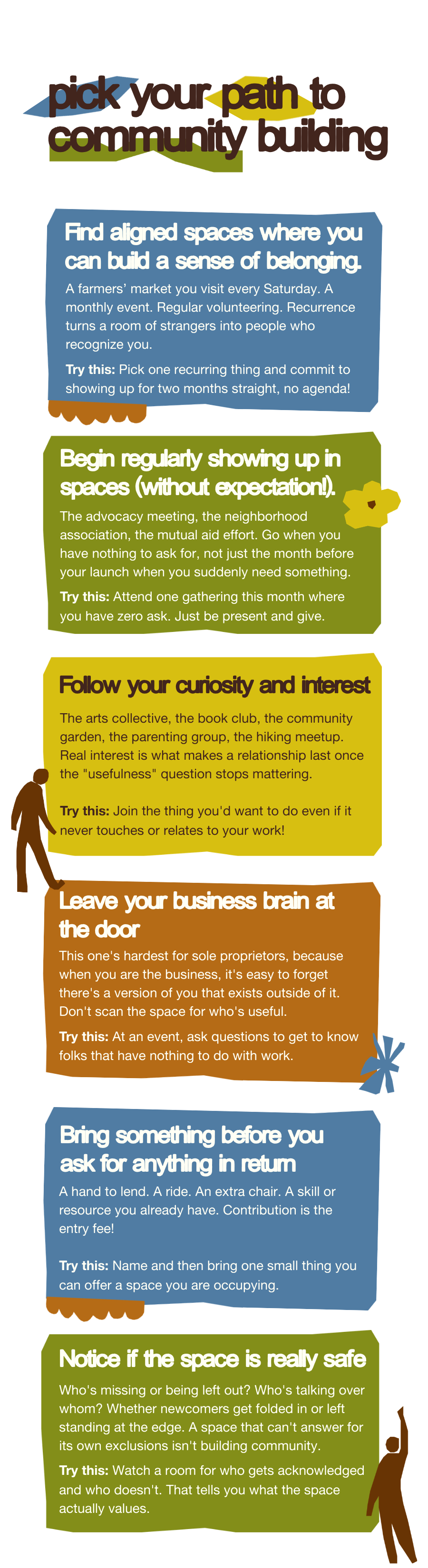
I don't personally build community through the brain but rather through the heart. I build it through showing up to what's already taking place within the communities I feel like I can safely be a part of: farmers markets and makers markets, festivals and volunteer opportunities, advocacy events, artist and queer spaces. None of these places depend on me to network them into existence. They already exist. I don't need to reinvent a wheel that was already created.
That instinct to invent everything yourself, to be the one who starts it, owns it, leads it, is supremacy culture and capitalism working exactly as designed. The system rewards the founder, the head of the table, the name on the event. It has no real reward system for the person who just shows up and helps something that already exists keep existing. But that's the actual work. A space built around one leader is a monoculture, dependent on a single person to lead. But what happens if the leader steps down? The "community" falls apart. Real community is collective. Shared power, shared responsibility, no single person required to hold the whole thing up or sustain it.
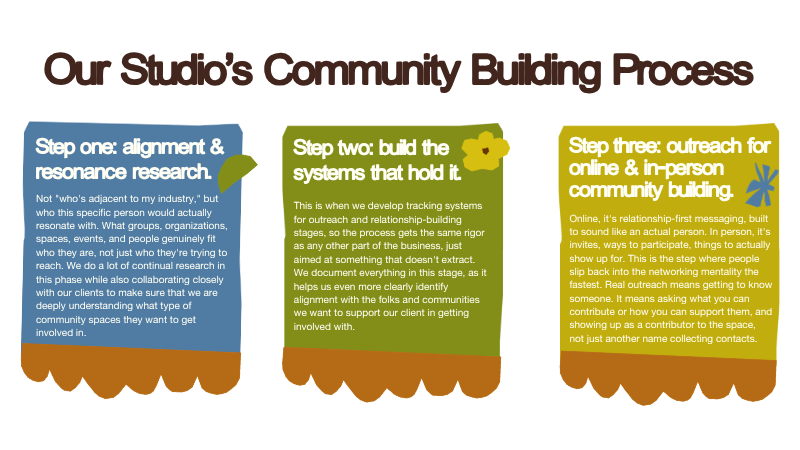
How DoGoodBiz Studio supports clients with community-building strategy
This isn't just how I try to live personally. It's the process we use with clients at DoGoodBiz Studio when building a community or outreach strategy, whether it's online or in-person. Here's what it sometimes looks like…
Through all three steps, we're tracking the same core question the whole way: what can be contributed to this space, before we ever ask what can be gained from it. Alignment first. Contribution before ask. Relationship over reach.
Which question are you asking?
Notice it this week. At an event, in a DM, at the table you're sitting at that isn't yours. Are you asking what can this do for me, or are you asking what can I offer this space?
Capitalistic systems will keep following you into every room, unless you actually replace their operating systems with new ones. That replacement isn't just a mindset shift you do once. It's an ongoing practice.
If you're building (or wanting to build!) this kind of community-building ecosystem, online or in person, and you want a partner to help you navigate it, this is something I am becoming more and more passionate about supporting folks with. We offer both community-building and outreach services within DoGoodBiz Studio, so reach out if you'd like to chat about it, and we can craft an approach that is completely catered to you!
Hi, I'm Natalie Brite, nonbinary creative and founder of DoGoodBiz Studio.
I work at the intersection of creative liberation and social responsibility, partnering with independent businesses, sole proprietors, and values-led creatives on the full range of what it takes to build a meaningful movement: brand ecosystems, web design, content management, marketing strategy, and the harder conversations about ethics that most of the industry is still avoiding.
Follow along on Substack for more.
