

Stop Saying the Words. Start Doing the Work.
Somewhere right now, someone is selling a $5,000 mastermind with the word "abundance" in every marketing promotion, while their own team is barely being paid a living wage. Somewhere right now, a wellness brand is posting about rest and boundaries while the person who wrote that caption hasn't taken a day off in six months. Somewhere right now, someone is running a paid "community" that's really just a sales funnel with a group chat attached. Somewhere right now, a climate-conscious brand is captioning an AI-generated forest with "protecting what we love." Somewhere right now, an "ethical" coach is calling a client's "I can't afford this" a limiting belief instead of a fact.
Maybe you're using some of this language to describe your own work. But the difference likely is that you're backing that language with intention, with practice, with years of decisions nobody sees. The words may be identical. What those words are standing on is what's different.
That's the actual issue. Not that the words got used, but that anyone can claim anything they want without being accountable to said claims.
Why Values-Led Language Stopped Meaning Anything
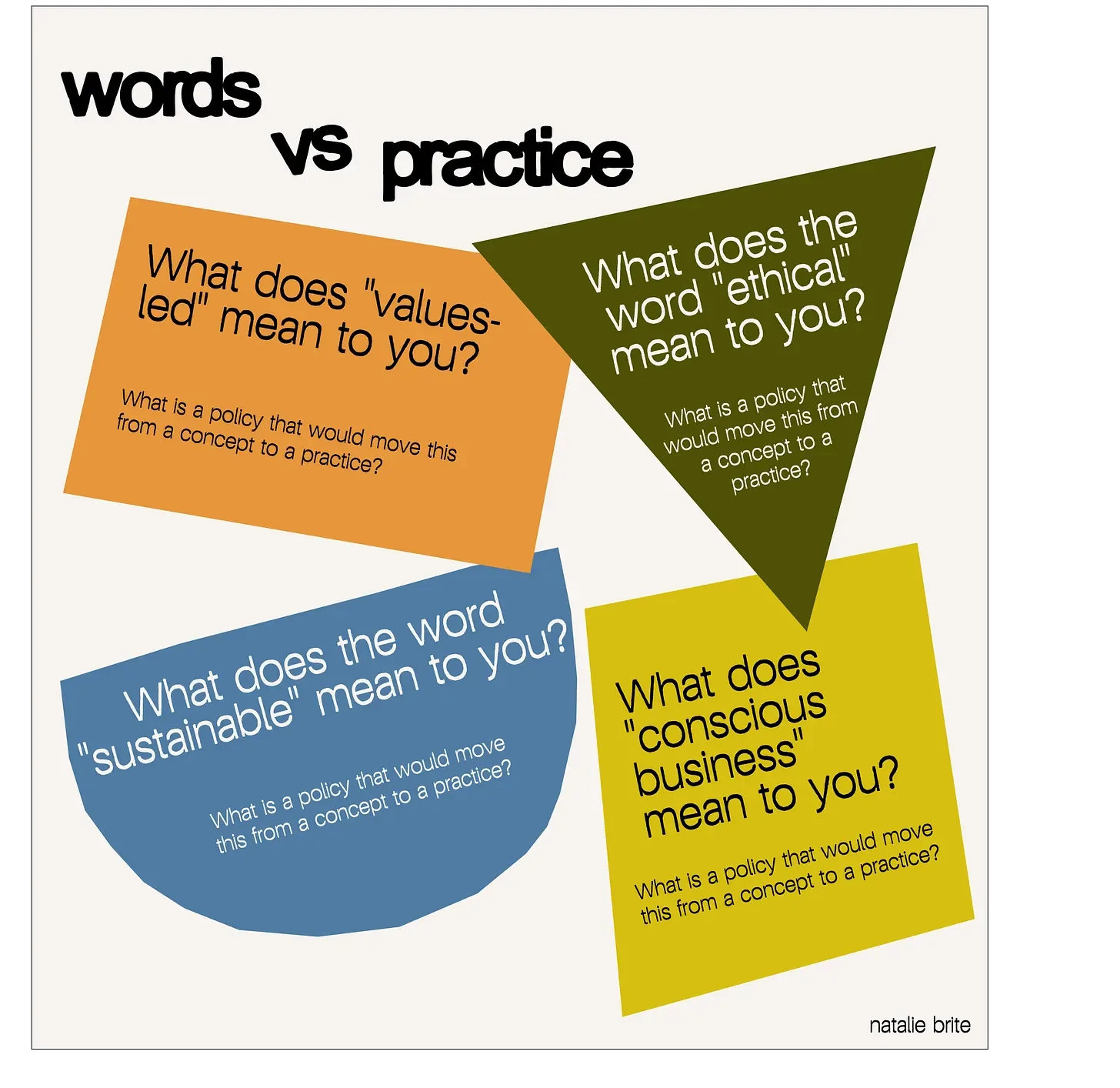
Words don't become meaningless by accident. They get extracted, same as everything else under the system we find ourselves in: find something with value, strip the part that means anything to anyone, keep the part that sells. "Sustainable" used to mean structural change. Now it means a recyclable mailer. "Values-led" used to mean turning down money that compromised the work. Now it means a mission statement nobody in the building actually practices.
The word survives. The stakes don't. That's the whole trick, and it works on a loop, because we don't often audit or examine our vocabulary the way we should.
I can't tell you how much time I've spent trying to find words that feel like they adequately reflect the work I do and what I stand for, without having been co-opted yet. I've pulled up the thesaurus more times than I'd like to admit, hunting for language that hasn't been contorted.
What I've learned over time is that anyone can say "values-led." Try this instead: I turn down a third of inquiries because the timeline requires my team and me to overwork and be underpaid. There are plenty of folks claiming they stand for something but not actually making the tough decisions that standing on it requires.
Anyone can say "ethical business." Try this instead: I don't promise results in my marketing that depend on circumstances I don't control. That's not just using language. That's how language becomes policy. You can't co-opt a policy. You can only either do it or not.
When the Medium Contradicts the Message
Lately, I've been noticing something more often than not while scrolling social media. It goes something like this: an environmental brand I've followed for years posts a campaign graphic, and something about it is immediately, unmistakably obvious. The imagery has that particular uncanny quality that points to it being AI-generated. I can spot it quickly, and I feel a wave of disappointment when it happens, because it's telling that folks who claim to be people-and-planet-conscious then go and generate images using technology that is greatly harming the planet and people.
When an organization whose entire identity is built around care for the living world, around the argument that how we do things matters as much as what we do, reaches for an AI image generator because it's faster or cheaper, something breaks in the coherence of what they're saying. The medium contradicts the message.
I understand the headspace that got them there. Running a mission-driven organization can be really hard. Budgets are thin, timelines are tricky, and the gap between the values you hold and the resources available to live them out fully is often challenging. I'm not interested in shaming anyone for navigating that gap imperfectly.
But it still matters to name: the AI flyer is often a symptom of a deeper pattern. And that pattern, the willingness to compromise values when the easier or cheaper or more fundable path is available, is something I've been seeing regularly.
I've watched individuals speak beautifully about ethics, about community accountability, about refusing to participate in extractive systems. Then watched those same folks make decisions about partnerships, about money, about who gets a seat at the table, that directly contradict those commitments. The pressure to survive, to secure dollars, to maintain a relationship can feel relentless. Values, it turns out, are the thing that often gets set aside when the stakes feel high enough.
The coherence between what we say and what we do is not a nice-to-have. It's the whole point. It's what makes the work truthful instead of performed. And it's worth protecting in every decision, even when there's an easier path available.
If you've felt disappointment from working with someone who talks about values but moves away from them when it's convenient, you know what I mean. And if you're determined not to let that happen in your own work, that determination is the actual practice this article is speaking to.
This is where accountability comes in.
A policy only means something if someone's checking whether you actually kept it. Not a client. Not the algorithm. You, and the people close enough to your work to call things out when it slips.
Most of us were never taught how to hold accountability without it turning into shame or punishment. So we avoid it entirely, and the words we use wind up meaning whatever's convenient again.
Six Ways to Turn Values Into an Actual Business Policy
Turn one refusal into a written policy. Chances are, you've already said no to something: a client, a timeline, a budget that didn't work. Write down the actual rule behind that no, in one sentence, and use it the next time instead of deciding fresh under pressure (or forgetting to apply it at all). This may even need to go into your agreements and contracts.
Publish one specific thing you've never said publicly. It doesn't have to be your whole philosophy. One number, one policy, one boundary is enough to start building the muscle. What you charge, what you won't do for any amount, how you handle a client who oversteps. Specificity is uncomfortable because it's checkable. That's the point.
Find one person who's allowed to ask you the hard questions. Maybe it's a friend, a peer, a collaborator, someone who has permission to say, "Is that in alignment, or is that the version you wish were in alignment?" Line up these conversations on purpose so you can hold yourself accountable.
Trace one dollar. Pick one thing you regularly pay for, a tool, a platform, a supplier, and find out what they actually fund, support, or believe in. You don't have to overhaul your whole life this week. Just follow one dollar all the way to where it lands and compare it with your non-negotiable values. If you find misalignment, it's time to bless and release.
Say the harder stuff out loud. Not just the stuff that sounds good or pleases others. The stuff that's actually true and slightly uncomfortable to admit. "I haven't turned down enough." "I don't actually know what I'm not looking at." Practice starts with an honest look at where there's room to improve.
Set a repeat date with yourself. A recurring, unglamorous check-in, quarterly, on your calendar, where you ask what you claimed and what you actually did. Practice isn't a decision you make once. It's a rhythm you keep committing to. Think of your values as a relationship. It requires showing up for it to stay healthy.
Living Your Values Beyond the Business
This is the part people don't usually want to hear, because it's inconvenient in a different way. An ethical practice that only shows up in your client contracts and your About page isn't a practice. It's a brand voice.
What are you actually consuming, and from whom?
What are you purchasing, and what does that money fund on the other end?
Who are you supporting and amplifying with your attention, your platform, your dollars, and who are you ignoring because it's easier, without admitting it?
Where does your time actually go versus where you'd say it goes if someone asked?
Run the Actual Check
Not the version with a perfectly scripted answer ready. The version where you sit with it long enough to generate honest answers.
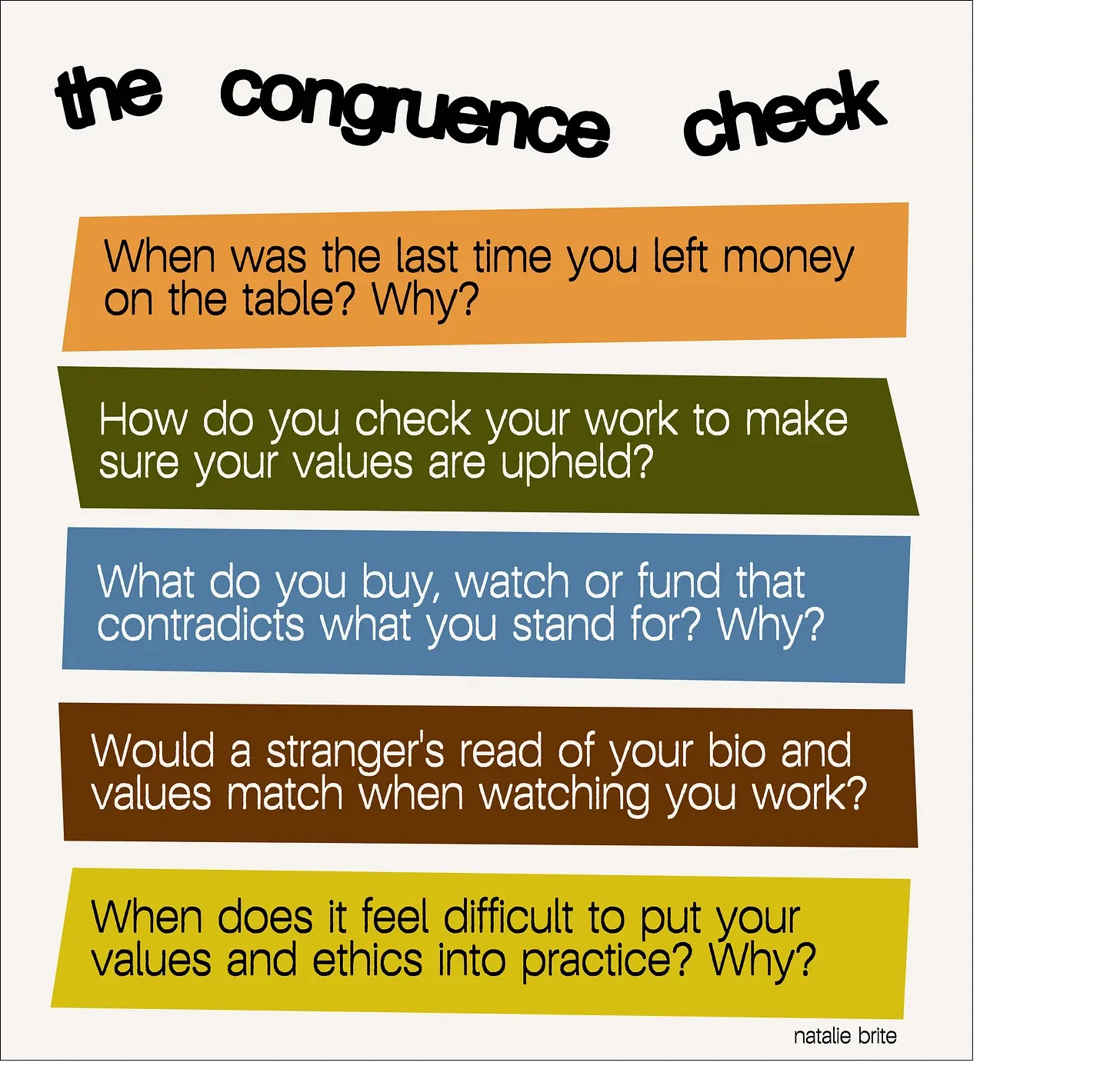
The last time you said no to money, what did you turn down, and why?
Is there a client, project, or partnership you're still saying yes to out of fear rather than alignment?
If someone who knows you well read your bio, then watched you work for a month, would the two match up?
When's the last time someone close to you told you something you didn't want to hear about your own practice, and how did you respond?
What's one thing you buy, watch, or fund right now that contradicts what you'd say you stand for?
Who are you supporting because it's easier, safer, or better for your numbers?
What's the last thing you shared or promoted that you didn't fully believe in?
What's something you claim matters to you that hasn't gotten your attention in months?
What would you have to give up to actually live the values you claim, and are you willing to?
None of this has to be perfect. Perfect isn't the bar, and chasing it is its own kind of avoidance. But there's a difference between a practice that lives everywhere in your life, imperfectly and messy but still there, and one that only gets performed where people are watching. That difference is the whole thing this piece is circling.
The words were never the point. They were supposed to be shorthand for a practice. The unfortunate part is that the system we exist in has figured out it's possible to keep the shorthand and skip the practice entirely. That's not a language failure. That's capitalism doing exactly what it does to everything it touches: extracts.
So let's stop protecting the words, and instead start protecting the stuff underneath the words. Say what you actually stand for, specifically, until the words don't matter anymore because the practice speaks for itself. I'm working on this just like the next person. Not because I've got it figured out, but because the figuring out is the practice.
Keep the practice louder than the language.
About the author
Natalie Brite (they/them) is a nonbinary creative and founder of DoGoodBiz Studio, an ethical creative studio based in Portland, Oregon. Natalie works at the intersection of creative liberation and social responsibility, partnering with independent businesses, sole proprietors, and values-led creatives on brand ecosystems, web design, content strategy, and the harder conversations about ethics most of the industry is still avoiding.
Want more essays like this one? Subscribe to the DoGoodBiz Substack for monthly field notes on values-led business and creative liberation.
