

Building a Values-Led Brand in Portland: What Makes It Different Here
There's a particular kind of conversation that happens in Portland that I don't think happens quite the same way anywhere else.
It happens at the farmers market when the person selling you fermented hot sauce starts talking about their cooperative ownership structure. It happens at the coffee shop when the barista mentions the worker-owned model, and you realize the tip jar is distributed differently than you assumed. It happens in the healing arts studio, the community garden, the zine library, the mutual aid network meeting… this ongoing, overlapping, sometimes exhausting, always alive conversation about how to do things differently.
Portland has been having this conversation for a long time. And if you're building a values-led brand here, that context is both your greatest asset and one of your most specific challenges.
The opportunity is real, and so is the noise
Portland has a higher density of conscious, values-led businesses per capita than almost anywhere in the country. That's really good news if you're building something rooted in ethics, ecology, or community care… your people are here; they're looking for what you're offering, and they're more sophisticated about the difference between performative values and practiced ones than almost any other market.
But it also means the noise level is high. Most people in Portland has a mission statement. Most brands have a sustainability commitment. It’s not uncommon for a studio, practice, or small business to have some version of "community-centered" or "values-led" or "ethical" in their copy somewhere. The bar for what those words have to mean to actually land (or actually be believed) is higher here than it is almost anywhere else.
Portland audiences have finely tuned radar for the gap between what a brand says and what it actually does. They've been burned by greenwashing, mission-washing, and values-as-marketing-strategy before. They're not cynical, but they are discerning.
What actually works here and why
Specificity over aspiration
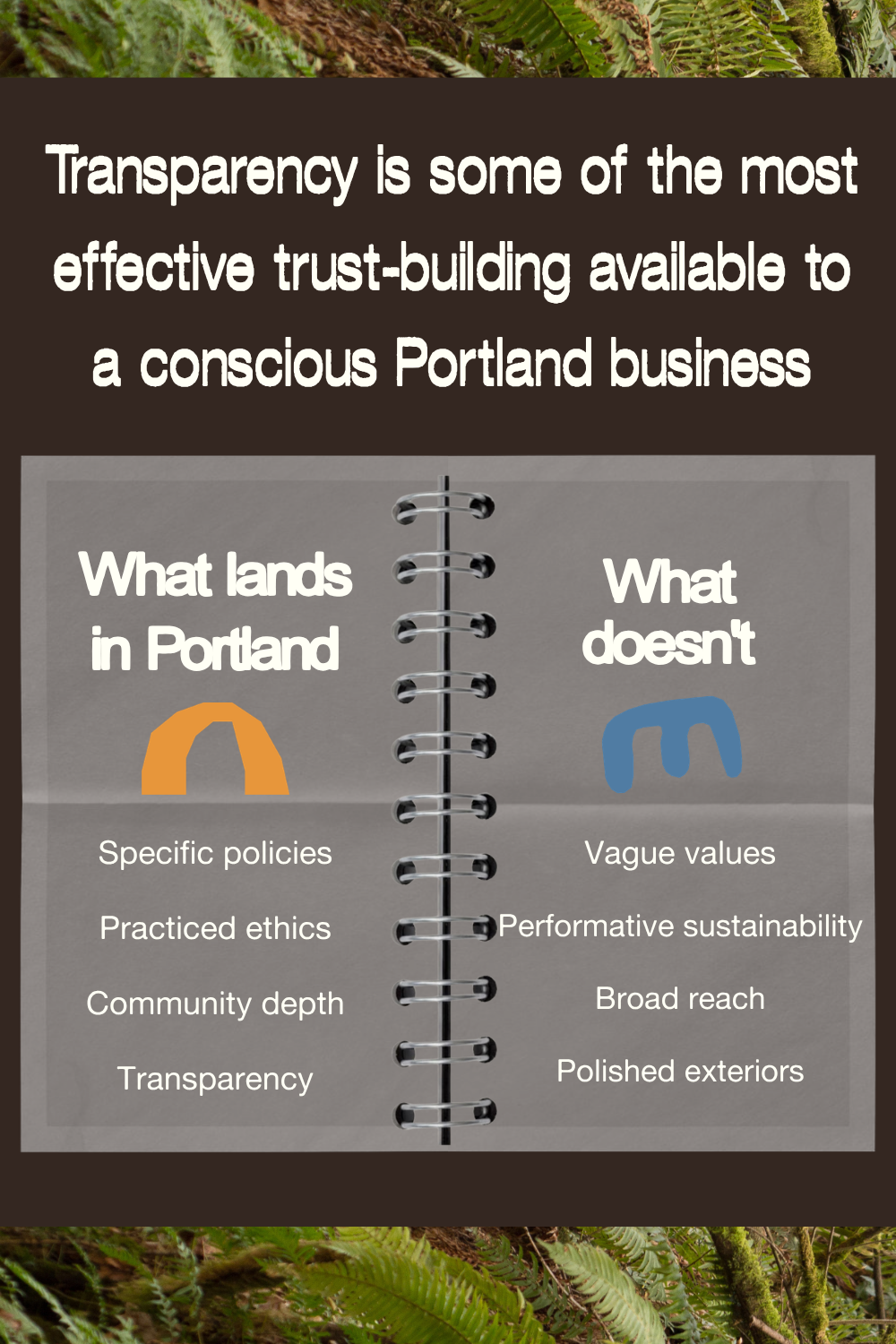
Vague values statements don't land in Portland the way they might in markets with less conscious business saturation. "We care about community" is table stakes. What lands is specificity: what you actually do, what you actually turn down, what you've actually built differently because of what you believe.
The businesses I've watched build genuine trust and loyal communities in Portland tend to say things like: we source exclusively from PNW makers. We cap our client load at four projects a month even when we need the revenue. We allocate 10% of profit to mutual aid every quarter regardless of how the month went. These aren't aspirational statements; they're policies. And in a market this discerning, the difference between a statement and a policy is everything.
Rootedness over reach
Portland's conscious business culture is skeptical of scale for scale's sake, and rightfully so. The pressure to grow fast, expand everywhere, build an audience rather than a community, is something many Portland business owners are actively resisting. That resistance is a feature, not a bug. The brands that thrive here tend to be deeply rooted in specific communities, specific relationships, specific places, and they let that depth be the differentiator rather than trying to compete on reach.
This has real implications for how you brand. A Portland-based healing practice doesn't need to look like it could be anywhere. It should look like it's from here… from this landscape, this culture, this particular constellation of values that the PNW has been cultivating. Trying to make your brand look generically national to reach a bigger audience often costs you the local depth that's your actual competitive advantage.
Relationships before marketing
The most effective marketing strategy for a conscious Portland business is rarely a content calendar or a paid ad campaign. It's relationships. Referrals. Showing up at the right community spaces. Being known by the right people. Cross-promoting with aligned businesses. Hosting something intimate and letting the room do the work.
This isn't just a values preference; it's a practical observation. Portland's conscious business community is networked in ways that reward genuine participation and penalize performative visibility. Being known as someone who shows up, collaborates generously, and does what they say they're going to do is worth more here than a perfectly optimized Instagram presence.
Transparency as a brand practice
Portland businesses that talk openly about their pricing, their process, their mistakes, and their ongoing questions tend to build deeper trust faster than those that maintain a polished, finished exterior. This isn't universal, but it's more true here than in most markets.
The audience you're building for in Portland has often been through the experience of a brand that looked good from the outside and disappointed up close. They're looking for evidence that what's on the inside matches what's on the outside. Transparency about how you price, why you made a particular decision, and what you're still figuring out is some of the most effective trust-building available to a conscious Portland business.
What makes branding different here
When I work with Portland and PNW-based businesses, a few things come up consistently that don't come up in the same way with clients elsewhere.
The anti-aesthetic tension
There's a particular Portland tension around aesthetics, a cultural suspicion of anything that looks too polished, too designed, too much like it's trying. This is rooted in a genuine value: authenticity over performance, substance over surface. But it can sometimes work against conscious business owners who interpret it as meaning their brand shouldn't be beautiful or considered.
The resolution isn't to make something deliberately rough or undesigned. It's to make something that feels genuinely made rather than manufactured, where the craft is evident, the choices are clearly intentional, and the aesthetic emerges from the values rather than being applied over them. Portland audiences can feel the difference between design that's performing coolness and design that's expressing something true. The goal is the latter.
The cooperative and collective question
A significant portion of the conscious businesses I work with in Portland have some element of collective or cooperative structure, shared ownership, collective decision-making, community governance. This creates specific branding challenges that most branding frameworks aren't designed for: how do you build a coherent brand identity when there isn't one founder or one singular voice? How do you communicate collective ownership without it becoming unwieldy? How do you honor the complexity of shared governance in a brand that also needs to be legible to people encountering it for the first time?
These are questions worth asking early, before the brand is built, because a brand designed around a single founder's voice and presence becomes a liability if the business is genuinely collective.
The landscape as reference point
The PNW landscape- old-growth forests, coastal estuaries, volcanic mountains, river systems, the particular quality of light in every season- is a genuine reference point for the values that conscious businesses here tend to hold. Ecological thinking, seasonality, reciprocity, the long arc of regeneration rather than the short arc of extraction- these aren't abstract philosophies in this landscape. They're visible everywhere you look.
The best Portland branding I've seen draws on this, not superficially, with fern illustrations and moss-green color palettes, but at the level of values and structure. A business that actually operates on ecological principles, that thinks in seasons, that prioritizes regeneration over growth, that understands itself as part of an ecosystem rather than a standalone entity, can let that show up in how it presents itself without resorting to visual clichés.
A practical starting point
If you're building or rebuilding a brand as a conscious Portland business, here are the questions worth sitting with before anything gets designed:
What's your policy, not just your value? For each thing you say you stand for, can you name a specific operational decision that reflects it? If not, that's the work to do before the brand work begins.
Who are you in relationship with? Portland branding works best when it's rooted in specific community relationships rather than a generalized audience. Who are your actual people? What spaces do they inhabit? What do they already know and trust?
What do you want to be legible to locally, and what do you want to be findable for more broadly? These aren't always the same thing, and your brand architecture might need to hold both… a local presence that feels rooted and specific, and a digital presence that can reach aligned people beyond the PNW.
What does the landscape have to teach your business? Not as a metaphor, as a structural question. How does your business move through seasons? What does reciprocity look like in how you price and offer? What are you composting, and what are you growing toward?
If you're building something here
DoGoodBiz Studio is a Portland-based ethical creative studio, and this city and this landscape are genuinely present in how we work. If you're a Portland or PNW-based conscious business looking for a creative partner who shares your context, knows these communities, and can help you build a brand that's as rooted and specific as the work you're doing, we'd love to hear what you're building.
The inquiry form is always open. So is the conversation.
