

When to Prune and When to Compost: A Values-Led Guide to Brand Refreshes and Rebrands
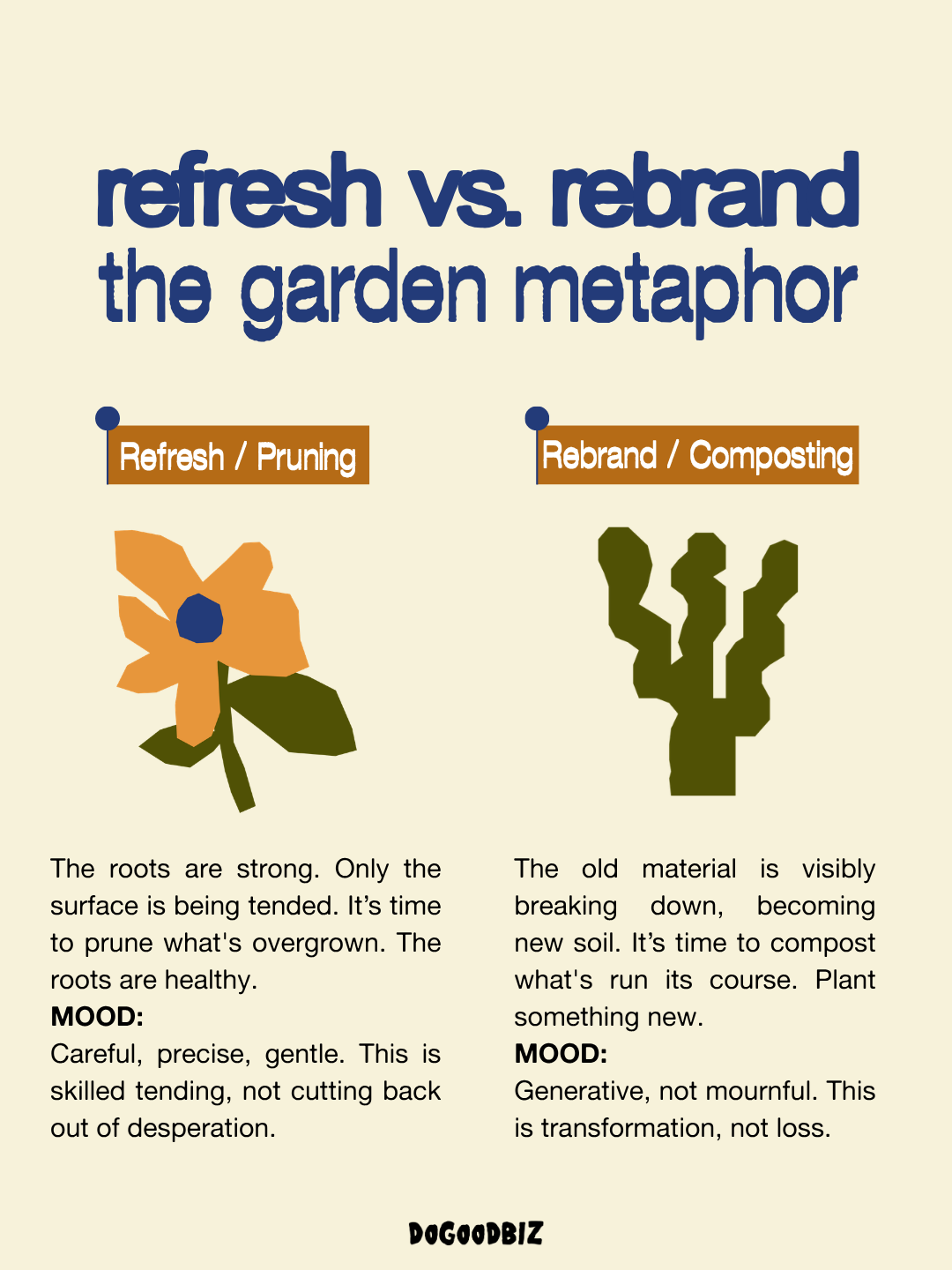
In a garden, you learn quickly that not every problem calls for the same intervention.
Sometimes a plant is struggling because it needs pruning… the old growth is blocking light, crowding the new shoots, holding energy that could go somewhere more helpful. You don't just dive into the garden and begin pulling it up. You cut back what's no longer serving it, and it comes back fuller, more itself, better able to do what it was always trying to do. I’ve learned this lesson greatly while educating myself on how to take care of the rose bushes we inherited when we bought our home. Prior, I had absolutely no knowledge of tending to rose plants, other than that I heard how difficult they can be to take care of. I started reading and learning as much as I could to help me properly care for our bushes, and quickly gathered the importance of proper pruning. The first summer that I started really getting the hang of pruning my roses, I saw an absolutely incredible thing take place: The roses began gaining multiple budding cycles, where we gained so many more flowers than any year prior. The more I learned how to properly prune, the more lush and healthy the roses became.
Other times, something has died at the root. Or the soil is depleted. Or the plant has run its course… or the conditions have changed so fundamentally that what's there can no longer be revived. You don't prune that. You compost it, letting it break down into something that feeds what comes next… and you start again with new seeds, new soil, a new understanding of what this particular patch of ground wants to grow. I had an experience related to this process of composting and starting again when a neighboring lot to our home cut down a bunch of red cedar and big leaf maple trees, causing a large portion of our land to begin receiving far more direct sunlight than it was used to. I noticed quickly how much this drastic change in sunlight began impacting our plants. Woodland natives started drying out and shriveling up. Shade plants were not tolerant of the sun at all and began to die. I knew then that I was going to have to rework some of our garden beds and landscaping to account for this change in light, causing me to have to remove some plants entirely that no longer fit the environment that they were planted in.
Brand work operates on similar logic.
A brand refresh is pruning. A rebrand is composting and replanting. Both are necessary at different moments. Confusing one for the other, such as pruning when you needed to compost, or pulling everything up when a careful cut would have done, costs time, money, and the particular kind of energy that goes into rebuilding something from scratch when you didn't need to.
This piece is a guide to telling the difference.
What the garden teaches us about brand evolution
Living systems don't stay static. They move through seasons, cycles of growth and dormancy, periods of abundance and periods of composting down. A garden that was thriving three years ago looks different today, not because something went wrong, but because living things change. The question is never whether your brand will need to evolve. It's how, and when, and how deeply.
Most brand advice treats a refresh or rebrand as a response to a problem… something to do when things aren't working, when the aesthetic feels off, when you're embarrassed by your website. And while those are real signals worth paying attention to, they're symptoms. The underlying question is ecological: what has actually changed in the conditions that your brand is growing in? And what kind of intervention does that change call for?
Pruning: what a brand refresh actually is
Pruning is precise. It's targeted. It removes what's overgrown or blocking light without disturbing the root system, the deep structure that holds everything together.
A brand refresh is the same. It's for when the roots are healthy, the values, the positioning, the essential identity of what you're building, but the visible growth has become tangled, overgrown, or out of shape relative to where the plant wants to go. The refresh cuts back what's no longer serving the brand's expression and lets the underlying identity come through more clearly.
In practice, a refresh might look like:
A color palette update that brings the existing identity into sharper alignment with who you've become
A typography refresh that elevates the aesthetic without changing what the brand is communicating
A logo refinement that keeps the essential mark while making it more considered and versatile
A website redesign that applies the refreshed visual language across a structure that's fundamentally still right
What a refresh doesn't touch is the root system: the positioning, the audience, the values, the core story of what you're building and why.
Our client, Mollie Birney, is a good example of this. After several years of working together (building her service suite, developing her content ecosystem, growing her audience and her community) her brand aesthetic had stopped keeping pace with where she'd arrived. Her positioning was strong. Her voice was clear. Her community was growing. What she needed was a visual language that matched the level of sophistication her work had reached. We refreshed her color palette, updated her typography suite, redesigned her logo suite, and rebuilt her website from scratch. The roots were healthy. What we did was prune, carefully, intentionally, so the plant could show up as fully itself.
Signs you need to prune:
The visual identity feels dated or inconsistent, but the overall sense of who you are and who you serve still feels accurate
You've grown in confidence, and the brand feels like it's lagging aesthetically rather than conceptually
You're using a DIY logo or early-days identity that was always meant to be temporary
The bones are right, but the execution feels rough or unpolished relative to where the work has gone
You want to feel prouder of your visual presence without fundamentally changing what it's communicating
Composting and replanting: what a rebrand actually is
Composting is a different kind of intervention entirely. It doesn't preserve, it transforms. It takes what has lived its life and breaks it down so the nutrients it holds can feed something new. You don't compost a plant that just needs pruning. But when something has truly run its course, when the soil is depleted, the conditions have changed, the plant can no longer grow where it is, composting is not a failure. It's the ecosystem doing exactly what it's supposed to do.
A rebrand is composting. It takes what exists, honors what it contributed, and lets it break down into the foundation for something that fits where you actually are now and where you're actually going.
A rebrand is for when something more fundamental has shifted (your audience, your positioning, your values, your understanding of what you're actually building) and the existing brand can't hold that shift without being essentially rebuilt from the ground up. It's not just updating the aesthetic. It's returning to the soil: reconsidering who you are, who you serve, what makes your work distinct, and building the visual and verbal identity from those answers.
In practice, a rebrand looks like:
A full brand strategy and positioning process (discovery conversations, audience research, values clarification) before any design work begins
New visual identity developed from the strategic foundation rather than evolved from the existing one
New verbal identity (voice, messaging, positioning language) that reflects where you actually are now
A website rebuild built around the new brand rather than updated to accommodate it
Signs you need to compost and replant:
Your audience has fundamentally shifted: you're trying to reach different people than you were when the brand was built
Your positioning has changed: you've added, removed, or significantly pivoted your core offerings
The values or philosophy behind your work have evolved in ways the existing brand genuinely can't hold
You're not just aesthetically embarrassed by your brand: you're conceptually embarrassed. It's telling a story that's no longer true.
You've outgrown the identity rather than just the aesthetic: the name, the positioning, the language, the visual direction all feel like they belong to an earlier version of the business
You can imagine updating the colors and fonts and still feeling like something fundamental is off
The question that tells you which one you need
Both pruning and composting start with the same diagnostic question: what has actually changed?
If what's changed is primarily how the brand looks and feels relative to where you've grown (the aesthetic has lagged behind the growth) you're probably pruning.
If what's changed is what the brand is communicating, who it's for, what it stands on (the identity has lagged behind a fundamental shift in the work) you're probably composting and replanting.
The clearest test: if you can imagine updating the colors and fonts and feeling genuinely better (more represented, more aligned, more proud to share it) you probably need a refresh. If you can imagine doing that and still feeling like something essential is off, you probably need a rebrand.
What goes wrong when we confuse the two
Pruning when you needed to compost
This is the more common mistake. You refresh the aesthetic (new colors, new fonts, maybe a new logo) but the positioning was actually what needed to change. Six months later the brand looks better but still doesn't feel right, because the thing that was off wasn't the visual language. It was the story underneath it.
This often happens when the rebrand conversation feels too big, too expensive, or too uncertain. A refresh feels more manageable. But a refresh built on a foundation that no longer fits is a bandage over something that needed surgery.
Composting when you needed to prune
Less common but equally costly in a different way. You pull everything up (the name, the visual identity, the positioning, the website) when what actually needed attention was a careful aesthetic update and maybe a clearer articulation of what you already had. You lose the equity you'd built, the recognition you'd earned, the coherence that came from having a consistent identity over time.
This often happens in moments of creative restlessness; when you're bored with what you have, or when you've been consuming a lot of other people's brands and have started to feel like yours isn't enough. Restlessness isn't always a signal to compost. Sometimes it's a signal to prune.
A third option: tending the soil before doing either
There's a season in the garden before either pruning or replanting; a season of assessment. Of getting your hands in the soil, understanding what's actually there, what the conditions are, what the plant actually needs before you pick up the shears or the compost fork.
In brand work, this is the strategy conversation. And sometimes, especially if you're in a period of genuine transition, if the direction isn't quite clear yet, if you're still figuring out what you're moving toward, the most useful investment is tending the soil first. Getting clear on the positioning before any design decisions are made.
Brand work done before that clarity arrives tends to produce a brand that needs to be redone six months later. Brand work done from clarity, from a real understanding of what the brand needs to communicate and who it needs to reach, tends to produce something that holds through seasons.
Which means the first question isn't always "refresh or rebrand?" Sometimes it's "do I have enough clarity about where I'm going to build something that will actually serve me when I get there?"
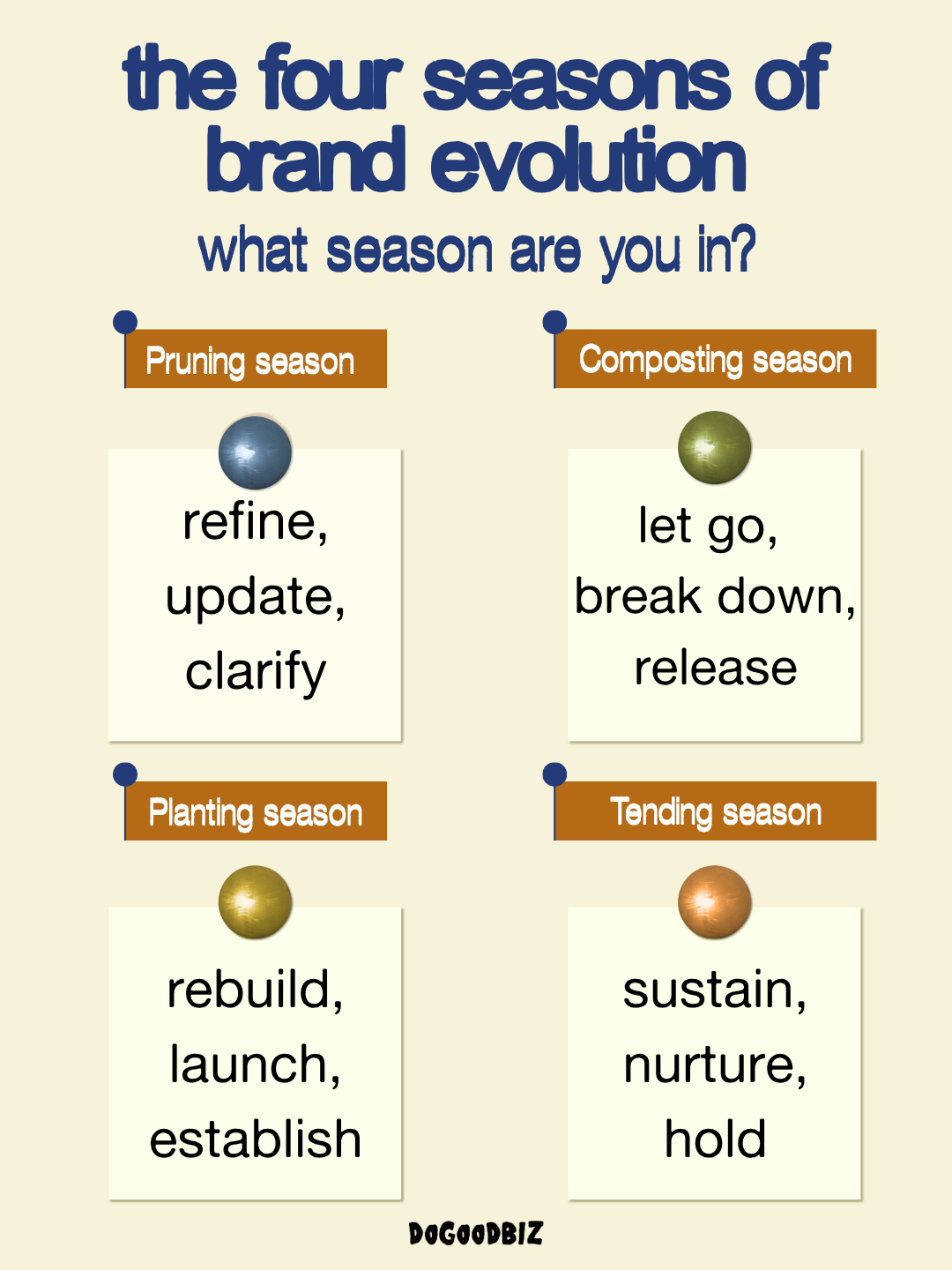
What season are you in?
Every garden moves through seasons… and so does every brand. There are seasons for pruning, seasons for composting, seasons for planting, and seasons for simply tending what's already growing without changing anything at all.
The most important thing is to read your season accurately before you intervene.
If you're sitting with that sense that something needs to shift (that your brand has stopped feeling like you, that the gap between the work you're doing and how the world sees it is becoming noticeable) that feeling is worth paying attention to. It's the garden telling you something.
What it's telling you depends on what's actually changed. And that's exactly what the first conversation is for.
At DoGoodBiz Studio, brand refreshes and full rebrands both live within Take Root: our foundational brand and web engagement for conscious leaders ready to build or rebuild their creative presence right. Every engagement starts with a strategy conversation, which means we figure out together what your brand actually needs before any design decisions get made.
If you're ready to figure out what season you're in, start a conversation →
And if you're still in the assessment phase, Field Notes is where this kind of thinking lives. Subscribe on Substack and we'll keep thinking alongside you.
