

Ecological Roles of Care: An Ethical Business Framework for Creatives & Values-Driven Brands
This framework builds on the idea of the creative ecosystem, if that concept is new to you, that piece is a good place to start.
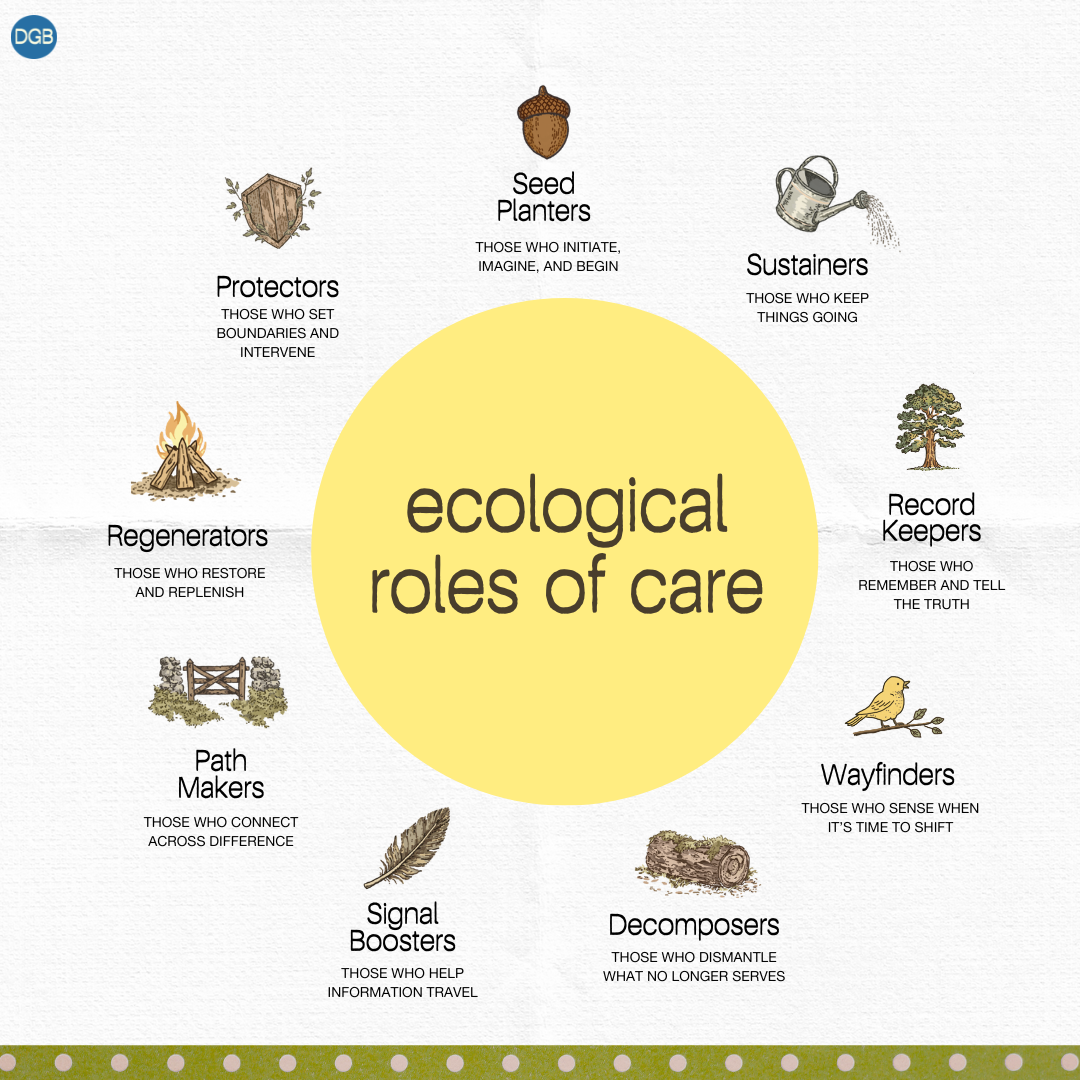
What if the problem isn’t that you’re not doing enough…
What if the problem is that you’ve been trying to carry the weight of the world by yourself?
We are living in a time where the illusion of separation is collapsing.
The illusion that your business is separate from climate collapse. Separate from political violence. Separate from injustice. Separate from collective grief. Your work does not exist in a vacuum.
How you market. How you price. How you source. How you build community. How you speak, or don’t speak. How you respond, or stay silent.
All of it reinforces something. Because every brand upholds values. Every business model mirrors a system. Every marketing strategy either extracts or circulates. Every piece of content either numbs, distracts, inflames, or deepens awareness. There is no neutral. There is only participation.
The question is no longer whether your work impacts the world. It’s whether you’re willing to look at how. Are you unintentionally holding up the very structures you critique? Are you replicating urgency, dominance, disposability, and extraction in the name of survival? Are you operating on autopilot inside “business as usual” because it feels safer than reimagining something different?
Or…
Is it time to shift?
My Ecological Roles of Care framework exists to name something we’ve forgotten:
There are many ways to participate in change. And there are many ways to practice care. You do not need to become someone else in order to matter. You just need to understand the role you are actually resourced to embody, and let that be enough.
Ecological Roles of Care is a framework for people who care about the well-being of people and the planet… but are uncertain about how to act on that care in a sustainable, ongoing way.
This framework is a way of understanding how care, responsibility, and contribution actually function inside living systems… including your business, your brand, your community, and your everyday life.
Instead of asking every individual to:
hold grief, outrage, productivity, and stability all at the same time
filter through misinformation and propaganda while somehow staying grounded
speak with courage and clarity on complex issues without time to process
be perfectly informed, perfectly ethical, and perfectly articulate in public
balance survival, visibility, advocacy, and leadership simultaneously
…it recognizes that resilient systems depend on role diversity, not individual perfection.
No one person is meant to metabolize every headline, decode every narrative, lead every charge, hold every boundary, and restore every wound at once. When we try, we don’t become more impactful. We become dysregulated. This framework interrupts that pattern. It reminds us that courage does not have one form. Responsibility does not have one expression. And impact does not require omnipresence.
When you understand your role, you stop copying other people’s strategies for impact … and you start embodying your own. And that is where your work becomes powerful. This framework builds on the idea that your business is not a machine, but a living system. If you’re new to that concept, start here → A Regenerative Path to Creativity and Business.
How to Determine Your Role
This framework names nine ecological roles that already exist in living systems, and in the ways people are already showing up, and helps you identify your:
Primary role: the way you most naturally contribute
Secondary role: the way you support and extend your impact
Tertiary role: the way you show up situationally or seasonally
Through identifying these roles, you begin to understand:
Your natural approach to impact work and how to weave it into your work and life
Your style of visibility and contribution
Your relationship to advocacy
How you weave ethics into your actions
How you design your business ecosystem in a way that works with who you actually are
Where you are overextending yourself
And where you are under-claiming your power
Step One: Identify Your Primary Role
Your primary role is the one you are already embodying… even if you haven’t named it. It is the way you instinctively contribute. It is how you show up when things feel uncertain. It is the lane you return to after rest.
To identify it, don’t ask: “What do I want to be?”
Ask:
When things feel chaotic, how do I naturally respond?
What kind of contribution feels steady in my body?
What do people consistently come to me for?
What role feels grounding rather than performative?
After I rest, what type of work do I feel resourced to return to?
Your primary role is often:
the contribution you take without being asked
the thing others describe you as
the work that feels “normal” to you but essential to others
If you feel exhausted because you are overextended inside this role, that’s a capacity issue. If you feel exhausted by the role itself, that’s alignment information. Your primary role should feel sustainable at its core, even if the conditions around you are hard. Care as a business practice extends into how we price our work; ethical pricing is one of the most concrete places this framework shows up in daily decisions.
Step Two: Identify Your Secondary Role
Your secondary role is usually something you are skilled at, but it takes more effort than your primary role. It might support your primary role. It might be something you step into when needed.
Ask yourself:
What role can I hold well, but need recovery time after?
What type of contribution feels useful but not endlessly resourced?
Where do I feel competent but slightly strained if I stay too long?
What role supports my primary role rather than replaces it?
Secondary roles are often where burnout happens, because they feel impressive or necessary. But they are not meant to carry your whole identity. They are supportive capacities. Not survival strategies.
Step Three: Recognize Your Tertiary Role
Your tertiary role is situational. You can step into it briefly. You can hold it during a specific moment. But you cannot sustainably live there.
Ask:
What role can I embody occasionally, but not long-term?
What drains me quickly if I try to stay?
What do I respect deeply in others but feel no desire to anchor my life around?
What role feels sharp or activated in crisis but unsustainable in normal rhythm?
Tertiary roles are edges. They are not your core operating system.
A Note on Cultural Pressure and Fantasy Roles
Instead of tryingto become the loudest voice. The fiercest protector. The most radical dismantler. The most tireless organizer. This framework asks a different question: What role can you hold with courage and longevity?
Not what role earns applause. Not what role avoids criticism. Not what role makes you feel morally superior. But what role allows your care to remain intact over time.
The Ecological Roles of Care
Notice which description makes your shoulders drop.
Notice which one feels steady in your body.
Notice which one feels like recognition, not aspiration.
If You’re the One Who Initiates, Questions, and Evolves Things…
If you’re the person who:
sees what’s missing before others do
feels restless inside outdated systems
launches before everything is polished
questions norms others accept
senses when something needs to pivot
gets uncomfortable when things stagnate
You are future-facing. You are culturally catalytic. You are often early.
Your pressure point?
Being asked to prove immediate results in systems that reward certainty.
Your real work?
Expanding what’s possible and interrupting what no longer fits.
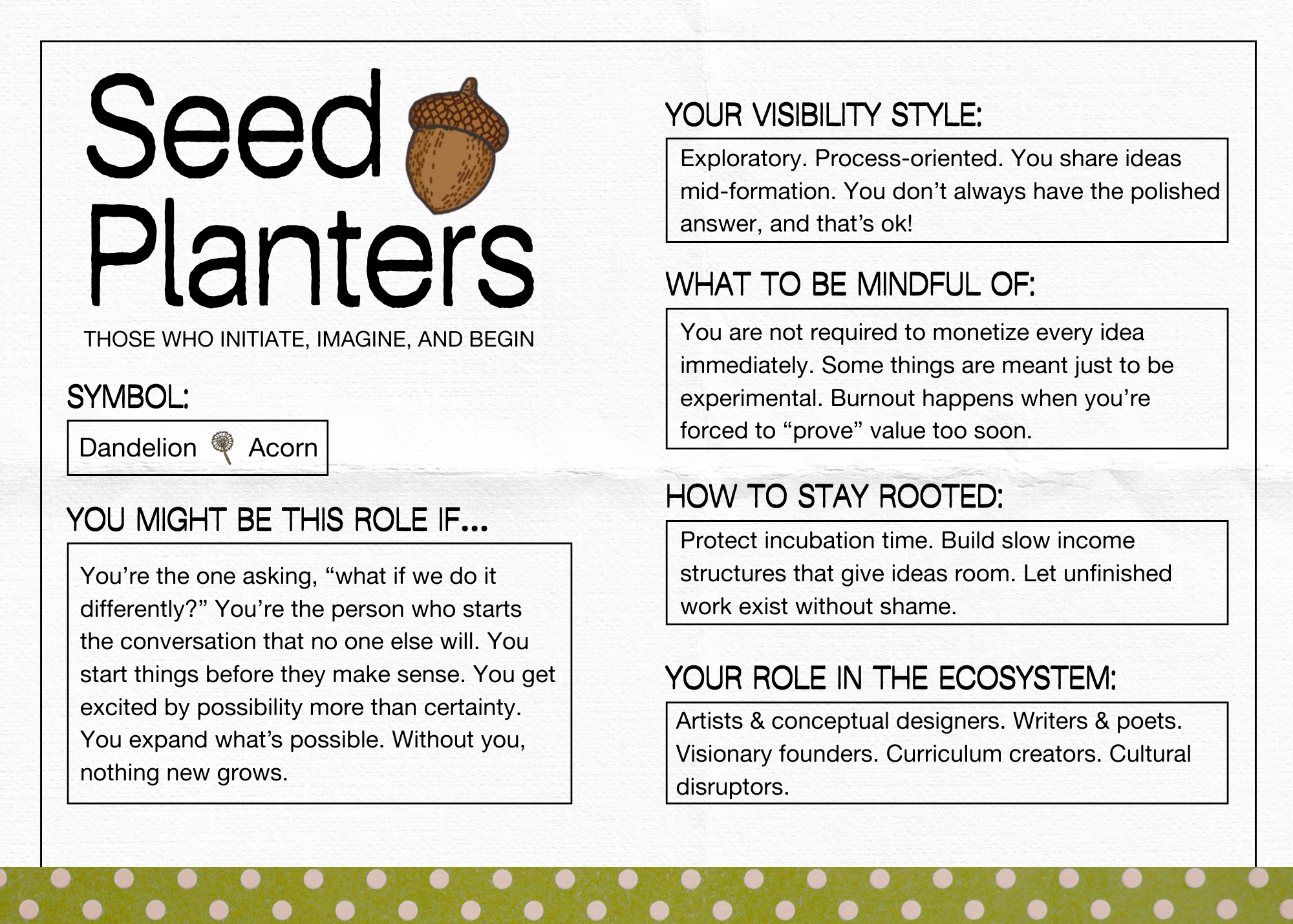
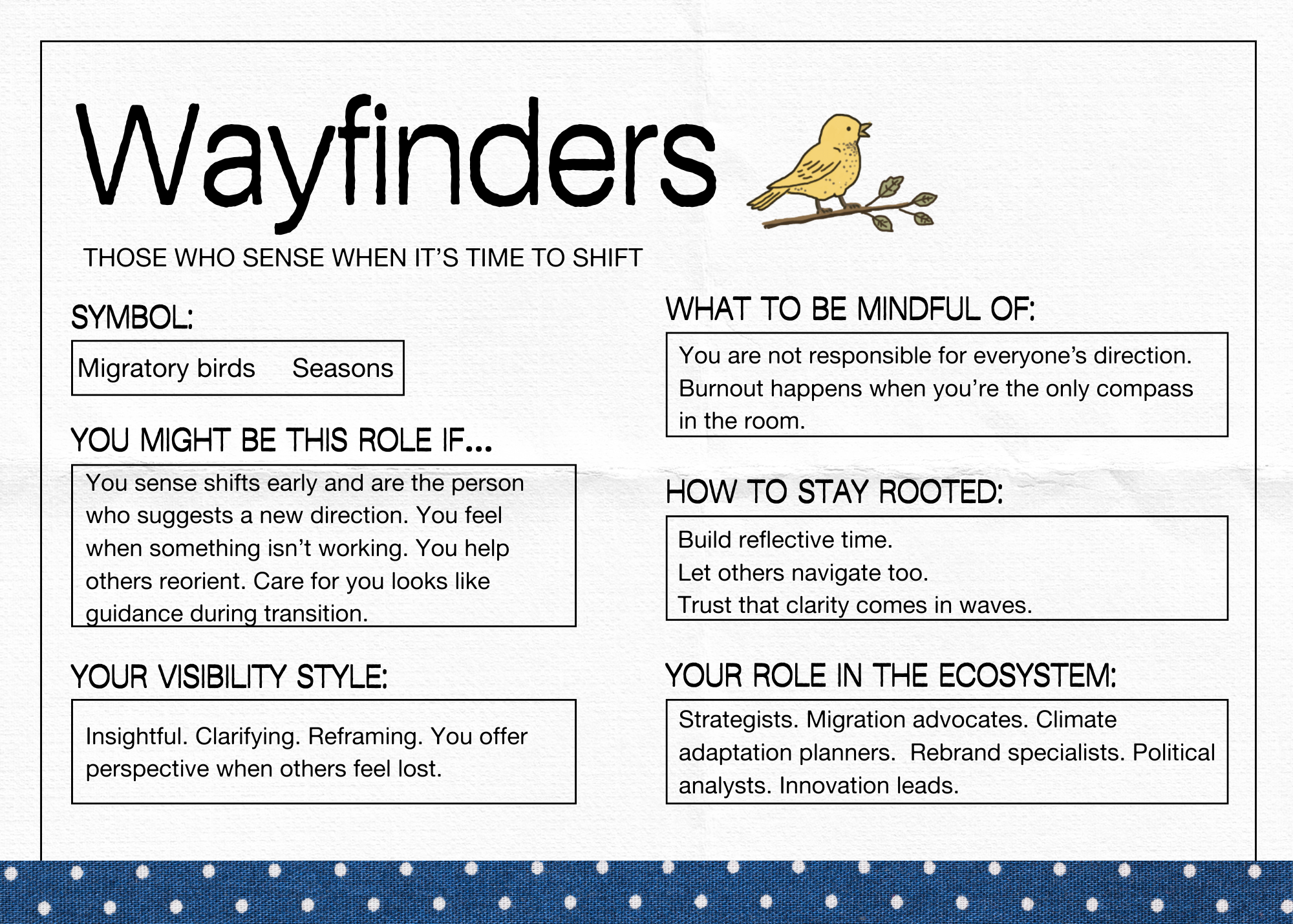
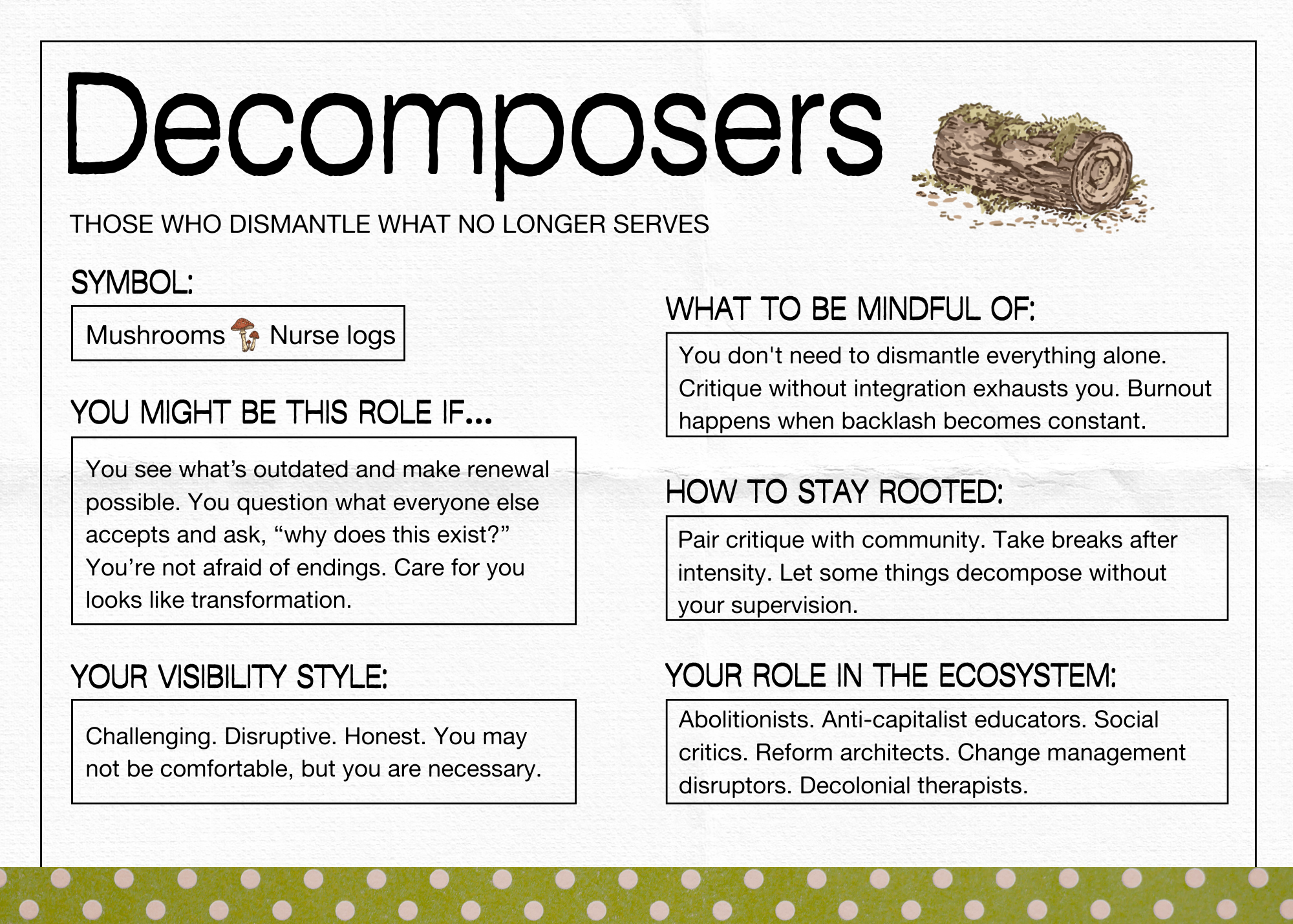
You likely resonate with:
Seed Planters – you initiate what doesn’t exist yet
Wayfinders – you sense when it’s time to shift direction
Decomposers – you dismantle what has outlived its integrity
You are not here to maintain the status quo. You are here to move the system.
If You’re the One Who Stabilizes, Connects, and Sustains…
If you’re the person who:
follows through when others lose momentum
notices misalignment before it becomes collapse
remembers details others forget
introduces people who need each other
cares more about longevity than hype
worries about people burning out
You are steady in movement. You are relational infrastructure. You are often underestimated because your work is not flashy.
Your pressure point?
Being overlooked, over-relied on, or taken for granted.
Your real work?
Making sure what gets built actually survives.
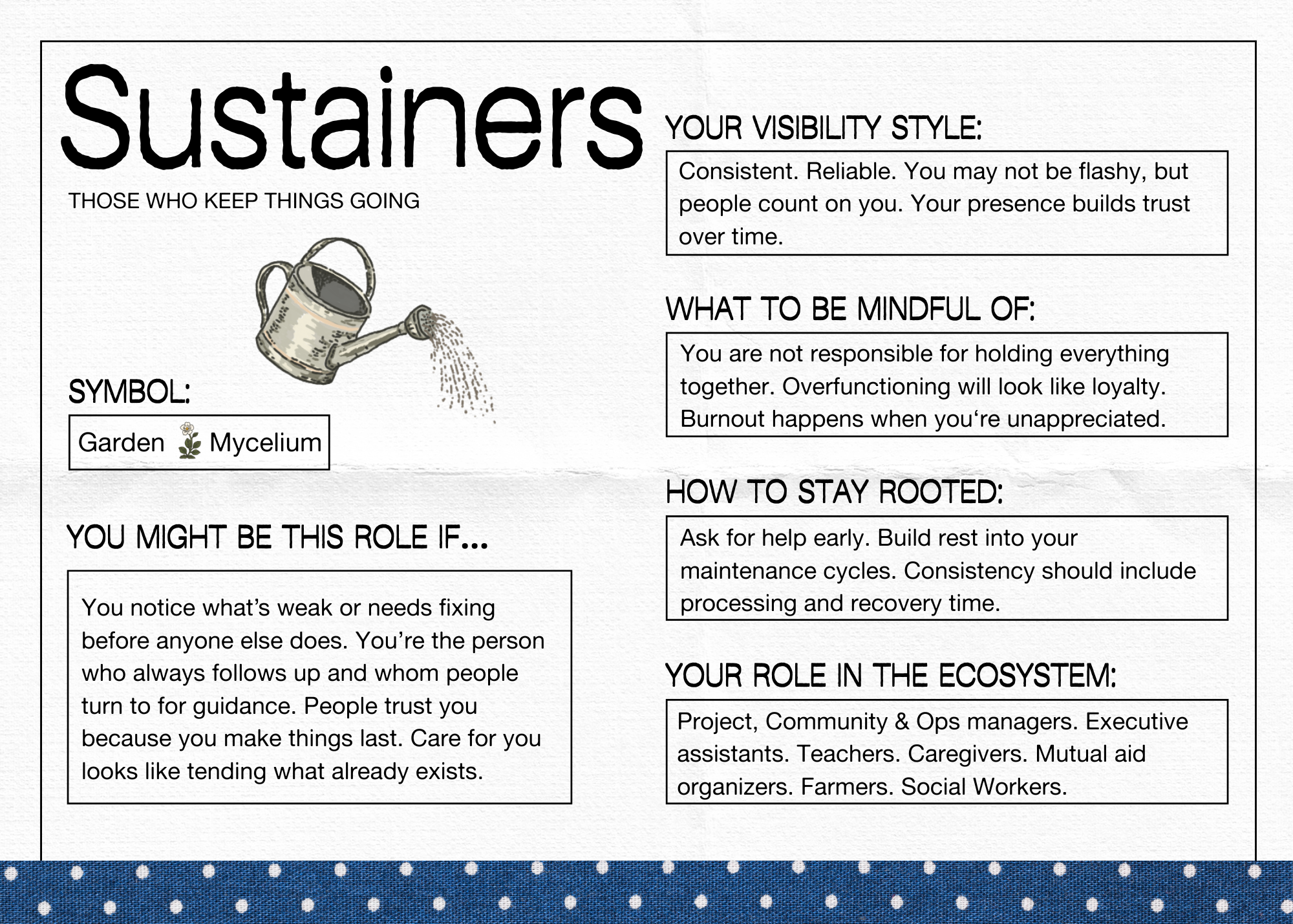
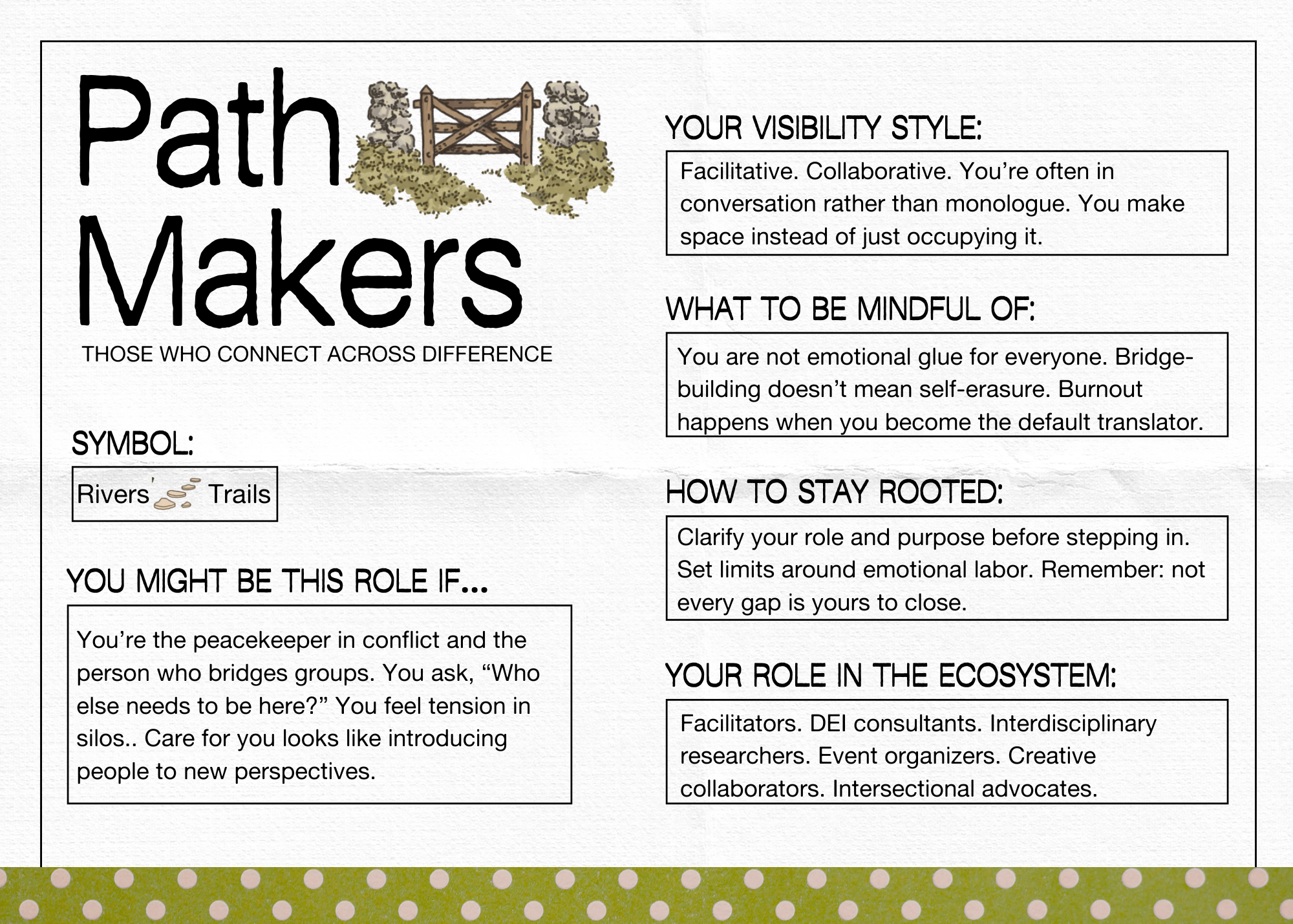
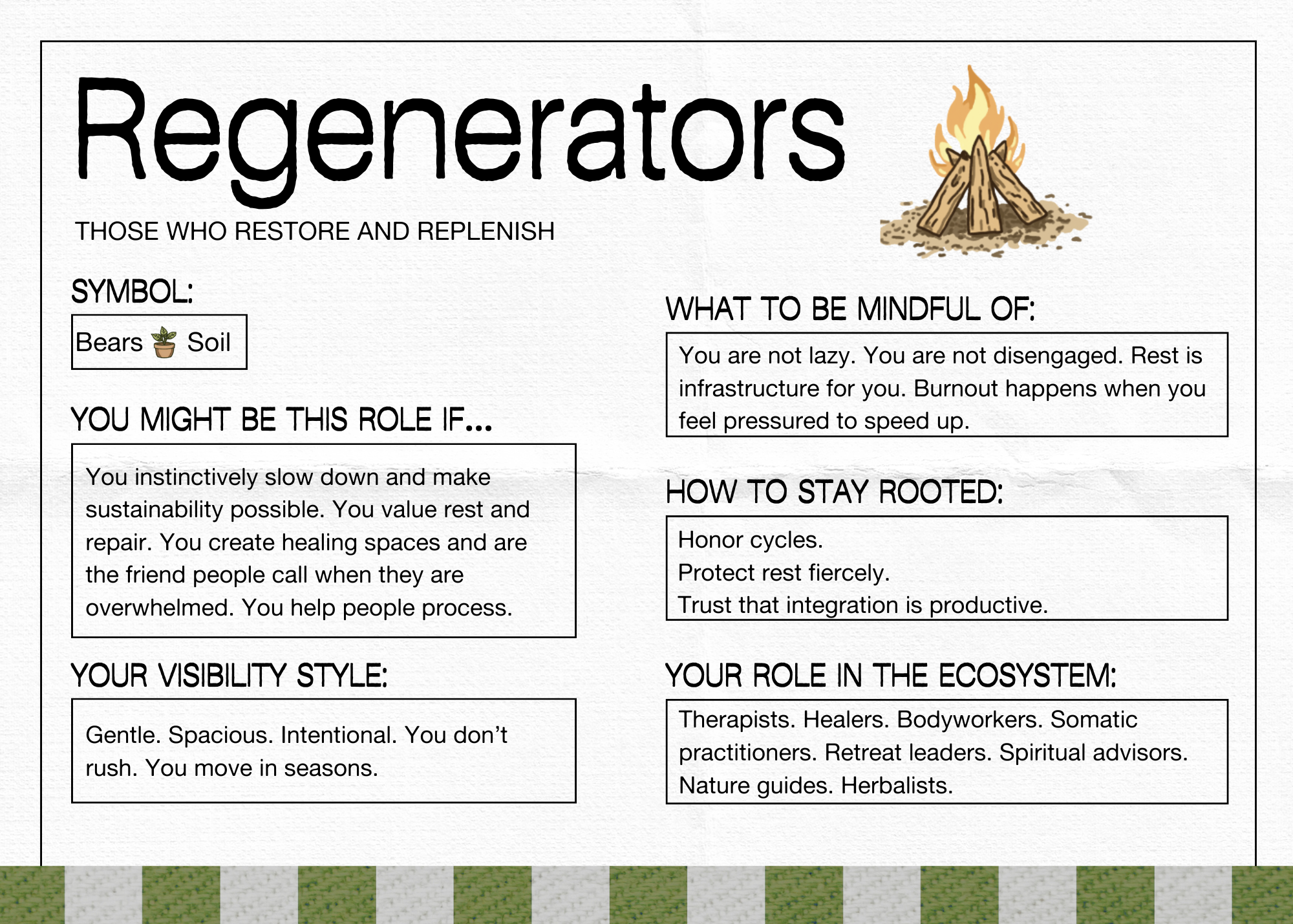
You likely resonate with:
Sustainers – you hold continuity and reliability
Pathmakers – you connect across difference
Regenerators – you restore capacity and prevent collapse
You are not here for spectacle. You are here for durability.
If You’re the One Who Holds Boundaries, Context, and Visibility…
If you’re the person who:
feels physically uncomfortable when harm goes unnamed
gets tagged when something happens
feels pressure to “say something” publicly
notices misinformation or missing context immediately
cannot ignore injustice even when it would be easier
feels protective over people, communities, or values
You are a steward of attention and integrity. You are structural in your care.
Your pressure point?
Being labeled too intense, too rigid, too much — or feeling like silence equals failure.
Your real work?
Directing power responsibly and refusing erasure.
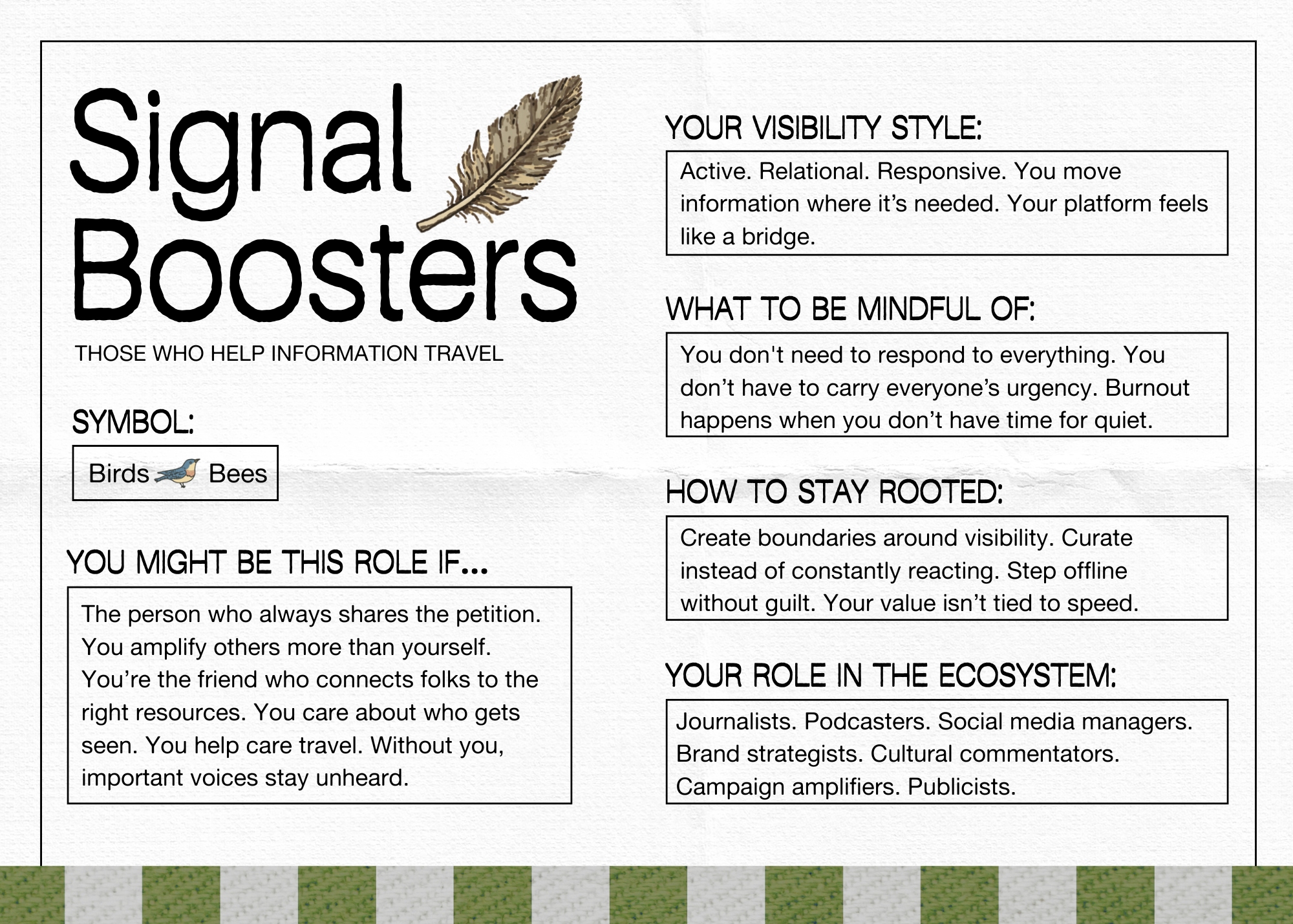
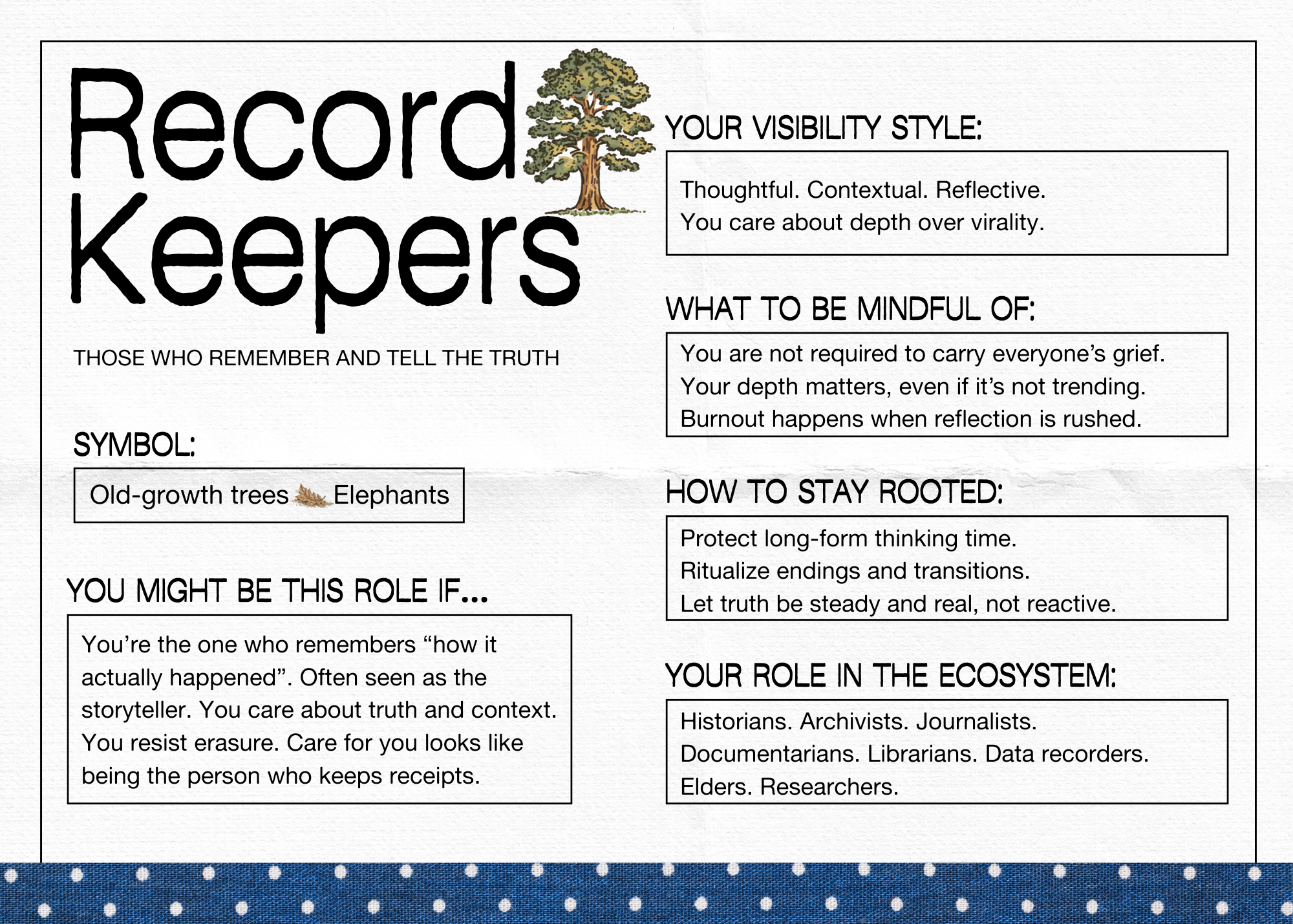
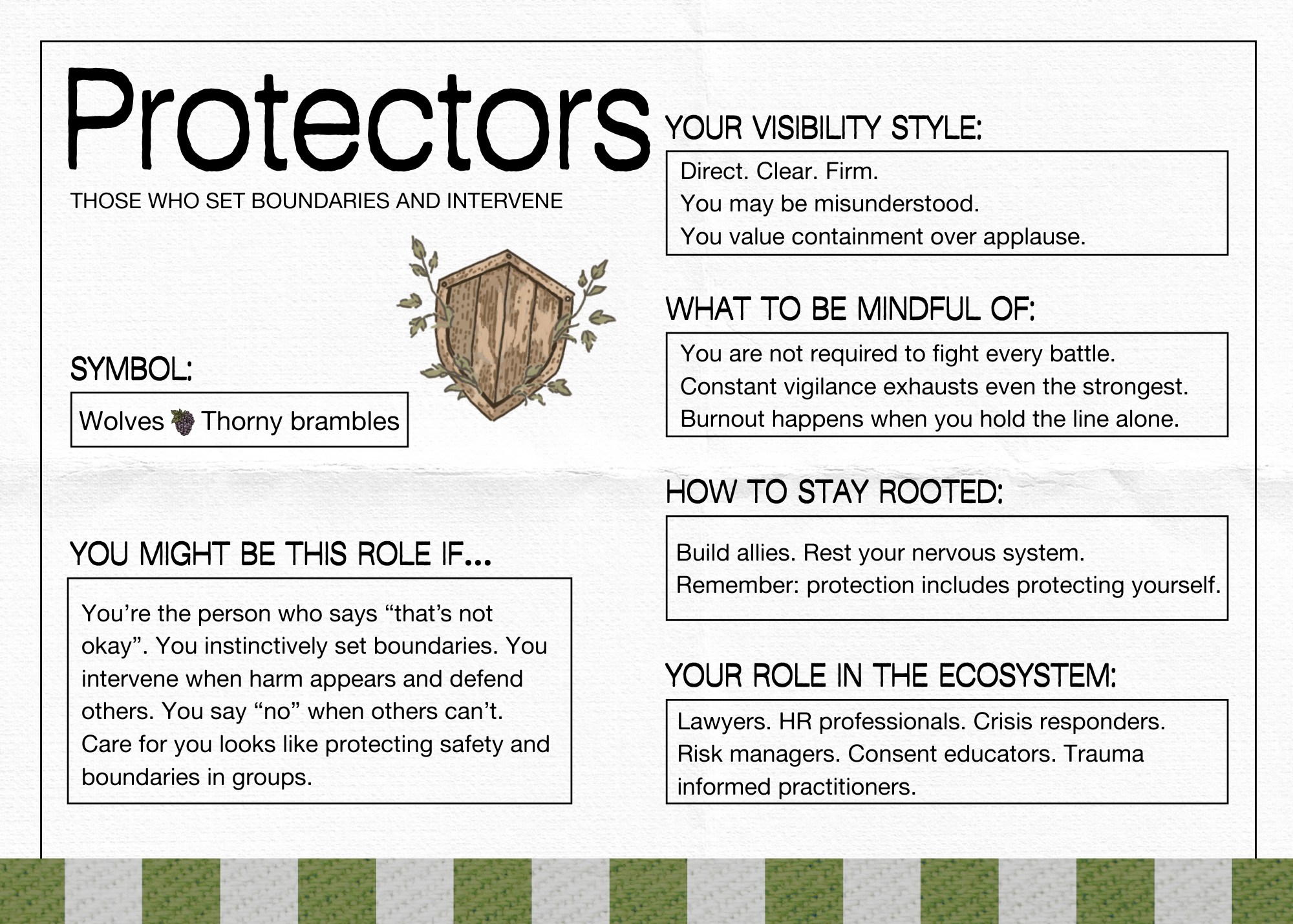
You likely resonate with:
Signal Boosters – you redistribute attention and resources
Record Keepers – you preserve truth and context
Protectors – you set boundaries around harm
You are not here to be comfortable. You are here to hold the line.
How to Apply Your Role
You don’t need a rebrand. You don’t need to burn everything down. You just need clarity. Here’s where to begin:
Name Your Primary Role
Before you change anything externally, identify your lane.
Ask yourself:
When the world feels chaotic, how do I instinctively respond?
What kind of contribution feels steady in my body?
What kind of impact work feels aligned, not performative?
Choose the one you can hold sustainably. That’s your starting point. If you want to explore these frameworks in community with others, Common Ground is where we practice this thinking together through mentoring, workshops, and small-group learning.
Audit Your Business For Misalignment
Once you know your role, look at your ecosystem:
Does your marketing reflect your impact style?
Are your offers aligned with how you naturally contribute?
Are you forcing visibility strategies that belong to a different role?
Are you overextending into roles that are not yours?
For example:
If you’re a Sustainer, but your business model demands constant novelty and high-energy launches, that friction will drain you.
If you’re a Signal Booster, but you’ve built a brand centered only on self-promotion, you’ll feel misaligned.
If you’re a Regenerator, but you’re modeling urgency and hustle, your nervous system will revolt.
Alignment reduces friction. Misalignment creates burnout.
If you’ve struggled with how to show up online during moments of crisis, this is where ethical marketing matters most. Here’s how we think about responsible visibility → Value-First Marketing: Ethical, Sustainable Content Strategy.
Redesign One Thing
Don’t overhaul everything.
Choose one area:
Your content strategy
Your pricing structure
Your community guidelines
Your collaborations
Your sustainability plan
Your leadership approach
And ask:
How would this look if it reflected my ecological role of care?
Make one shift. Small. Structural. Sustainable.
Practice Collective Thinking
This framework is about understanding that: You hold one role. Others hold different ones. And ecosystems survive through relationship.
Ask:
Who complements me? Who balances my weak spots? Who holds what I don’t?
That’s where real strategy lives.
This Is the Work We Do
At DoGoodBiz Studio, we help creatives, founders, and values-driven brands translate their care into infrastructure.
Designing business models that align with your ecological role
Developing marketing strategies that reflect your natural visibility style
Building community structures rooted in shared responsibility
Integrating ethics into systems, not just messaging
Creating sustainability plans that prevent burnout
Strengthening leadership without replicating dominance culture
If you’ve been feeling the tension between caring deeply, running a business, wanting to make an impact, and not wanting to collapse under the weight of it… This is the work. Not abandoning your business. Not abandoning the world. But learning how to build in a way that reflects who you actually are and how you’re actually meant to contribute. For a deeper look at how nature's patterns can inform how we work and create, read Working Like Nature.
If you’d like support integrating your ecological role of care into your business model, marketing approach, leadership style, or long-term sustainability plan…
Let’s build something that can hold you (and the world you’re trying to shape) at the same time.
