

What Is a Community-Based Business Model? (And Is It Right for You)
If you've ever felt like the standard business playbook wasn't written for someone like you (someone who cares about people, about the planet, about doing work that actually means something), you're not imagining it. Most of that playbook was written for a different goal entirely. Community-based business models exist as an answer to that gap. They're not a new invention. They're a return to something older: the idea that business, at its best, is a form of care. That the people you serve and the ecosystem you operate within matter as much as your bottom line, and that building with that belief at the center actually makes for a more resilient, more meaningful, and more sustainable way to work.
In this article, I want to break down what community-based models actually are, what makes them distinct from traditional approaches, and how to tell whether this kind of structure is the right fit for where you are and what you're building.
What Is a Community-Based Business Model?
A community-based business model places the well-being of people and planet alongside, or even above, profit as a measure of success. These businesses are often called social enterprises, though that term covers a wide spectrum. What they share is a structural commitment to creating value that extends beyond the transaction: to the communities they serve, the environments they operate within, and the people involved in building them.
This isn't just a mission statement that lives on your About page. It's baked into how the business operates… how decisions get made, how profits get used, how success gets measured, and who has a voice in shaping what comes next.
Community-based businesses tend to be:
Co-led or collaborative in nature, sharing power rather than concentrating it
Oriented around genuine reciprocity — members, clients, or customers receive real value beyond the product or service
Invested in the health of their ecosystem, not just their own growth
Measuring impact alongside revenue as a real indicator of how things are going
They show up in many forms: cooperatives, social enterprises, community-supported models, values-led studios and practices, mutual aid networks, and small businesses that choose to build differently. The structure matters less than the orientation. This orientation is what we call a creative ecosystem, a nature-inspired model for building a body of work that's relational, sustainable, and built around reciprocity rather than extraction.
How Is This Different From a Traditional Business Model?
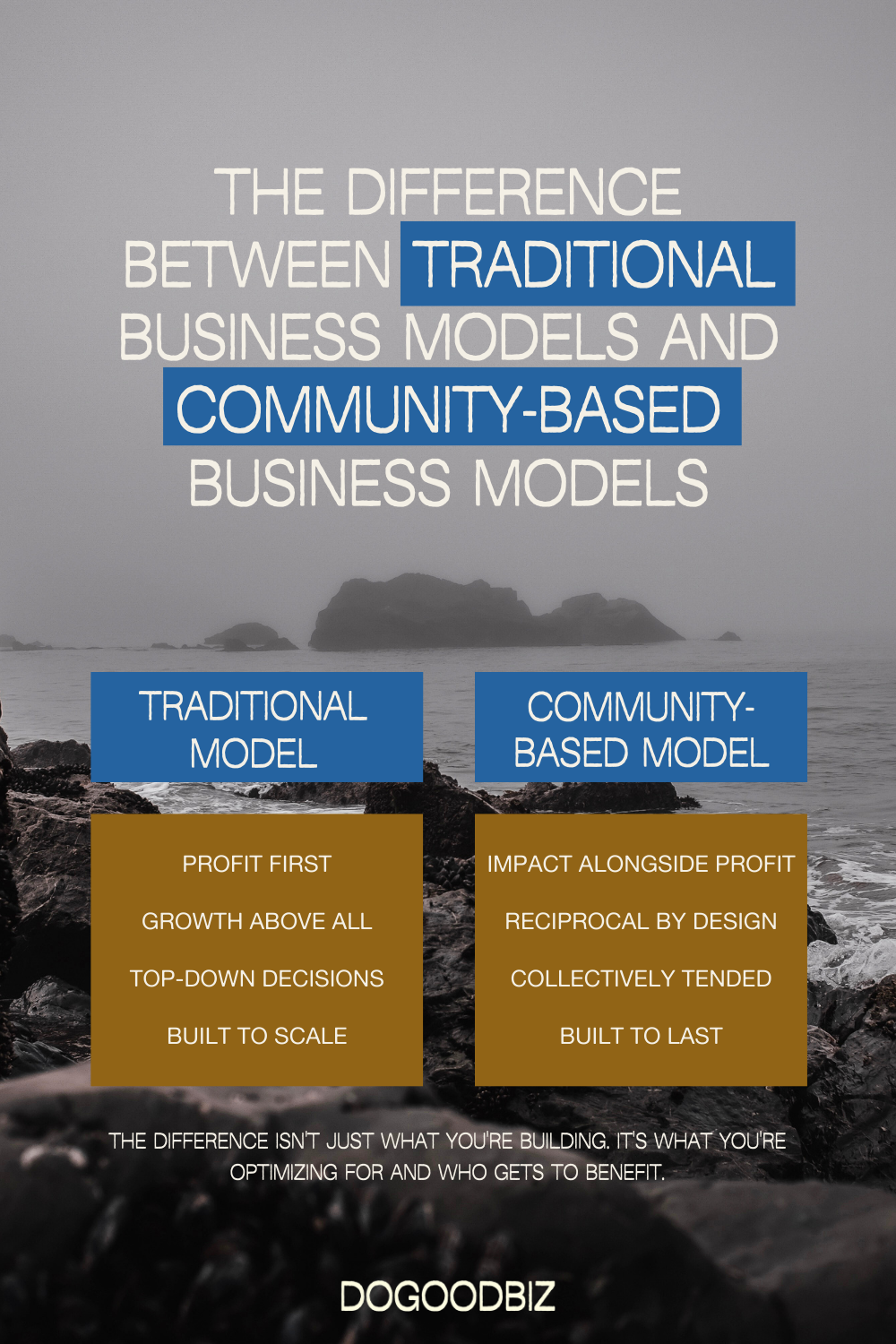
The most honest answer: it's a difference in what you're optimizing for.
Traditional business models are built around profit maximization and scale. Growth is the goal. More customers, more revenue, more market share. That's not inherently wrong… but it tends to treat people, planet, and community as secondary considerations at best, and as obstacles at worst. Community-based models flip the question. Instead of asking how do we grow as fast as possible, they ask who we are growing for, and what thriving actually look like for everyone involved? Profit is still part of the picture, sustainability requires it… But it's a means, not the end.
In practice, the difference often shows up in small but significant ways. A community-based business might:
Price based on sustainability rather than what the market will bear
Invite feedback that genuinely shapes what they offer next
Refer potential clients to other providers when they're not the right fit
Reinvest a portion of revenue into the communities or causes they care about
Build slower, more intentionally, because the depth of relationship matters more than the speed of acquisition
None of this requires being a nonprofit or sacrificing financial health. Some of the most stable small businesses I've encountered are community-based ones, precisely because they've built the kind of deep, trust-based relationships that don't evaporate when the market shifts. We've written in depth about what ethical pricing actually looks like in practice, including how to build a model that honors both your sustainability and your community's accessibility.
What Does It Actually Look Like in Practice?
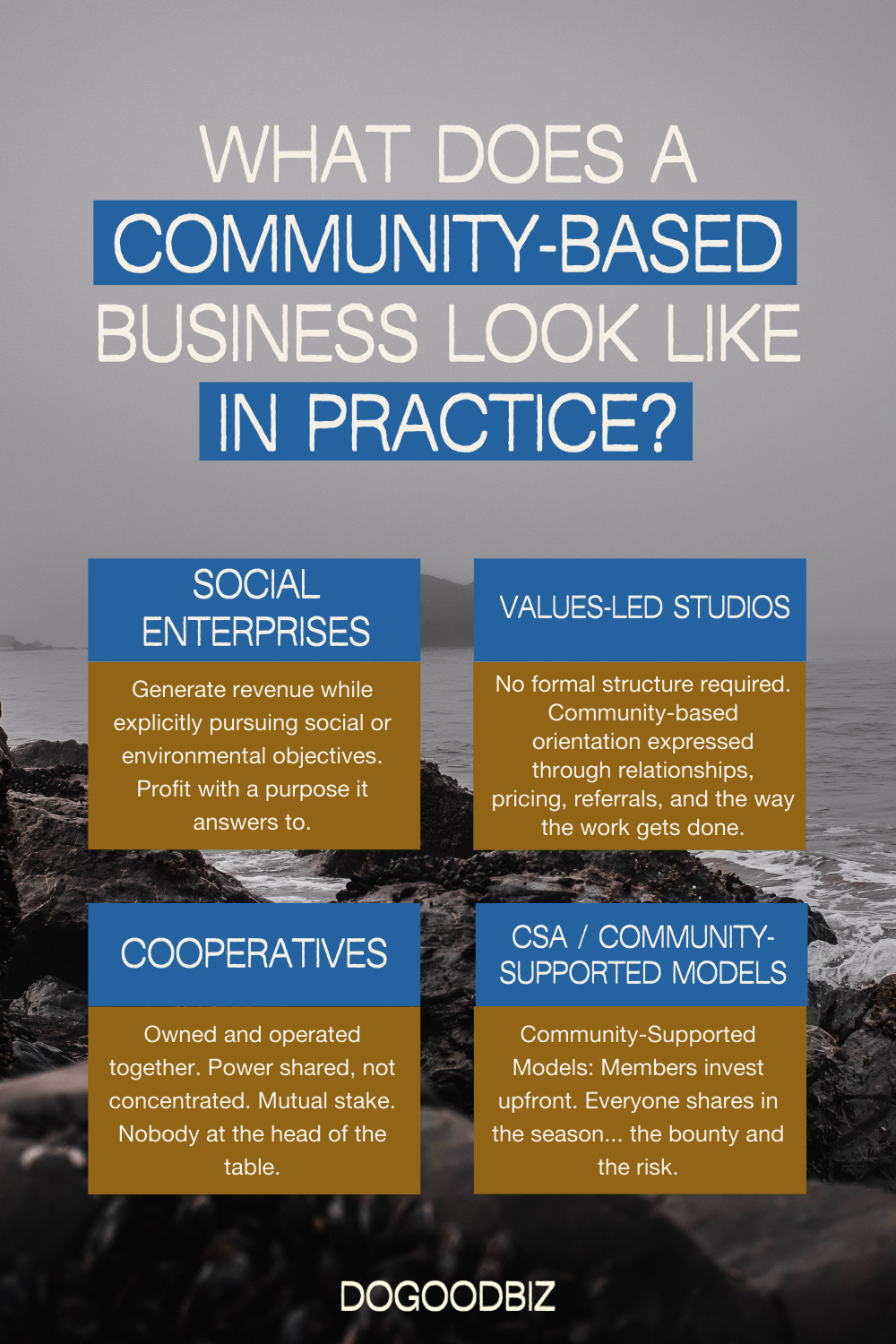
Community-based business models aren't one-size-fits-all. Here are a few of the most common structures, any of which might overlap with or inspire your own:
Cooperatives
Owned and operated collectively by members (workers, producers, or consumers) who share in both the decision-making and the benefits. Artist co-ops, food co-ops, and worker-owned studios all fall here. The defining feature is shared power and shared stake.
Community-Supported Models (CSAs and beyond)
Popularized in agriculture, but applicable far beyond it. Members pay upfront to support a season or cycle of work, sharing in both the output and the risk. This creates a different kind of relationship than a simple transaction… one built on mutual investment.
Social Enterprises
Businesses that generate revenue while explicitly pursuing social or environmental objectives. These range widely: some use a donate-back model, contributing a percentage of profits to aligned causes; others design their core product or service to directly address a community need.
Values-Led Small Businesses and Studios
This is where most of the people I work with land. Not a formal cooperative or registered social enterprise… but a business built with genuine intentionality about who it serves, how it operates, and what kind of impact it makes. The community-based orientation is expressed through relationships, pricing, referrals, content, and the way the work itself is done.
The structure matters less than the orientation. What distinguishes community-based businesses is what they're optimizing for and who gets to benefit from that.
How to Know If This Model Is Right for You
A community-based approach isn't the right fit for every business, and it's worth being honest about that. It requires a genuine commitment (not just a values statement) to operating differently. It often means slower growth, more complex decision-making, and a willingness to measure success in ways that don't always show up neatly in a revenue report.
That said, if any of the following feel true for you, it's worth exploring seriously:
You started your business because you wanted to make a difference, not just make money — and you want your structure to reflect that
You feel alienated by traditional marketing and growth tactics and are looking for approaches that feel more aligned
You care deeply about the people you serve and want relationships that go beyond the transaction
You want your business to be part of something larger — a movement, a community, a more equitable economy
You're interested in building something that lasts, rather than something that scales fast and burns out
If that list resonates, you're probably already thinking in community-based terms. The work is in building structures and systems that support that orientation… so it becomes the foundation of how you operate, not just an aspiration. At DoGoodBiz Studio, helping values-driven small businesses build those structures is exactly what we do. If you're ready to think through what a community-based creative ecosystem could look like for your work, explore our Creative Ecosystem Development services or reach out directly. We'd love to hear what you're building.
A Personal Note on Why This Matters to Me
I've been working with and inside community-based business models for years, and what I keep returning to is this: the businesses that build this way tend to have a different quality of aliveness to them. They're not just financially sustainable… they feel sustainable to be part of. The people involved genuinely want to show up. There's a culture of care that permeates everything from how client calls are handled to how setbacks get navigated. That's not an accident. It's the compounding effect of genuinely putting people and planet into the architecture of the business from the start, not as an afterthought, but as the foundation.
At DoGoodBiz Studio, this is the orientation we bring to every project we take on. We don't just design brands or build websites; we help conscious businesses build ecosystems that reflect their values, attract the right people, and grow in ways that don't require burning anything down to do it.
Frequently Asked Questions
-
A community-based business model is one where the people you serve are treated as active participants, not just customers, often through cooperative ownership, shared decision-making, or revenue structures that circulate value back into the community itself, rather than only extracting from it.
-
Yes, and in many cases, more sustainably so. Community-based businesses often have higher client retention, stronger word-of-mouth, and deeper brand loyalty than traditionally structured businesses. Profit isn't the enemy of this model; extraction is. There's a meaningful difference between generating revenue that sustains your work and building a business that treats people or planet as resources to be consumed.
-
Not at all. Many of the most alive community-based businesses are for-profit sole proprietorships and small studios. What defines this model is your orientation and your practices… not your legal structure. You can be a solo designer, a one-person consultancy, a small creative studio, and still operate in genuinely community-centered ways.
-
Start with the question: who am I actually building this for, and what do I owe them? From there, look at your current practices… pricing, communication, referrals, content, how you handle feedback… and ask honestly which ones reflect that care and which ones don't. Community-based business isn't a destination you arrive at; it's a direction you keep orienting toward. The first step is just deciding to face that way.
Building a values-led business and want a strategy that reflects that?
We help conscious entrepreneurs design marketing and brand ecosystems rooted in community, not extraction. If you're building a community-based creative practice from the ground up, Take Root is where the foundation work begins: brand identity, web design, and the creative infrastructure to hold everything you're building together.
Browse our services to see how we work, or send us a note about what you're building.
→ Keep reading: Community-Driven Business Models: 10 Real-World Examples
Natalie Brite (they/them) is a designer, writer, and creative director at DoGoodBiz Studio, an ethical creative studio for conscious businesses building something good for people and planet.
Read next:
Why Creative Ecosystems Matter More Than Personal Brands — The nature-inspired model for building a body of work that's relational, sustainable, and built to last.
What Is Ethical Pricing? — How to build a pricing model that honors both your sustainability and your community's accessibility.
Community-Driven Business Models: 10 Real-World Examples — Concrete examples of what community-based structures look like across different industries.
