

Community-Driven Business Models: 10 Real-World Examples
There's a particular kind of business that doesn't grow by buying reach or using unethical, often exploitative practices to encourage growth. It grows because people actually want to be part of what it's building. We call these community-driven businesses, and they're not a new concept; they're actually an ancient one. Long before marketing funnels and conversion dashboards, humans built economies around proximity, trust, and reciprocity. The baker who remembered your order. The cooperative that shared the harvest. The guild that trained the next generation.
What I want to name here, and what often gets lost in conversations about "community-led growth", is that you don't need a venture-backed platform or a team of ten to build this way. Some of the most alive examples of community-driven business are happening at the smallest scales: one-person studios, indie makers, ethical service providers, and creative cooperatives. People building something worth gathering around, without the backing of a big marketing budget.
The ten examples below are drawn from that world, not from Silicon Valley, but from the kinds of businesses that your readers are either building themselves or are genuinely inspired by. Real, human-scale proof that community is a growth strategy available to all of us.
If you're still building your understanding of what community-based models actually are, start with What Is a Community-Based Business Model? before diving into these examples.
What Makes a Business Model Community-Driven?
A community-driven business model is one where the people you serve actively participate in how your business grows, not just as customers, but as contributors. They might share your work with others, give feedback that shapes what you offer, support each other inside your ecosystem, or feel so genuinely seen and reflected by what you do that they become natural advocates. The key distinction: community members aren't passive recipients of your marketing. They're woven into the fabric of what you're building. This relational orientation is at the heart of what we call a creative ecosystem, a nature-inspired model for building a body of work rooted in reciprocity rather than extraction
For small business owners, solo founders, and independent creatives, this is both more accessible and more instinctive than the traditional growth playbook. It's what happens when you stop trying to reach everyone and start genuinely showing up for the people who already care.
10 Real-World Examples Worth Studying
1. The Independent Herbalist Who Built a Learning Community Before She Had Products
Model: Audience-first business development
Before launching a single product, she spent two years writing freely about plant medicine, foraging ethics, and regenerative living. Her newsletter grew slowly and intentionally, with people who genuinely wanted to learn, not a manufactured following. When she finally opened a small shop selling dried herbs and seasonal blends, her community already trusted her deeply. The first batch sold out in hours, entirely through word of mouth from readers. This is the Glossier story at a human scale: build genuine relationships with the people you want to serve before you ask them to buy anything. The payoff isn't instant, but it compounds in ways that paid advertising simply can't.
Ask yourself: what do you know that your people are hungry to learn? Sharing that freely, consistently, over time, is one of the oldest community-building strategies that exists.
2. Rize Up Bakery — Putting Your Whole Self Into Your Business
Model: Founder personality as community magnet
Azikiwee Anderson, the baker and founder of Rize Up Bakery in San Francisco, didn't build community through a strategy. He built it by being fully himself… sharing his process, his values, and his joy in real time. "A majority of the stuff that I put up is not really preconceived," he's said. "I'm having a good time, and so I show people what I'm doing."
His community grew because authenticity is magnetic in a way that content calendars aren't. People don't just buy bread from Rize Up, they feel genuinely connected to the person making it and the purpose behind the business. For solo business owners, this is your actual competitive advantage: no corporation can replicate you. Your perspective, your process, your people, and values are the community asset that scales with you, not despite you.
3. The Maker Who Treats Her Newsletter Like a Campfire
Model: Owned media as an intimate community hub
She makes hand-dyed textiles out of a home studio in the Pacific Northwest. Her Instagram barely moves the needle. But her monthly newsletter, which reads less like a marketing email and more like a letter from a friend, has a 60%+ open rate and generates most of her shop revenue. She writes about her process, the dye plants she's growing, and what she's been thinking about. She asks questions. Readers write back.
Her newsletter isn't a broadcast. It's a gathering. And that's a distinction worth sitting with: a broadcast performs for an audience, while a gathering invites people in. The latter is harder to build and infinitely harder to replicate. You don't need a big list to do this. You need a genuine perspective and the willingness to share it with the people who've already said they want to hear from you.
4. Paynter Jacket — Building in Public as a Community Practice
Model: Radical transparency + limited release community
Paynter is a small clothing brand that releases jackets in limited batches and shares nearly everything about how those batches come together… the factories, the decisions, the constraints, the behind-the-scenes reality of making things ethically. Their co-founder has said, "It's really easy to mix up having an audience with having a community. You can have a community and feel so part of something. And I think it's all about how engaged you are."
Paynter's approach creates something rare: customers who feel like participants in something they helped make possible. Each release sells out in minutes, not because of advertising, but because their community has been part of the process all along. Building in public doesn't mean sharing everything; it means sharing enough that people understand what you're really making and why. That kind of transparency builds loyalty that a discount code never could.
5. The Healing Practitioner Who Let Her Clients Build the Curriculum
Model: Community co-creation + peer learning
A somatic therapist offering small group programs noticed that her clients were learning as much from each other as from her. So she restructured her offerings to lean into that: group cohorts with space for peer sharing, a private community between sessions, and an annual survey that genuinely shapes what she teaches next. Her clients don't just attend programs; they help build them. The result is a business model with very low churn and very high word-of-mouth. People refer their friends not just because the work is good, but because the community itself is part of what they're recommending.
This applies across every service-based creative business: the people you work with often know things about what they need that you don't. Creating space for them to contribute that knowledge makes your offering better and your community stickier.
6. The Artist Cooperative That Replaced Competition With Collaboration
Model: Cooperative structure + shared resources
A small group of illustrators and graphic designers, tired of competing for the same clients, formed a cooperative studio. They share a client pipeline, cover for each other during capacity crunches, cross-reference work that isn't the right fit individually, and split overhead costs for software and equipment. Each person maintains their own identity and clientele, but they grow together rather than alone.
The cooperative model is one of the oldest community-driven business structures in existence, and it's having a quiet revival among independent creatives who have figured out that "going it alone" is optional, not required. Real collaboration, not the performed, aestheticized kind, creates a resilience that solo hustle rarely achieves. Even informally, this is worth asking: who in your ecosystem could you build alongside rather than beside?
7. Made with Local — Farmers Markets as Living Market Research
Model: In-person community as product development engine
Sheena Russell, founder of Made with Local, a Canadian snack company, credits her early farmers market years with something that no analytics dashboard could have given her: genuine, face-to-face feedback from the people she was making food for. "The market research that we could do with all those customers that came by was invaluable," she said.
For small product businesses, the in-person community is often undervalued because it doesn't scale in the way digital channels seem to. But there's a quality of relationship and trust that forms when you hand someone something you made and watch them eat it, wear it, or use it. That relationship is the root system. Everything else grows from it. If you have a physical offering, showing up in person, consistently, over time, in the places where your people already gather is one of the most sustainable community-building practices available to you.
8. The Zine Maker Who Turned Readers Into Contributors
Model: Community-generated content + participatory publishing
She started making zines about sustainable living from her kitchen table. When she put out an open call for submissions… asking readers to share their own practices, stories, and sketches, the response flooded in. Issues became collaborative. Readers became contributors. Contributors became advocates. She shipped zines to 40 countries last year without a single paid ad.
What's happening here is something the big platforms spend millions trying to manufacture: a sense of co-ownership. When your community literally appears in your work, they share it not just because they like it, but because they're in it. They're proud of it. Open calls, surveys, reader spotlights, community round-ups… these aren't just content tactics. They're invitations that say: you're part of this, not just a recipient of it.
9. The CSA Farm That Makes Members Feel Like Owners
Model: Subscription + shared investment community
Community Supported Agriculture, the CSA model, is one of the most beautifully simple community-driven business structures in existence. Members pay upfront at the start of the season, which gives the farmer operating capital and means members share in both the bounty and the risk. They're not customers buying a product. They're participants in a growing season.
The farms that have built the most loyal CSA communities are the ones that lean into this: farm newsletters, u-pick days, harvest dinners, occasional honest updates when something doesn't go as planned. The more members understand what they're part of, the more invested they become in its success. Whatever you offer, there's a version of this question worth asking: how can the structure of my business invite people in as participants rather than just purchasers?
10. The Solo Designer Who Made Her Process Her Brand
Model: Behind-the-scenes transparency + values-led community
She works alone, takes limited clients, and prices her work accordingly. She's never had a large following, but her community is genuinely engaged because she's been sharing the honest reality of running an ethical design practice for years. The late client payments. The projects she turned down and why. The slow seasons and what she does with them. The values she's not willing to compromise. People who find her don't just want a designer. They want her specifically because they've watched her make decisions they respect, over time, in public. That specificity is her community's foundation. In a crowded market, radical clarity about who you are and what you stand for is its own form of community-building. The right people will find it. And they'll stay.
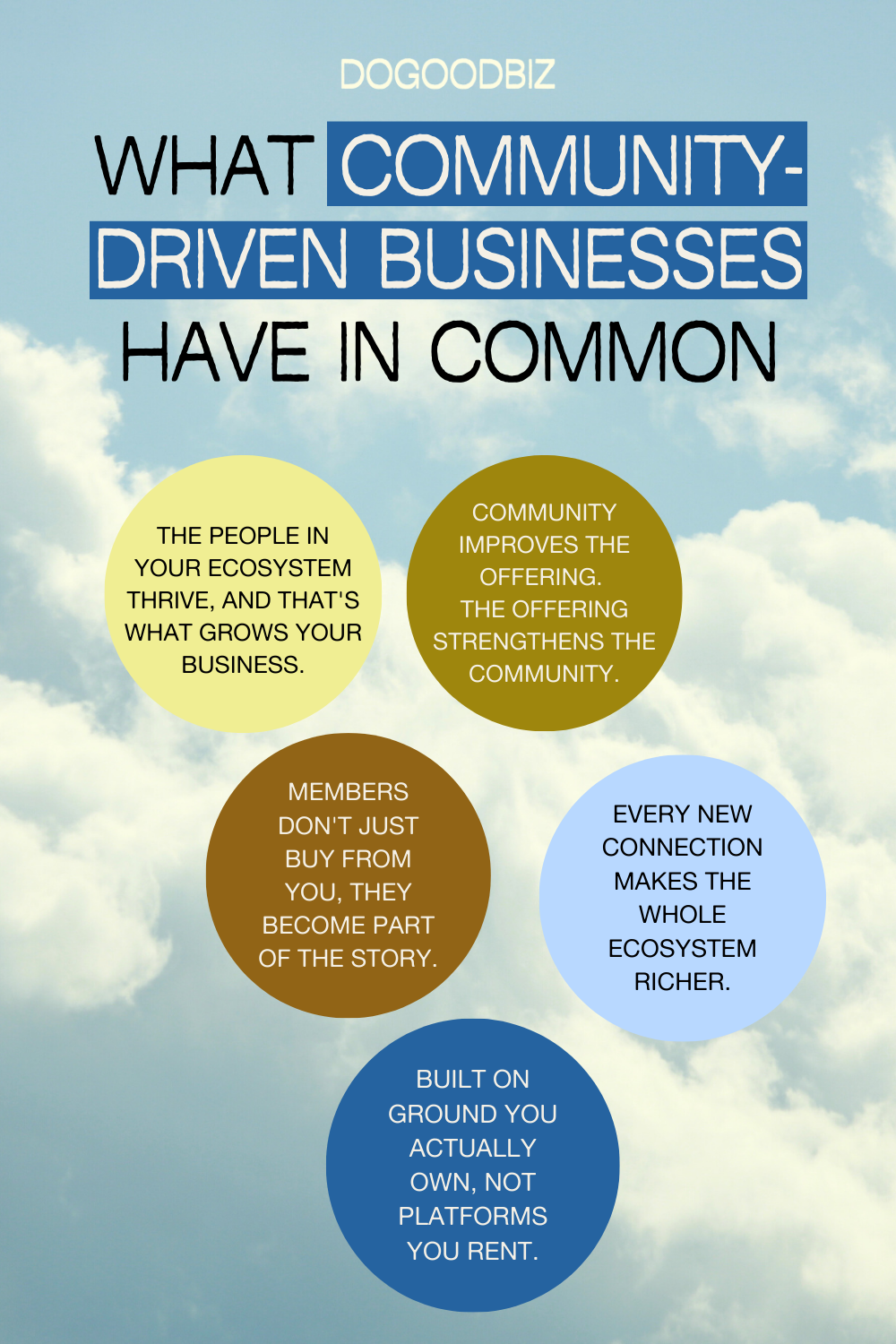
What These Examples Actually Have in Common
Looking across these ten stories, a few patterns emerge worth naming not as a formula, but as an orientation:
The community's interests and the business's growth are genuinely aligned, not in tension. When the people you serve thrive, so do you.
Members don't just buy from these businesses; they feel seen by them. Identity investment runs deeper than brand loyalty.
Each new connection makes the ecosystem richer for everyone. That's the compounding quality of genuine community.
These businesses aren't dependent on platform algorithms or rented attention to stay visible. They've built something that belongs to them.
Community improves the offering, and the better the offering strengthens the community. It's a living system, not a funnel.
How you price is part of your community commitment; we've written in depth about ethical pricing and what it looks like in practice for values-led businesses.
An Honest Note Before You Start Building
Not every "community-first" business is actually community-driven. Some use belonging as a retention hook without genuinely caring for the people inside it. The distinction matters, and your audience will feel it eventually either way. The question worth sitting with isn't just how do I build community to grow my business… What am I actually building that's worth gathering around? What is the real value I'm creating for the people who show up? What do I owe them, and am I prepared to deliver on that over the long term?
Community built on genuine care compounds over time in a way that community-as-tactic doesn't. For small business owners building something they actually believe in, that distinction is everything.
If you're building a community-based creative practice and need a brand and web foundation to hold it, Take Root is where that work begins.
Common Questions:
-
Not at all. In fact, smaller communities are often more alive and more loyal than large ones. Many of the examples above involve dozens or hundreds of people, not thousands. The question isn't how many… it's how genuinely connected. A newsletter with 200 people who actually read and respond will do more for a small business than 10,000 passive followers on a platform you don't own.
-
Loyal customers appreciate you. Community members participate with you. In a genuine community, people contribute… they share ideas, support each other, give feedback that shapes what you build next, show up in ways that go beyond the transaction. That participation creates a different quality of relationship, and a different quality of advocacy, than appreciation alone.
-
Start with your most engaged people… the clients, readers, or customers who respond, refer, and return. Find out how they talk about your work, what else they're thinking about, and whether they know each other. Then ask: is there a space, even informally, where these connections could be nurtured? The tool matters far less than the intention. A consistent reply to emails. A monthly open Q&A. A space where people feel like they're in something together, not just buying from it.
Building Something Worth Gathering Around
At DoGoodBiz Studio, this is the heart of what we mean when we talk about creative ecosystem development. Not just a brand that looks good or a website that converts, but a presence that genuinely draws people in and gives them a reason to stay. If you're thinking about how to grow your business through trust rather than traction, we'd love to be part of that conversation. Click here to reach out to us.
