

PR doesn't have to be a second full-time job. Values-led PR is outreach built on relationships: introducing your work to the publications, podcasts, events, and partners whose communities overlap with yours.
To make it manageable:
Choose one or two kinds of outreach, not all of them.
Make a short list of ten places that fit.
Set a small, steady rhythm, like one pitch and one relationship touch each week.
Keep one adaptable pitch ready, so you never start from a blank page.
Track everything in one place, so you never start over.
When I talk with small business owners and movement builders about PR, outreach, and community building, I rarely hear that they don't believe in it. They know relationships are how good work travels. What I hear instead sounds like this: I don't know where to start. I don't have time. I started once, and I couldn't keep up.
That isn't a lack of care or skill. It's that outreach usually gets presented as a giant, open-ended project: build a media list, write a press kit, pitch everyone, show up everywhere. For a one-person business or a small team already holding everything else, that's a recipe for doing nothing at all, or for doing it in bursts and then feeling guilty when it stops. (If that rhythm sounds familiar, you might also find How to Run a One-Person Marketing Team helpful.)
What most people need isn't a bigger plan. It's a smaller, steadier practice: knowing where to begin, choosing just enough, and a rhythm light enough to keep.
In this piece, I'll walk through what usually gets in the way, how to choose the kinds of outreach that fit you, and a simple weekly rhythm you can sustain, including a sample pitch you can adapt.
Why PR and outreach feel so overwhelming
Most of the overwhelm comes from a few predictable places. The good news is that each one has a small fix.
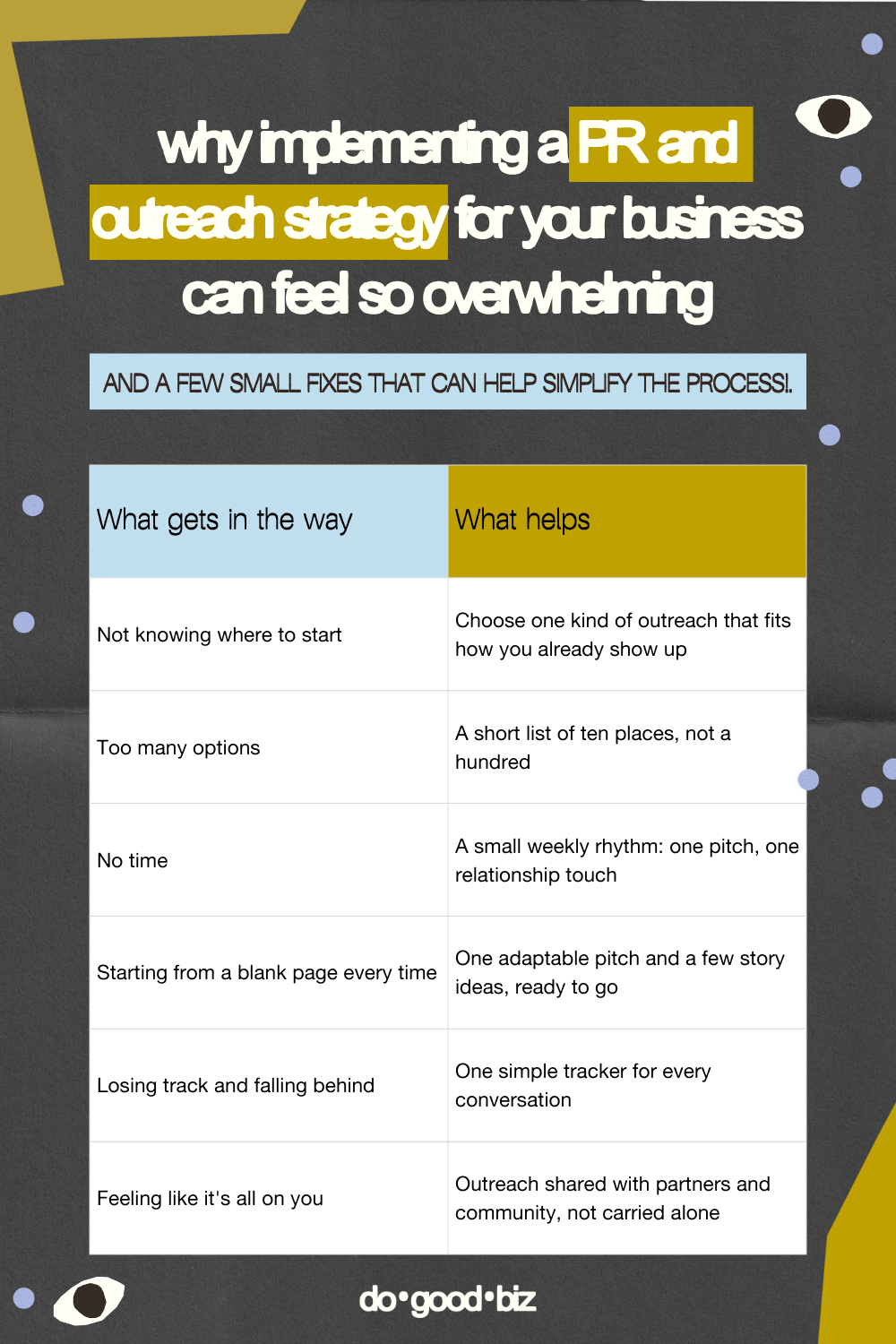
That last one matters most. We're often taught to think of outreach as climbing: who can lift me higher? I think of it more like a web. Every relationship you tend connects you to others, and over time the work gets lighter, because people start reaching back. You're not building a ladder alone. You're tending a web with everyone whose work sits next to yours.
Where to start: with what comes naturally
You don't need to do every kind of outreach. You need one or two that fit how you already show up, so they feel like an extension of your work instead of another job.
My Ecological Roles of Care framework can help you choose…
Signal Boosters, who naturally redistribute attention, often find it easiest to start by sharing and amplifying others, which opens doors to partnerships.
Record Keepers, who preserve stories and context, tend to do well with guest writing and sharing what they've documented.
Pathmakers, who connect across differences, are often natural at partnership outreach. If you already know your role, let it point you to your first one or two kinds of outreach below.
Not sure of your role? Read Ecological Roles of Care.
Five kinds of values-led outreach
PR is wider than press releases. Here are five forms of outreach, who each one tends to suit, and the easiest first step for each. Pick one or two to start.
1. Local and niche press
Community papers, neighborhood newsletters, and publications for your industry or movement. Their audiences are smaller and closer, and they're often looking for grounded, local stories.
Good fit if you're rooted in a place or a specific community. Easiest first step: find the editor of one local or niche publication you already read.
2. Podcast guesting
Long-form conversations on shows whose listeners overlap with the people you serve. There's room for nuance, and listeners get to know how you think.
Good fit if you explain things better out loud than on the page. Easiest first step: list three podcasts you've actually listened to that your clients might enjoy.
3. Guest writing
Contributing to other people's newsletters, Substack, blogs, and publications. Your ideas reach a new community through someone they already trust.
Good fit if you're a writer or a Record Keeper with something to share. Easiest first step: turn one of your existing posts into a pitch for someone else's newsletter.
4. Partnership outreach
Reaching out to organizations and businesses whose work sits next to yours, for co-hosted events, workshops, cross-promotion, or referral relationships. This is outreach as community building, not networking. (Link: Community Building vs. Networking)
Good fit if you're a natural connector. Easiest first step: name two businesses or organizations whose clients would also benefit from your work.
5. Events and speaking
Panels, workshops, community gatherings, markets, and local conferences. Being in a room with people is still one of the most natural ways to build trust.
Good fit if your work lands best in person. Easiest first step: look up two local events in the next three months where the people you serve will be.
A simple outreach rhythm you can keep up with
Here's what makes outreach sustainable: a rhythm small enough to keep, even in a busy season.
Once, to set up (about an afternoon)
Choose your one or two kinds of outreach.
Write your story in two or three sentences: what you do, who it's for, and why your work matters now.
Jot down three story ideas: something you wish more people understood, a lesson you learned the hard way, a signature framework, perspective, or ideology.
Make your list of ten places or people that align with what you come up with.
Start a simple tracker with five columns: name, place, contact date, notes, next step.
Every week (about an hour)
Send a few pitches or follow-ups and continue nurturing relationships in motion.
Make one relationship touch: share someone's work, send a thank-you, or introduce two people who should know each other.
Log activities in your tracker.
Every month (about 30 minutes)
Look over your tracker and note what's come of it, making sure it’s all up to date.
Add a few new places or people to your list for future connection building.
Every season
Step back. What's working, what can you compost, and what would you like to try next?
Try this: Put a recurring one-hour block on your calendar this week and give it a kind name, like "relationship tending."
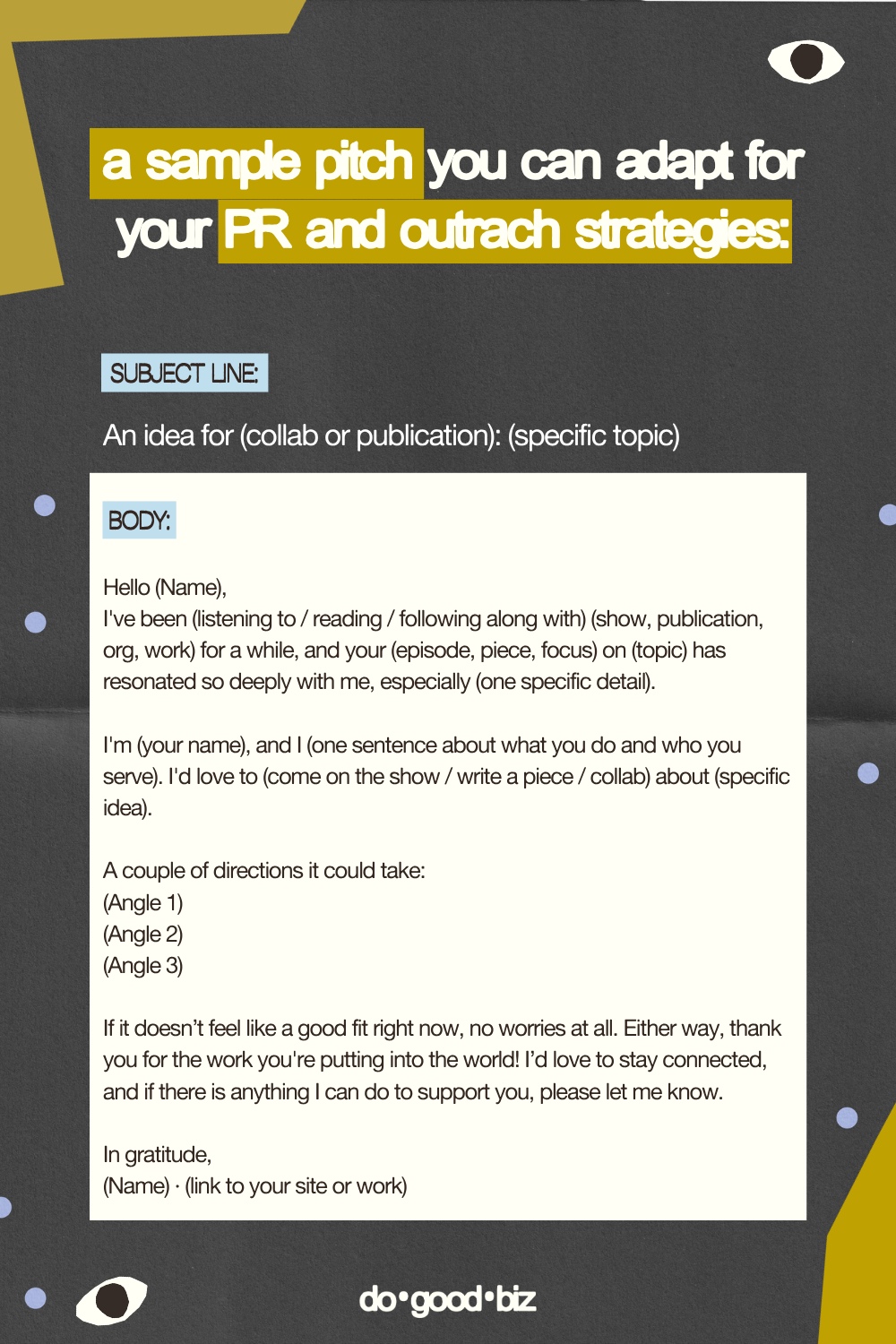
A sample pitch you can adapt
The keyword is: ADAPT!
Scripts and templates are things to help simplify and streamline things…but when it comes to PR and outreach, it is absolutely important to craft messaging that sounds like you.
What to expect
Many pitches will go unanswered, and that's normal; no one can promise placements! But a steady rhythm compounds. Each relationship makes the next one easier; your tracker turns into a living map of your community, and over time, some of the outreach starts coming to you.
So measure it intentionally but don’t get too attached to outcomes. Instead of counting mentions, notice the fit of the places that say yes, the people who reach out because of them, and the relationships that keep going. It’s all about quality over quantity, though at times it can end up feeling a bit like a quantity game at first as you build momentum.
Common questions about PR and outreach
-
Start small: choose one or two kinds of outreach that fit how you already show up, make a list of ten places where the people you serve already read, listen, or gather, and send one thoughtful pitch.
-
Less than most people expect, if it's steady. After an afternoon of setup, about an hour a week is enough to begin: one pitch or follow-up and one relationship touch.
-
Keep the rhythm small enough to survive your busiest weeks, and track everything in one place so you never start over. If you miss a week, just pick it back up; the relationships are still there.
-
Listen to a few episodes first. Then send a short, personal note with one specific idea for that show's listeners and a link to something that shows how you think, like an article or a past interview.
-
They overlap. PR introduces your work to new communities through publications, podcasts, and events. Community building tends the relationships with the people already around your work. A good outreach rhythm feeds both.
If you'd rather not hold all of this alone
If outreach keeps slipping to the bottom of your list, you're not doing anything wrong; you're one person holding a lot. Our Outreach & PR work takes on the strategy, the pitching to the press, podcasts, and partners that fit, and the record-keeping, so relationships keep growing even in your busiest seasons. And if you'd like help tending the community around your work, that's Community Building & Engagement.
Learn more about our Outreach & PR as well as our Community Building services
Until next time,
Natalie Brite · DoGoodBiz Studio
Read next
How to Run a One-Person Marketing Team (Without Burning Out): marketing that fits your capacity
Community Building vs. Networking: why contribution beats extraction
