

The Living System of Your Creative Nature: Creative, Business, and Marketing Ecosystems Explained
✱ Quick answer: ✱
Your creative ecosystem is you and your creative practice: the tree. Your business ecosystem is everything that keeps your business alive and able to give back: the garden. Your marketing ecosystem grows out of the business and carries your work beyond the fence to the people it's for. Together they're one living system. When the tree is depleted, the garden struggles; when the garden's soil is thin, no amount of marketing takes root.
I've been writing about creative ecosystems for a while now: the idea that your work is a living system, not a machine. The question that keeps coming up around our work with creative ecosystems is some version of Okay, but where does my business fit? And my marketing?
It's a good question, because those are the places the machine metaphor is loudest. Business advice talks about scaling and optimizing. Marketing advice talks about funnels and conversions. Even people who've embraced a more ecological way of working often slip back into machine-thinking the moment money or visibility enters the conversation.
So I made a map. It shows three ecosystems nested inside one living system: the tree, which is you and your creative practice; the garden, which is your business; and everything beyond the garden fence, which is your marketing. It also turned out to be a map of every framework we use within the studio, and of the three roots they all grow from.
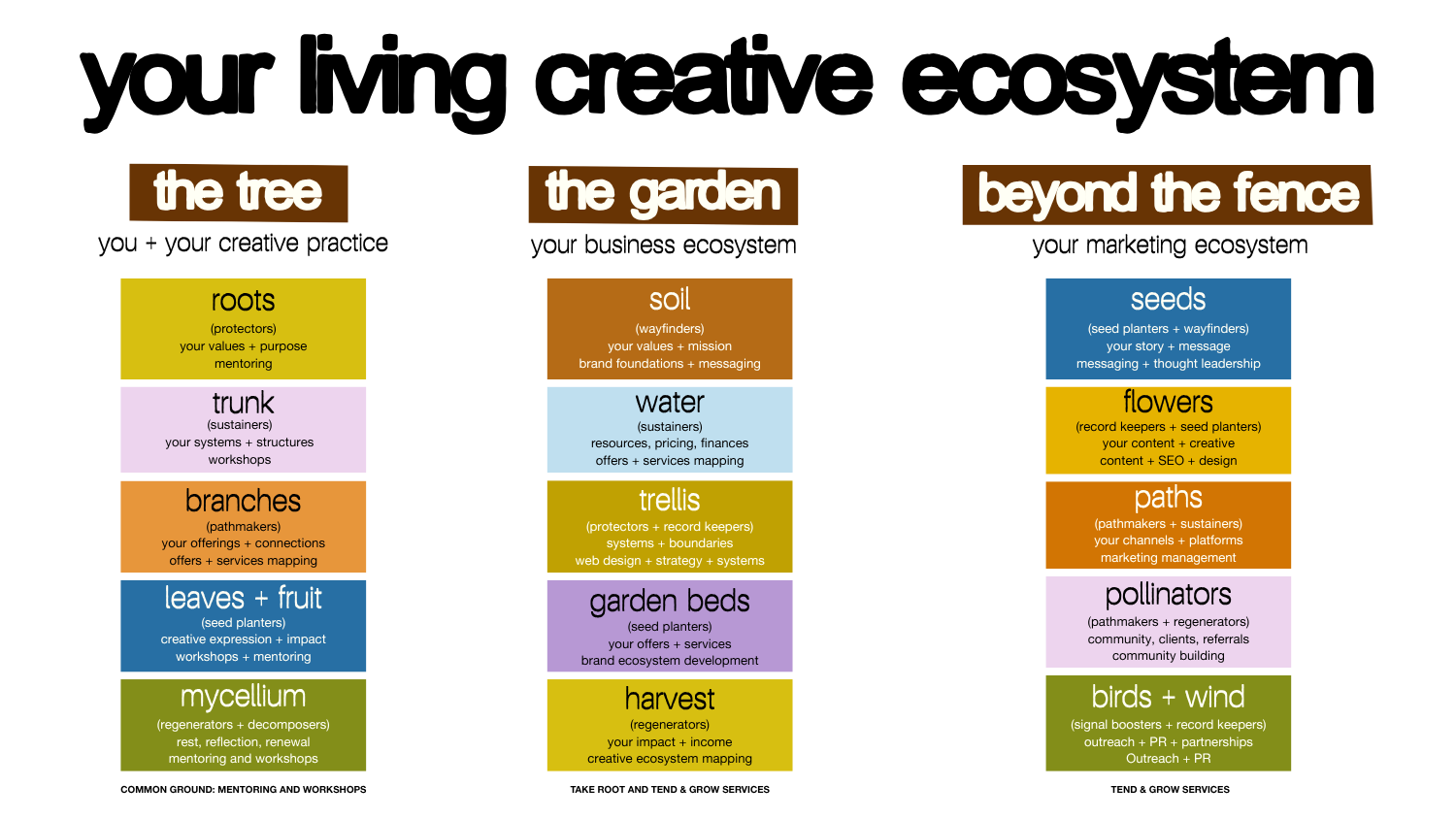
Your work is a living system: your creative practice is the tree, your business is the garden, and your marketing reaches beyond the fence. Our free ecosystem quiz shows which part needs your care right now, which Ecological Role of Care you’re resourced to embody, and where to focus next. It takes about 3 minutes!
Six frameworks, one living system
Everything we do at DoGoodBiz Studio grows from six frameworks. They aren't a list to memorize; they're the parts of one system, and the map shows where each one lives:
Creative Ecosystems: the whole map. Your work seen as a living system, not a machine.
Creative practice: the tree. You, your values, rhythms, ways of making, and tending to the self
Business ecosystems: the garden. Everything that keeps your business alive and able to give back.
Marketing ecosystems: beyond the fence. Everything that carries your work to the people it's for.
Branding and marketing in your true nature: the bridges. How your business shows up, and how it reaches people, grows from who you are.
The Ecological Roles of Care: the names in parentheses above. The ways we contribute to living systems, and a way to see which parts you're naturally resourced to tend.
Underneath all six are three roots: ecology, anticapitalism, and decolonial approaches. I'll come back to those at the end. First, let's walk through the map, one zone at a time.
The tree: you and your creative practice
Everything starts here. Before there's a business or a marketing plan, there's you: your values, your rhythms, the way you make things, and what you need to keep making them. If the tree is depleted, nothing downstream can make up for it.
Roots: your values and purpose
What holds you steady when everything else shifts. Roots are the things you won't compromise on and the reasons you started.
At home here: Protectors, who set boundaries around what matters and hold the line when it's tested.
Trunk: your systems and structures
The habits and rhythms that carry your creative energy: how you plan, how you rest, how you protect time to make. A strong trunk means your creativity doesn't depend on willpower alone.
At home here: Sustainers, who hold continuity and keep things going when momentum fades.
Branches: your offerings and connections
How your work reaches outward: the things you offer and the relationships you're part of. Branches are where your inner practice starts touching other people.
At home here: Pathmakers, who connect across difference and introduce people who need each other.
Leaves and fruit: your creative expression and impact
What you make, and what it gives. The visible part of the tree, and the part most people mistake for the whole thing.
At home here: Seed Planters, who initiate what doesn't exist yet.
Mycelium: rest, reflection, and renewal
The underground network that restores the whole system: rest, reflection, and the composting of what no longer serves. It's invisible, and nothing thrives without it.
At home here: Regenerators, who restore capacity, and Decomposers, who break down what has outlived its purpose so something new can grow.
The tree is where Common Ground lives: creative mentoring and workshops for the inner work of your practice, whether you need a sounding board, hands-on feedback, or a session to build your playbook or map your offers.
The garden: your business ecosystem
If the tree is you, the garden is the business or purposeful work you've planted: everything that keeps it alive and able to give back. A garden isn't built once. It's tended season after season, each part in relationship to the others.If the tree is you, the garden is the business you've planted: everything that keeps it alive and able to give back. A garden isn't built once. It's tended season after season, each part in relationship to the others.
Soil: your values and mission
What everything in the business grows from. Your roots show up here as a mission: what the business is for, and who it's for. Thin soil can't be fixed with more effort above ground.
At home here: Wayfinders, who sense when it's time to shift direction and keep the business oriented.
Water: your resources, pricing, and finances
What nourishes the garden, and what has to keep arriving. Pricing that sustains you, resources you can count on, money that circulates instead of running dry.
At home here: Sustainers, who hold continuity and reliability.
Trellis: your systems and boundaries
The structure that gives growth something to climb and keeps it from sprawling: your website, your processes, your policies, and the boundaries that protect your capacity.
At home here: Protectors, who set boundaries around harm, and Record Keepers, who document what works so it doesn't live only in your head.
Garden beds: your offers and services
What you're actually growing. Each bed needs different care, and a garden with too many beds is hard to tend well.
At home here: Seed Planters, who start new things.
Harvest: your impact and income
What the garden gives back, to you and to your community. A healthy harvest feeds the next season instead of exhausting the soil.
At home here: Regenerators, who restore capacity and make sure the system can keep giving.
And one more thing grows from the garden: your marketing ecosystem
Marketing isn't separate from your business. It branches off it, the part of the garden that reaches beyond the fence. Which is why marketing struggles when the garden underneath it does: if your offers are unclear or your pricing can't sustain you, no channel or campaign will make up for it.
Take Root tends the garden's foundation: brand, messaging, and website, the soil, trellis, and beds. Tend & Grow helps it keep growing.
Beyond the fence: your marketing ecosystem
A healthy garden nobody can find is still lonely. Your marketing ecosystem is everything that carries your work beyond the fence to the people it's for: not a funnel pushing strangers toward a sale, but a set of living connections that help the right people find their way to you, and carry your work further.
Seeds: your story and message
What you plant in people's minds, and what every other part of your marketing grows from. If the story isn't clear, the content, channels, and outreach built on it won't be either.
At home here: Seed Planters, who initiate new ideas, and Wayfinders, who name where things are heading.
Flowers: your content and creative
What draws people in and gives them a reason to stay: your writing, visuals, newsletters, and the materials people actually keep.
At home here: Record Keepers, who document and share what they've learned, and Seed Planters.
Paths: your channels and platforms
The ways people find their way to you: your website, email, search, and the social platforms that fit. Clear, well-tended paths matter more than many overgrown ones.
At home here: Pathmakers, who connect people across difference, and Sustainers, who keep the paths tended over time.
Pollinators: your community, clients, and referrals
The people who move among your circles and carry your work from person to person. In my experience, many values-led businesses grow here first.
At home here: Pathmakers and Regenerators, who tend relationships so they keep giving. (Link: Community Building vs. Networking)
Birds and wind: your outreach, PR, and partnerships
What carries your work to entirely new ground: press, podcasts, guest writing, and partnerships that introduce you to communities you couldn't reach alone.
At home here: Signal Boosters, who redistribute attention, and Record Keepers, who keep the stories and context worth sharing. (Link: PR Without the Overwhelm)
Tend & Grow is the work beyond the fence: marketing strategy and systems, ongoing marketing management, content, community building, and outreach.
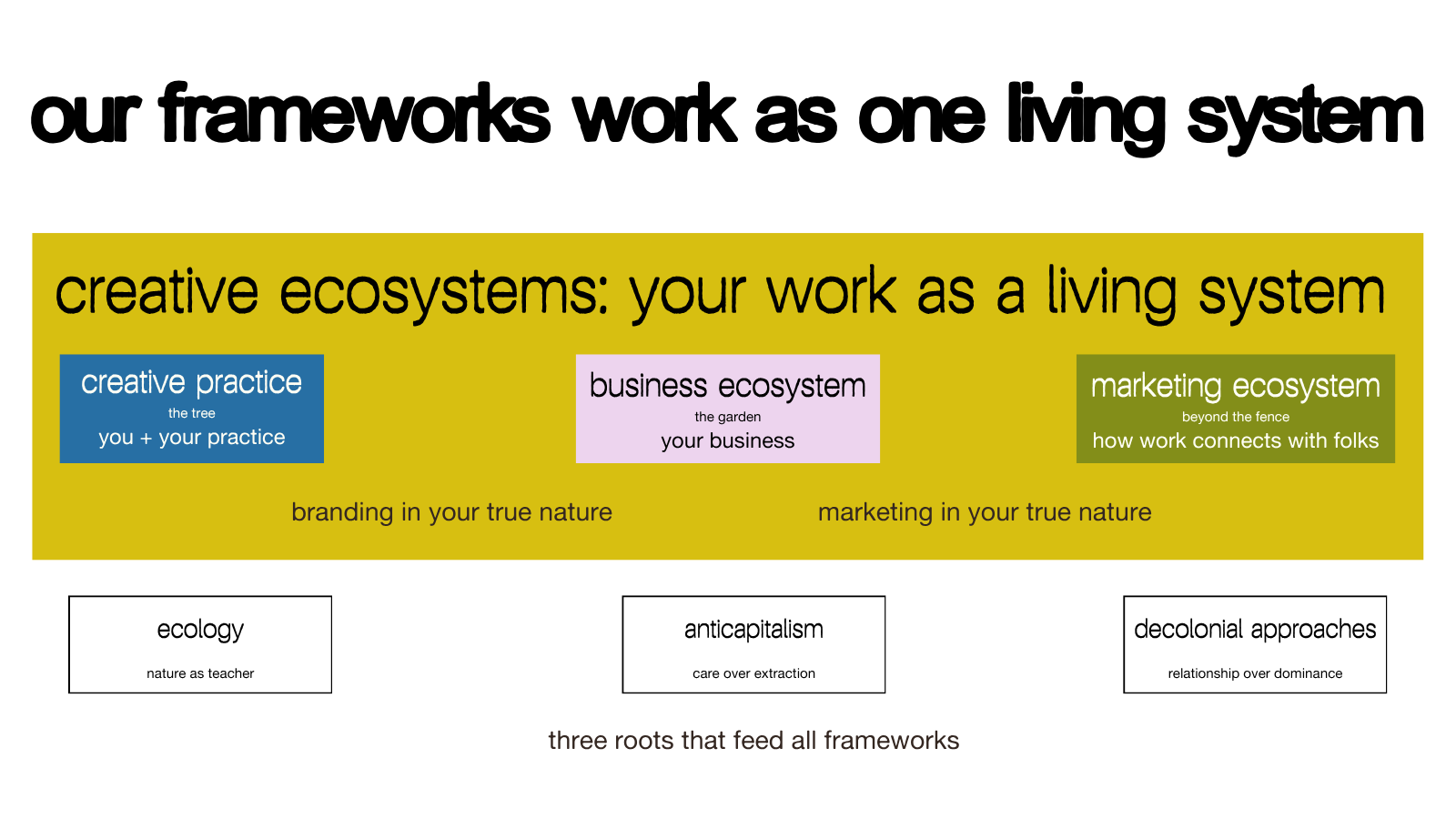
How the three connect: two bridges
The arrows between the zones aren't just words. They're the two places I see things go wrong most often, and the two frameworks I keep returning to.
Branding in your true nature: from the tree to the garden
Your brand should grow from your roots. When it's built from a template, a trend, or someone else's idea of what a professional business looks like, the garden ends up planted in borrowed soil, and it never quite takes. Branding in your true nature, which I've also called nature-based branding, means your values, voice, and way of working shape how the business shows up, not the other way around.
Marketing in your true nature: from the garden beyond the fence
There are many ways to market a business: content, email, community building, collaboration, speaking, local presence, and more. Social media is only one of them. Marketing in your true nature means choosing the few that fit how you naturally build trust, instead of forcing a playbook built for someone else.
Where your Ecological Roles of Care fit
If you know your primary role, look for it on the map. It probably shows up in more than one place, and those parts of your system likely feel easier to tend: a Sustainer may find the trunk, the water, and the paths come naturally, while a Signal Booster may feel most at home with the birds and wind.
The parts far from your role are worth noticing too. They're where a collaborator, a partner, or support can hold what you aren't resourced to hold, because a living system depends on role diversity, not on one person doing everything.
How to use the map: a short self-check
Read each question slowly and notice which ones land.
The tree: Is rest built into how I work, or only what happens when I burn out? Do my offers still grow from what I care about?
The garden: Is my pricing sustaining me? Are my offers clear, and few enough to tend well? Do my systems hold the work, or do I hold everything?
Beyond the fence: Can the right people find their way to me? Who carries my work further, and am I tending those relationships?
Try this: On the map, note the part that feels most alive right now and the part that feels thinnest. The thinnest part is usually the place to tend first, and it's often not in the zone you'd expect.
The roots underneath it all
Every framework on this map grows from the same three roots. They shape not just what we say, but how we price, partner, and work.
Ecology: nature as teacher
We look to living systems for how to work: reciprocity, interdependence, seasonality, diversity, and the composting of what no longer serves. Nature isn't a decoration we borrow. It's a teacher for how growth can happen without depletion. It's why the map is a tree, a garden, and the life beyond the fence, rather than a funnel or a flowchart.
Anticapitalism: care over extraction
Capitalism measures worth by output and growth, treats people and relationships as resources, and rewards extraction. We work against that logic. Success is measured by sustainability and relationship; growth is welcome, but enough is a real place to arrive. In practice, that looks like published prices, budget-based and sliding-scale options, pro bono work for movements, and teaching clients how their own systems work so they're never dependent on us.
Decolonial approaches: relationship over ownership
Many habits we inherited in business have colonial roots: marking ownership, treating land, labor, and culture as resources to claim, and assuming there is one "professional" way to look, speak, and work. Decolonial approaches mean questioning those inheritances, crediting the knowledge our frameworks learn from, and designing for the communities we serve rather than imposing a single standard.
When something on the map feels off in your own work, it's often one of these roots asking for attention: a business growing faster than its soil can hold, a brand built on borrowed language, or marketing that extracts attention instead of offering something.
Common questions
-
A creative ecosystem is you and your creative practice, seen as a living system: your values, rhythms, offerings, expression, and the rest and renewal that sustain them. In this map, it's the tree.
-
A business ecosystem is everything that keeps a business alive and able to give back: its values and mission, resources and pricing, systems and boundaries, offers, and impact. In this map, it's the garden.
-
A marketing ecosystem is the part of a business ecosystem that reaches outward: your story, content, channels, community, and outreach, working together to help the right people find your work. In this map, it's everything beyond the garden fence.
-
No. A funnel moves people in one direction, from stranger to sale. An ecosystem is a web of connections that carry your work in many directions, including from your community back to new people, and it depends on the health of the business it grows from.
-
With the part of the map that feels thinnest. Often that's not marketing at all, but something in the tree or the garden that marketing has been trying to make up for.
-
A framework of nine roles people play in living systems, in three clusters: the future-facing and catalytic (Seed Planters, Wayfinders, Decomposers), the stabilizing and relational (Sustainers, Pathmakers, Regenerators), and the stewards of attention and integrity (Signal Boosters, Record Keepers, Protectors). Each person carries a primary, secondary, and tertiary role, which shows which parts of their ecosystem they're naturally resourced to tend.
-
It means how your business shows up, and how it reaches people, grow from who you are rather than from a template, a trend, or someone else's playbook. Branding in your true nature, also called nature-based branding, shapes your brand from your values and ways of working. Marketing in your true nature means choosing the few kinds of marketing that fit how you naturally build trust.
-
Questioning the habits business inherited from colonial systems, like treating land, labor, and culture as things to own and assuming one "professional" standard, and designing instead for the communities you serve, while crediting the traditions your work learns from.
If you'd like to see your own system clearly
Creative Ecosystem Mapping is how we look at the whole living system at once: your tree, your garden, and everything beyond the fence. You leave with a clear picture of what's thriving, what's missing, and what to tend first.
Until next time,
Natalie Brite · DoGoodBiz Studio
