

Our 2026 Anti-Trend Report: What We Refuse To Participate In And What We’re Growing Instead
2026 already feels like it’s going to be one of those seasons where the weather can’t quite make up its mind… storm clouds one minute, unexpected sunshine the next. There’s turbulence, yes, but there’s also a sense that bigger change is rooting itself beneath the surface.
As a creative studio, there are trends we will absolutely not be doing this year. And there are beliefs and movements that we’ll stand behind with our whole chest, because our creative lives, our communities, and, honestly, our futures depend on it.
In many ways, 2026 is going to be a year that asks us to choose:
What do we want to participate in?
What do we refuse to continue?
And what kind of future are we planting with the work we do?
Let’s talk about all of it.
Reflection Moment: Your 2026 Weather Report
Before you keep reading, take 1–2 minutes and jot down:
How does your 2026 feel in your body right now? Stormy? Hopeful? Foggy?
What’s one thing you already know you’re done participating in?
What’s one thing you already know you’re committed to growing?
Keep this list nearby. We’ll come back to it.
The Trends We Refuse to Entertain in 2026
“Bleached Out Neutrality” Colors of the Year
(Insert us, gently gagging in the corner.)
Pantone has crowned a 2026 “color” of the year that looks like it was scraped off the side of a medical supply closet, and we’re opting out. And not because it’s simply uninspired. We’re opting out because color is never neutral. Not culturally, not historically, and definitely not politically.
And that’s exactly the problem with these annual “color of the year” announcements: they’re framed as harmless design fun, when in reality, they often mirror a much bigger cultural pattern.
A pattern where corporations try to soothe the public with soft, washed-out palettes during moments of collective crisis. A palette of denial dressed up as sophistication.
Color trends don’t emerge in a vacuum; they emerge from the same systems that uphold colorism, gender norms, and white supremacy culture. So when Pantone hands us another barely-there shade of “don’t look too closely,” it’s not just a color choice, it’s a cultural choice.
Color as a Cultural Weapon (and Why We’re Naming It)
Let’s be honest: the elevation of pale, muted palettes as “elegant,” “luxury,” or “professional” mirrors our society’s long-standing preference for lightness in skin, in aesthetics, in people. When whiteness is upheld as the standard for beauty, credibility, and marketability, of course design culture follows suit.
We see this in:
The glorification of pale, desaturated palettes as “high-end.”
The dismissal of vibrant, dark, or saturated hues as “too intense,” “unrefined,” or “unprofessional.”
The way gendered color coding funnels children into binary boxes before they’ve even learned to speak.
The branding trope that “feminine” must be pink and airy, “masculine” must be dark and stoic… as if brands need predetermined genders at all.
Color is never just color.
It’s a story.
It’s symbolism.
It’s social programming.
And when we quietly follow these palettes, especially the ones handed down from institutions invested in maintaining the status quo, we participate in upholding the very power structures many of us claim to be dismantling.
We’re Choosing Living Colors Instead
Inside our studio, we’re choosing a different path. We’re not aligning ourselves with palettes that feel bleached of meaning, sanitized of culture, or engineered to soothe a world that actually needs more honesty, not more beige.
We’re choosing living colors: Pigments inspired by soil, moss, rust, mycelium, dusk skies, riverbeds, clay bowls, wildfire sunsets, and that weirdly magical sliver of sunlight across a windowsill at 4:23 p.m.
Colors with texture.
Colors with meaning.
Colors that remind us the world is alive, and so are we.
These are colors that refuse to flatten themselves for mass appeal.
Colors that won’t bow to trends or algorithms.
Colors that honor the earth and the people who walk it.
Color as a Tool of Creative Liberation
Most importantly, we believe color can be liberatory.
Color can teach us:
To trust our instincts over what’s “on trend.”
To break away from palettes designed to make us more palatable.
To express ourselves honestly, not in the ways the market expects.
To reclaim creativity from corporate uniformity.
To build worlds (and brands) that feel like they belong to us — not to the systems we inherited.
When we return to color with intention, we’re not just designing. We’re practicing liberation.
We’re saying:
We don’t have to create within the constraints that supremacy culture built.
We don’t have to dull ourselves down to be accepted.
We don’t have to participate in the aesthetics of denial.
In 2026, we’re coloring outside every line that tells us who we should be.

Mini Practice: Your 2026 Color Refusal
Grab a notebook or notes app:
List 3 colors or palettes you’re done using just because they “look professional”, “fit the industry”, align with “feminine” or “masculine”… etc.
Now list 3 colors that feel like you… alive, honest, rooted.
Write one sentence:
“In 2026, my work will look more like _________ and less like _________.”
That’s the beginning of your visual manifesto.
The Glorification of Sickly Thinness
Just like color, the body is never neutral.
The culture’s chokehold on harmful body ideals always resurfaces when fascism rises… a tidy, controlled, nearly disappearing body becomes the metaphor for a tidy, controlled society. A society where compliance is rewarded, softness is punished, and humanity is squeezed into whatever shape upholds the power structure of the moment.
It’s no coincidence that as political climates intensify, beauty ideals become harsher, more punishing, more impossible.
Authoritarianism always wants us smaller in voice, in presence, in appetite, in joy. And we won’t participate.
Just as bleached-out color palettes uphold whiteness and sanitization, the glorification of thinness upholds the same systems:
white supremacy culture
patriarchal control
gender policing
capitalist extractivism
the belief that worth is earned through suffering
When our bodies shrink, so does our sense of power. When our nourishment is compromised, so is our capacity to resist. When our aesthetics are dictated by systems that want to erase us, so is our creativity. This is why, in 2026, we’re naming embodied business as an act of rebellion.
2026 Is the Year of Embodied Business
We’re choosing creativity that comes from real, nourished bodies; bodies with needs, rhythms, hungers, softness, and sovereignty. Bodies that take up space. Bodies that refuse to make themselves smaller for palatability. Because businesses, especially creative ones, wither under conditions of self-erasure. Creativity cannot thrive in a starved vessel. Liberation cannot emerge from a punished body. When we design, lead, or create from a place of deprivation or performance, the work becomes brittle. When we create from nourishment, presence, and embodiment, the work becomes alive.
Rejecting Beauty Ideals as a Form of Resistance
We stand with every person reclaiming their humanity from beauty industrial complexes that thrive in authoritarian climates. We stand with everyone who has been made to feel that power, promise, or worth must be earned through disappearance.
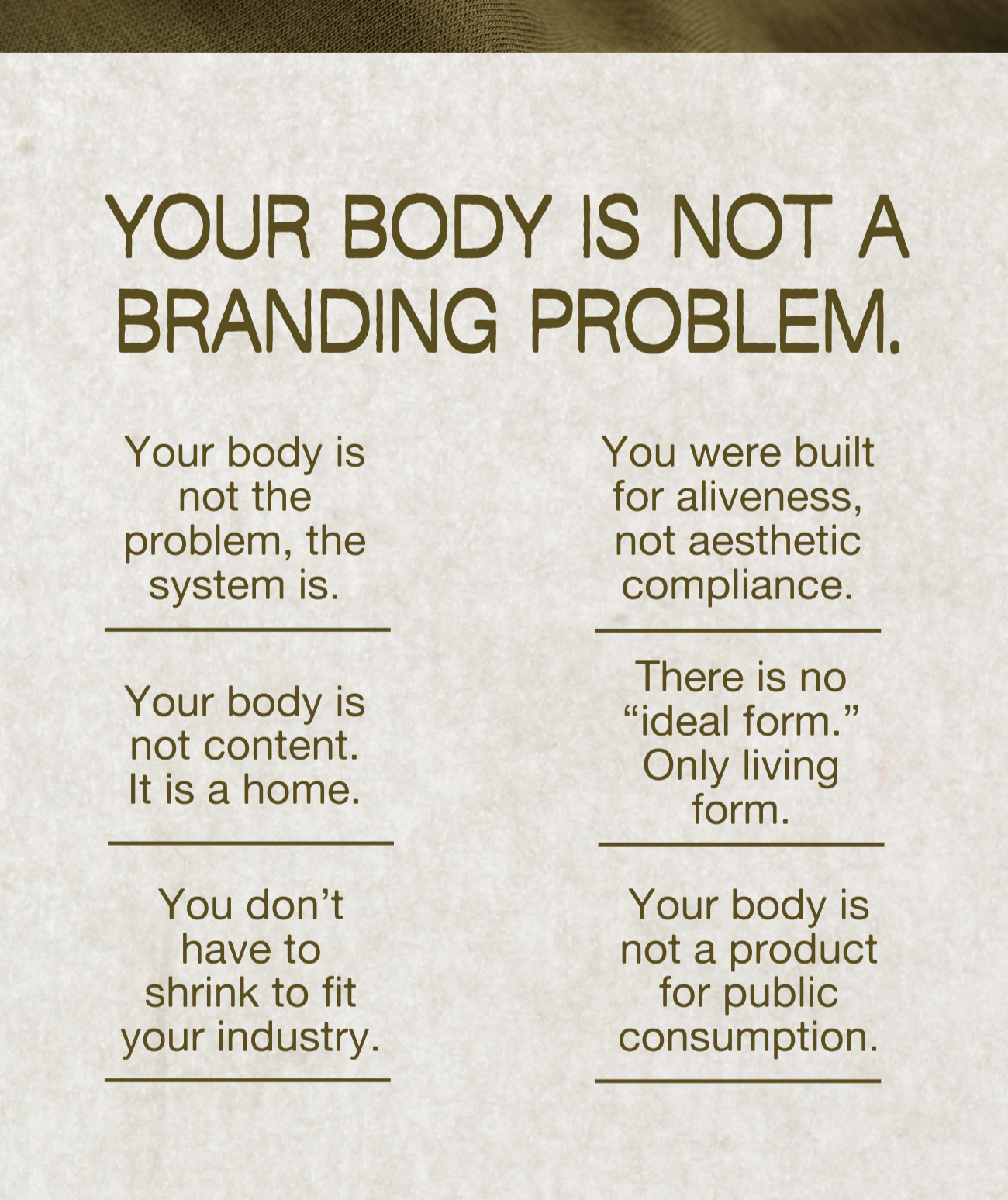
Your body, your literal physical existence, is not a branding problem to solve.
It is not a marketable asset to sculpt.
It is not a liability to minimize.
Your body is a source of intelligence, creativity, and resistance.
Embodiment as Liberation
Just as we return to living colors, we return to living bodies… fully inhabited, fully nourished, fully allowed to be what they are.
To reclaim the body is to reclaim your creativity.
To reclaim your creativity is to reclaim your power.
And to reclaim your power is to disrupt the systems that benefit from your exhaustion, insecurity, and self-doubt.
In 2026, we’re choosing embodied business, embodied creativity, and embodied rebellion.
We’re eating, resting, softening, taking up space, and refusing the aesthetics of erasure.
Check-In: Your Body & Your Business
Ask yourself:
Where am I asking my body to be “on brand” instead of letting it be human?
What expectations about my appearance, personality, or productivity am I ready to release?
What would “embodied business” mean in my daily life this year? (List 3 real behaviors: more breaks, slower launches, no work after X time, etc.)
Choose one small embodiment shift you’re willing to commit to this month.
Gender Binaries as a Marketing Strategy
Hard pass.
If the glorification of thinness is about shrinking bodies and the glorification of bleached-out palettes is about sanitizing culture, then gendered branding is about confining our identities into tidy little boxes that make the world easier for systems of power to manage.
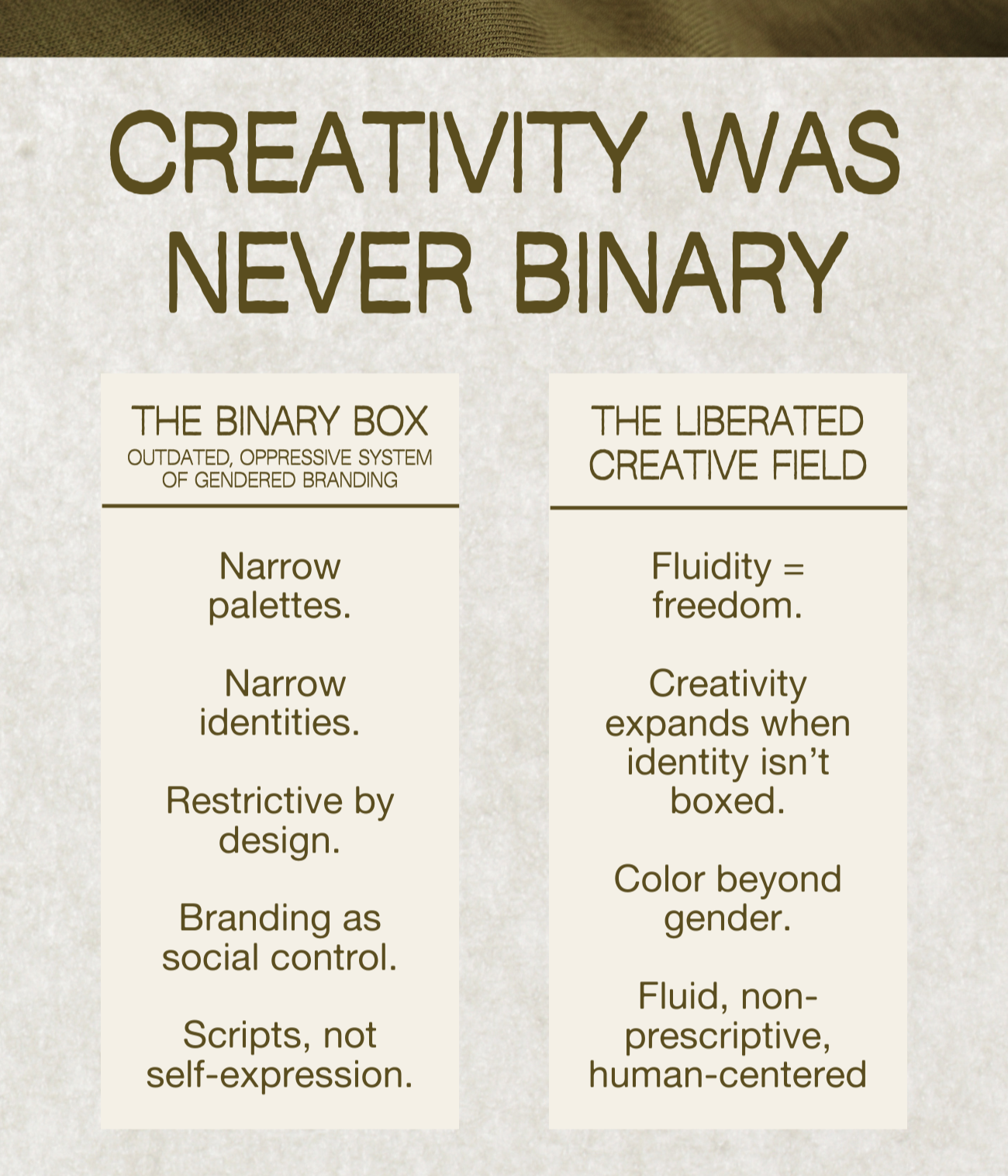
Creativity has always been non-binary. Nature itself refuses the binary. And yet branding still clings to outdated gender scripts like it’s 1952 and we’re all decorating our assigned bathrooms.
Gendered branding isn’t cute. It’s a tool of social control.
Just like colorism and body ideals, gender binaries in marketing didn’t appear out of nowhere. They come from the same systems we’ve already been talking about: white supremacy culture, heteropatriarchy, and capitalism… all of which benefit from keeping us predictable, compliant, and divided.
Binary Branding as a System of Control
For decades, marketing has relied on the belief that people must fit into two rigid boxes:
Soft = feminine = pink = emotional = domestic
Strong = masculine = blue = logical = authoritative
These aren’t brand choices, they’re cultural scripts designed to uphold hierarchy.
And when brands lean on these binaries, even inadvertently, they reinforce:
Gender policing
Harmful stereotypes
The idea that aesthetics have genders
The belief that creativity must “perform” masculinity or femininity to be legible
The false binary that people are simpler than they actually are
This is not just outdated; it’s oppressive.
2026: The Year Binary Branding Finally Collapses
The world is more fluid, more curious, more expansive than ever. Younger generations are already rejecting branding that tries to gender them into submission. They’re not interested in buying products that come with built-in identity constraints. 2026 is the year “masculine vs. feminine branding” becomes the new dinosaur, a relic of an era that’s finally dying off.
Forward-thinking brands won’t be aligning with masculinity or femininity. They’ll be aligning with humanity.
Designing for Humans, Not Scripts
Businesses that thrive in this next era will be those that:
Design for real people, not gender stereotypes
Choose colors, forms, and styles because they communicate meaning, not because they fit a binary
Understand identity as fluid, relational, and shaped by lived experience
Allow creativity to breathe, stretch, and exist outside prescriptive categories
This is not about making everything “neutral.” It’s about making everything honest and alive.
Creative Liberation Requires Gender Liberation
When we free our creative work from gender constraints, we make room for:
More nuanced storytelling
More expansive visual worlds
More self-expression
More belonging
More authenticity
Just as we’re choosing living colors and embodied business, we’re choosing a liberated creative practice; one that refuses to uphold gender scripts that were never designed for freedom.
In 2026 and beyond, we’re designing ecosystems, not binaries. Fluidity, not categories. Humanity, not gender roles. Because creativity, like nature, was never meant to be boxed in.
Prompt: Audit Your Brand for Gender Scripts
Take inventory:
Where does my brand lean on “for women,” “for men,” “feminine,” or “masculine” language or visuals, and why? What structures am I upholding by doing so and am I OK with that?
Which of those choices actually feel aligned, and which feel inherited, expected, or default?
How could I describe my work without using gendered shorthand at all?
Write 2–3 new, non-gendered ways to describe your brand’s vibe, aesthetic, or audience.
“Growth At Any Cost” Economics
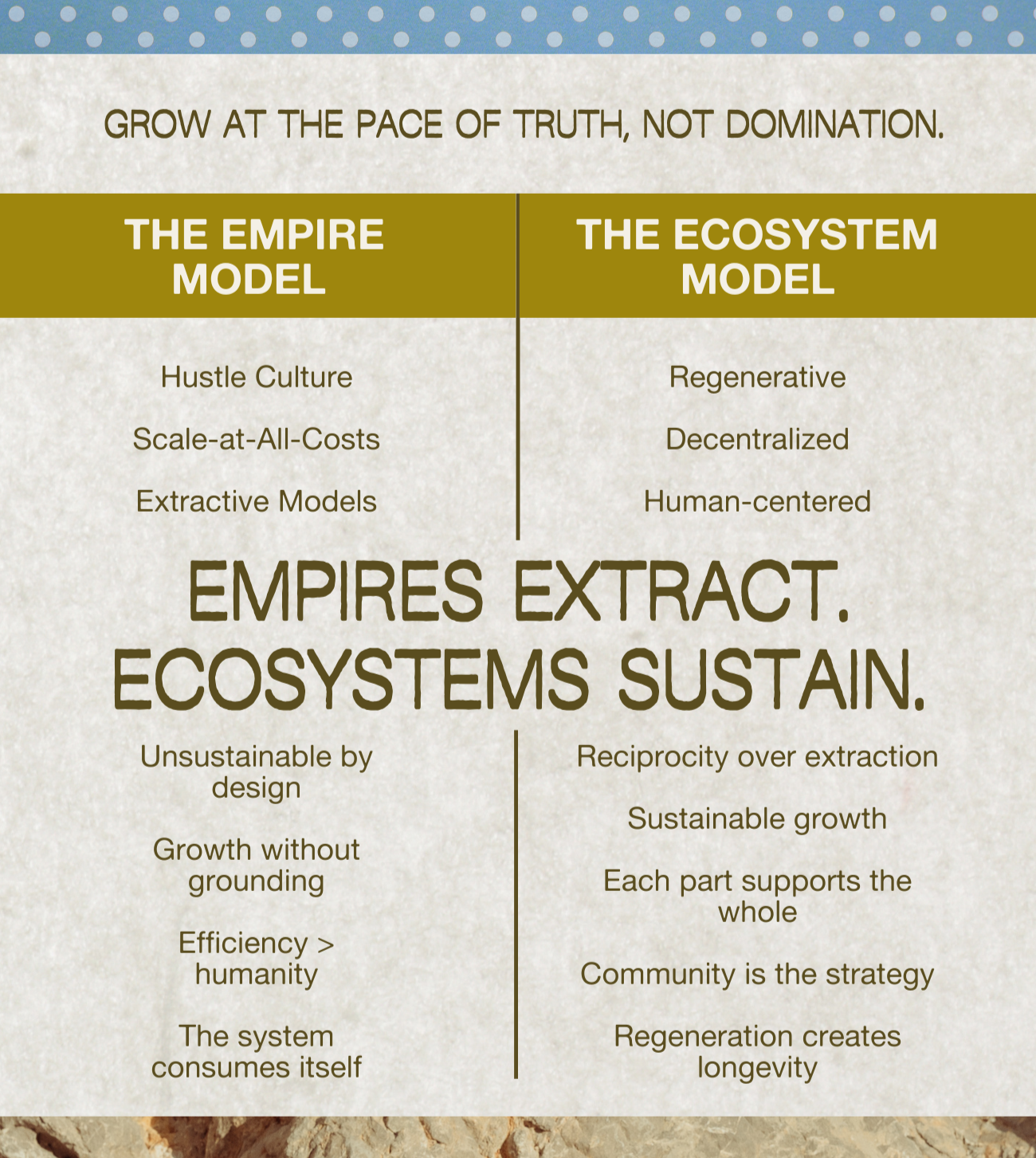
The age of empire-building is over.
We’re witnessing the final gasps of grind culture; the income-hoarding coaching empires, the performative wealth signaling, the “10x your revenue in 30 days” smoke-and-mirrors routine. These models weren’t just unrealistic. They were built on the same extractive logic that props up white supremacy culture: produce more, consume more, dominate more, at any human or ecological cost.
It’s the economics of empire: scale over sustainability, optics over integrity, accumulation over community. And in 2026, it doesn’t just feel outdated, it feels delusional.
Because shouting “I’m still asleep!” in a world begging us to wake up is not a strategy. We’re living through climate collapse, political instability, rising fascism, and a cultural exhaustion that can be felt in our bones. People don’t want empires anymore. They want ecosystems. They want businesses that feel alive, relational, and rooted in something more meaningful than quarterly metrics.
2026 Demands a Different Kind of Economy
This year is not about exponential growth; it’s about right-sized growth. It’s about choosing sustainability over spectacle, regeneration over extraction.
We’re stepping into an era defined by:
Circular economics — where resources move through cycles, not pipelines.
Sustainable, diversified income streams that honor our humanity rather than exploit it.
Local manufacturing and community-centered collaboration.
Business models rooted in reciprocity, not hierarchy.
Regenerative practices that replenish rather than deplete.
This is a sustainable business. Embodied business. Liberatory business. A business that grows at the pace of truth, not at the pace of domination.
Empires crumble because they consume themselves. Ecosystems endure because they take care of what they rely on.
Exercise: Your Anti-Empire Business Check
Ask yourself:
Where am I still chasing scale or revenue from a place of fear, comparison, or pressure?
What would “right-sized” growth look like for me this year? (Be specific.)
What’s one small shift I can make toward ecosystem-building (community, collaborations, reciprocity) instead of empire-building?
Write 1–3 “Enough Statements,” like:
“In 2026, enough looks like ______.”
Tech Hype Without Ethics (AI, We’re Looking at You)
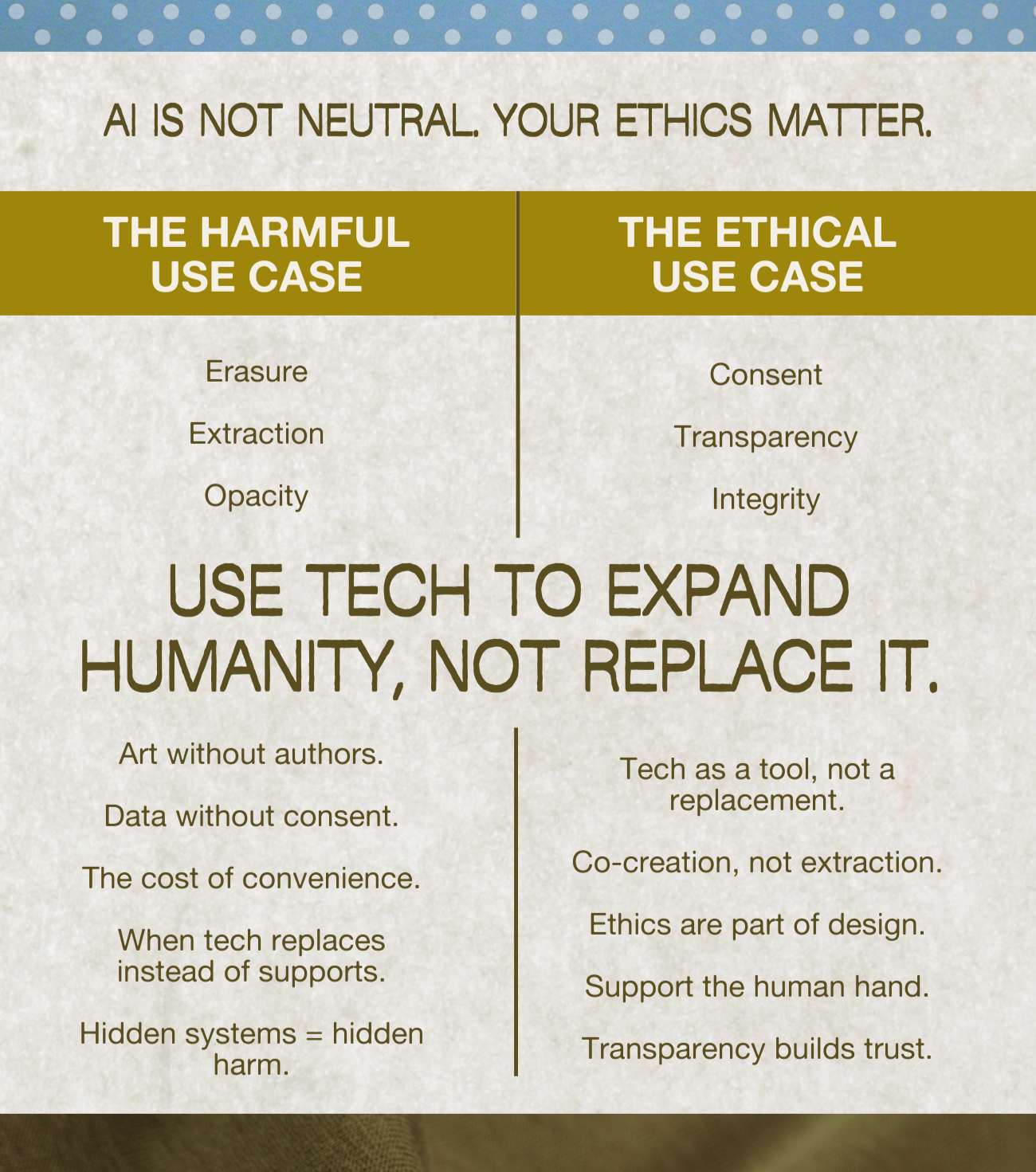
AI is going to get louder, faster, and more omnipresent. That part isn’t up for debate. But how we engage with it… that is where the line gets drawn.
And just like body politics, color theory, and gendered branding, technology doesn’t exist outside of the systems we’ve been naming. AI is shaped by bias. It’s trained on inequality. It’s built on the labor and cultural extraction of millions of people who never consented.
Which means AI isn’t just a tool. It’s a moral landscape.
And 2026 is the year we stop pretending otherwise.
AI Without Ethics Upholds the Very Systems We’re Dismantling
When AI is used irresponsibly, it reinforces:
Artistic erasure
Surveillance culture
Data extraction
White supremacy and biased datasets
Profit-over-people business models
The devaluation of embodied, human creativity
When we automate away craft, we don’t liberate ourselves, we hand our agency to systems built for extraction.
What Matters Now Is Not the Tool, But the Values Behind It
2026 asks us to use AI with:
Transparency — no hidden automation.
Consent — respecting creators’ rights and boundaries.
Attribution — honoring the lineage of the art, ideas, and labor we draw from.
Integrity — making sure AI supports creativity, not replaces it.
Intention — using tech to restore capacity, not erase humanity.
AI should free us from busywork, not from our creative identities and autonomy. It should create spaciousness, not strip away the soul of the industries we belong to.
2026 Will Split the Room
Not between “AI users” and “AI avoiders.” But between:
those who use AI to accelerate harm, and those who use it to build liberatory futures.
We know exactly where we stand. We’re here for ethical tech, transparent creation, and tools that expand human creativity, not harm it.
Because the future of business isn’t AI-powered.
It’s ethically powered.
Human-powered.
Liberation powered.
Values Check: Your Personal AI Ethics
If you use or plan to use AI in your work, journal on:
Where am I already using AI? Where might I be hiding that from my audience or clients?
What personal red lines do I want to set around AI use? (No training on artists without consent, no AI imagery, no fake or made-up claims, etc.)
How can I name my AI policies clearly on my website or in my client onboarding?
Write 3–5 sentences that could become your “AI Ethics Statement” for your brand.
The Shifts We Are Participating In
A Return to Human-Centered Business
After years of watching the online world sprint toward automation, scale-at-all-costs, and soulless money & clout chasing, the pendulum is swinging back, hard. People are hungry for real connection, real integrity, and real humans behind the work they support.
2026 is not the year of bigger, faster, louder. It’s the year of truth.
We’re seeing a collective reclaiming of:
Authentic relationships built on mutual care
Local sourcing and community-rooted production
Makerspaces, studios, and creative ecosystems that gather people
Businesses and relationships that feel human, not mechanized or extractive
Brands that understand their place inside, not above or separate from, the community
Founders who know what they stand for and aren’t afraid to speak up
The differentiator is no longer:
“How quickly can you produce content?”
But rather:
“Do you care about the world you’re creating content for?”
Human-centered business isn’t a trend. It’s a sustainability and survival strategy in a time of dehumanization.
Embracing Values-Based, People & Planet Centered Marketing
Gen Z isn’t just rewriting the marketing playbook, they’re shredding the old one and composting it.
Their thesis is very simple:
“If you don’t stand for anything, you’re not relevant.”
They grew up in a world of climate collapse, fascism creeping at the edges, and political instability as wallpaper. Their bullshit detectors are tuned to a frequency older generations can’t avoid.
Meanwhile, many older generations are still clinging to outdated beliefs like heirlooms… relics of a time when “neutrality” was considered safe, professional, or polite.
But neutrality is not neutral. Neutrality upholds the dominant culture.
So in 2026, values-based marketing isn’t a “nice-to-have.”
It’s the floor. The bare minimum.
People want:
Transparency
Anti-racism in practice, not in branding campaigns
True sustainability (beyond recycled mailers)
Business owners who don’t dodge social issues because they’re “polarizing”
Brands that take real stances against fascism, white supremacy, bigotry, and structural harm
Your values aren’t a brand accessory. Your values are your strategy.
The Decentralization of the Attention Economy
Trying to “beat the algorithm” in 2026 is going to feel like trying to catch fog with a fishing net… exhausting, confusing, and fundamentally missing the point.
We’re entering a decentralized attention economy where people are choosing intimacy over virality, depth over scale, and community over mass reach.
Expect to see:
Smaller, values-aligned platforms
Niche newsletters and micro-communities
Local-first brand ecosystems
Creative networks instead of content factories
More people stepping away from algorithmic spaces altogether
A rise in unpolished, genuine, values-led presence
Performance is out. Relational marketing is in.
Creativity Becomes the New Currency
As AI-generated sameness floods digital spaces, human creativity becomes more valuable, not less.
Small businesses, sole proprietors, and micro-creatives will lead cultural innovation because they can do what machines can’t: create from lived experience, identity, humanity, and values.
We’ll see a resurgence of:
Handcrafted goods and tactile design
Folk art, field-guide aesthetics, and natural textures
Mixed-media storytelling (zines, collage, animation, hybrid formats)
Visual work that looks alive
Imperfection as a design flex; the signal of an unautomated hand
In an era where technology can replicate everything except the soul, creativity is no longer a commodity.
It’s a political act.
It’s a differentiator.
It’s a form of resistance.
Circular, Local, Earth-Centered Business Models
Climate instability and global supply chain fragility have made it abundantly clear: extractive business models are not just unethical, they’re unsustainable.
2026 will bring a rise in:
Local manufacturing and hyperlocal production
Upcycling and repair economies
Rental, reuse, and circular product models
Zero-waste packaging and regenerative practices
Ecosystem-based entrepreneurship
Multiple income streams built for resilience, not domination
This is the shift from empire thinking to ecosystem thinking. The businesses that will thrive are those that understand they are part of an interconnected web, not perched above it.
A Cultural Demand for Better Living Conditions & Less Work
The collective nervous system is fried. People are exhausted, grieving, stretched thin, and done being spiritually or physically owned by their jobs.
2026 will usher in a quality-of-life revolution.
Expect:
Four-day workweeks being pushed for as a new norm
Work-life boundaries becoming normalized
Anti-hustle culture business models
Flexible, accessible, human-centered workplaces
A rejection of “work as identity”
Greater emphasis on community care and mutual aid
A cultural shift toward nourishment, rest, joy, and embodied presence
People aren’t dreaming of becoming machines anymore. They’re dreaming of becoming human again.
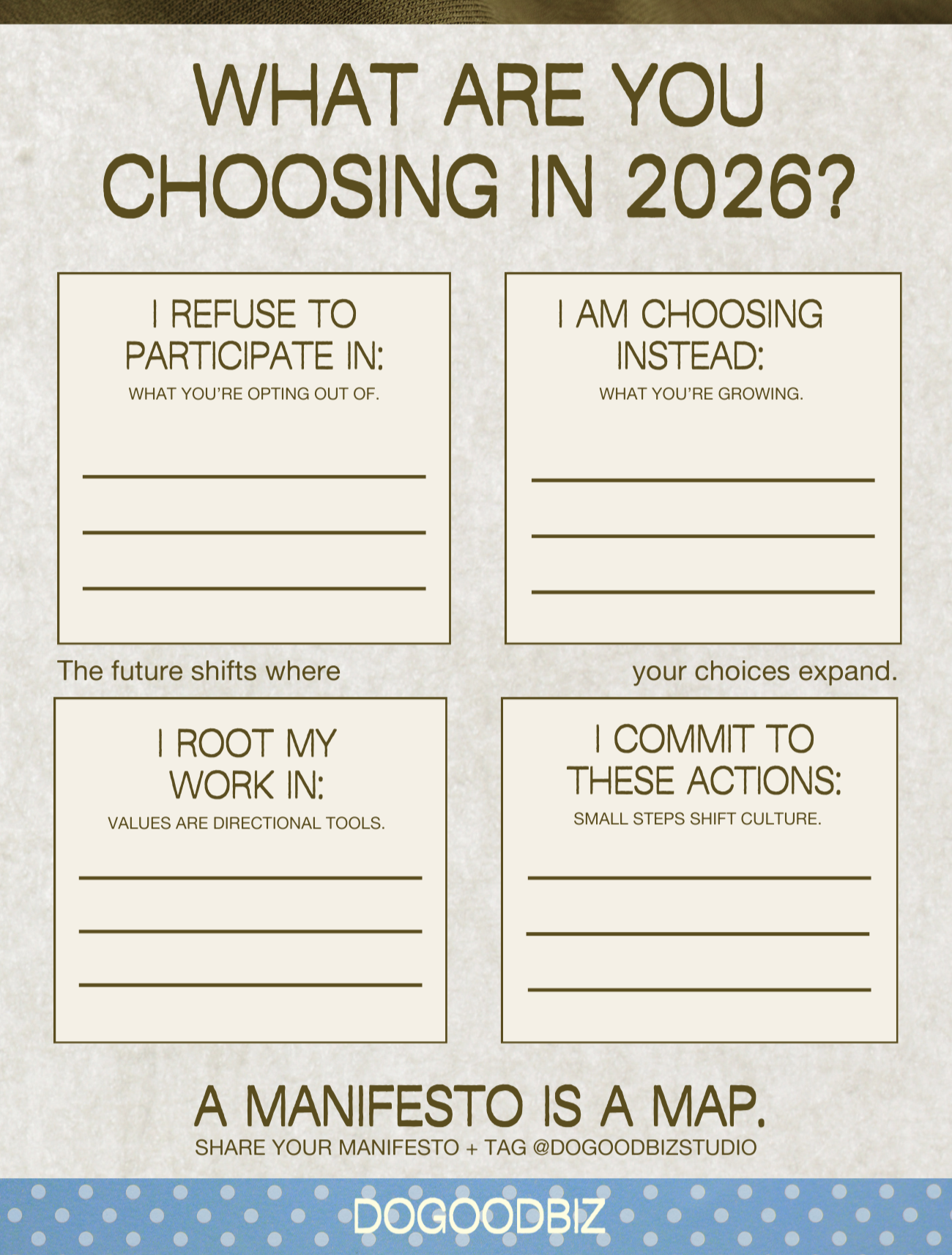
Build-Your-Own Mini Manifesto
Using everything you’ve just read, complete these prompts:
In 2026, I refuse to participate in…
(List at least 5 things: aesthetics, business models, norms, expectations.)In 2026, I actively choose to stand for…
(List at least 5 values, practices, or commitments.)The world I’m helping build through my work looks more like…
(Describe it: community, conditions, aesthetics, politics.)Turn it into a single statement you can put on your wall or in your studio:
“In 2026, my work exists to ________, and I refuse to ________.”
That’s your first draft of a 2026 manifesto.
So What Do We Do With All of This?
We build differently. We create differently. We market differently. We choose differently.
This next era demands something deeper from small businesses, creatives, and founders:
Take a stance.
Acknowledge the world you’re operating in.
Design with integrity.
Market with intention.
Build without extracting.
Create work that doesn’t look away from the world’s realities but looks directly into them and chooses to do better.
2026 is not asking us to be perfect. It’s asking us to be awake. To be embodied. To be values-led. To be liberated in the ways we design, communicate, and contribute.
It’s asking us to create ecosystems, not empires. It’s asking us to remember we belong to each other. And it’s asking us to build businesses that make the world a little more livable, not a little more optimized or controlled.
Because in the end, your business is not just a brand.
It’s a worldview.
It’s a stance.
It’s a contribution.
It’s a way of shaping the future.
And the future we’re choosing is one rooted in care, creativity, justice, and collective liberation.
If you used this piece to sketch out your own 2026 manifesto… what you’re opting out of, what you’re standing for, and the world you’re trying to help build… share it with me!
What are you refusing, and what are you choosing instead, in 2026? Post a snippet, a notes-page photo, or a graphic of your manifesto and tag @dogoodbizstudio so we can cheer you on, and amplify the futures you’re dreaming into being.
If you're building something that rejects these trends, then we'd love to work with you. DoGoodBiz Studio exists for exactly this kind of business. Start a conversation →
Natalie Brite | DoGoodBiz Studio
