Transform Your Marketing with Ecosystem Mapping
Most small business owners were never taught how to build a marketing system that feels human, doable, or rooted in their values. Instead, we’re told to “grow fast,” “be everywhere,” and “keep up”, all ideas rooted in hustle culture and platform dependency, not in sustainable business or well-being.
But what if your marketing didn’t feel like running an endless race?
What if it functioned more like a creative ecosystem: relational, grounded, diverse, resilient, and adaptable? That’s what Marketing Ecosystem Mapping is all about. It’s the process we use inside DoGoodBiz Studio to help creatives, healers, coaches, artists, and values-driven entrepreneurs build a marketing system that mirrors how nature works…not how capitalism tells us to hustle. And once you start thinking in ecosystems, not platforms, something shifts.
Marketing becomes clearer.
Your energy becomes protected.
Your audience becomes better supported.
Your content becomes more sustainable.
And suddenly… everything feels more possible.
This article breaks down how ecosystem mapping works and why it’s a powerful tool for building marketing that actually aligns with your life, mission, and nervous system.
First, What Is a Marketing Ecosystem?
Most people think of marketing as a scattered collection of tactics:
post on Instagram
write an email
create a Reel
maybe write a blog
hope the algorithm blesses you today
This is not a system. It’s a reaction.
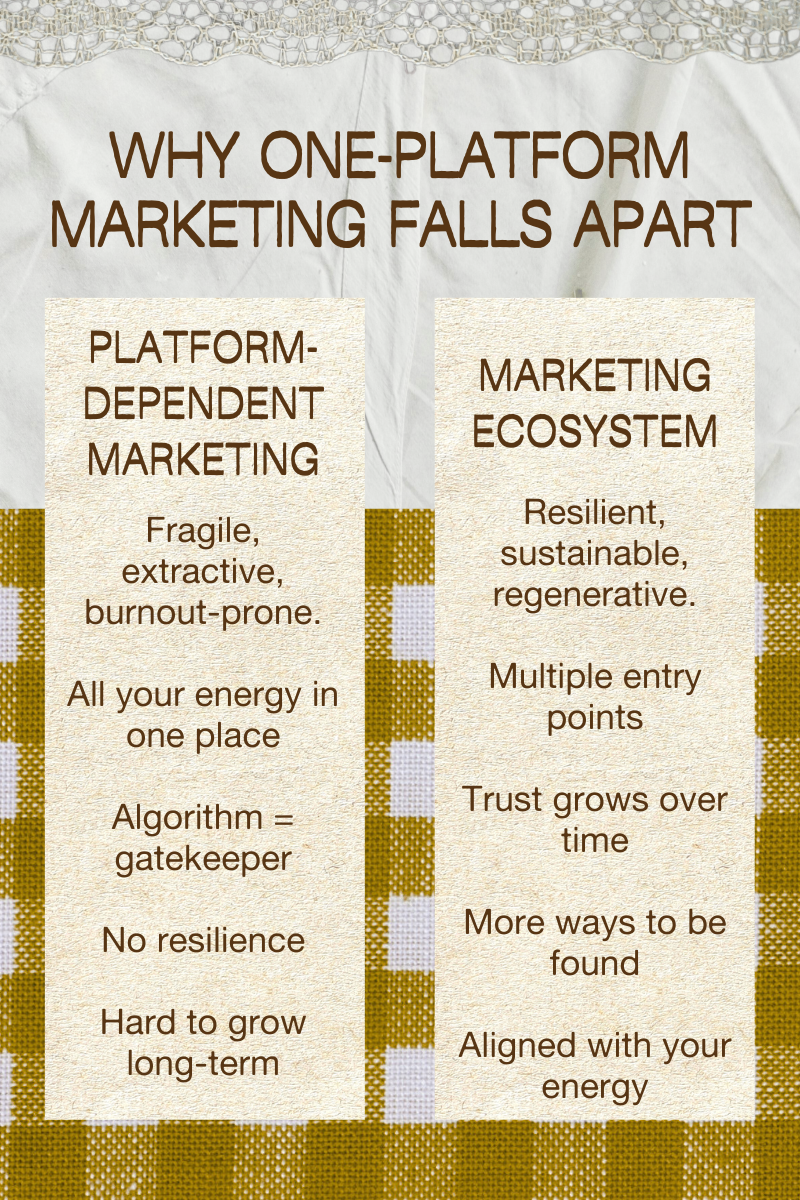
A marketing ecosystem, on the other hand, is a living network of touch-points that support each other, much like a forest supports itself through roots, mycelium, soil, water, and sunlight.
In a healthy marketing ecosystem:
You understand how each channel works together
Nothing relies on a single platform
Social media is optional, not a lifeline
Your audience is guided through a meaningful journey
You protect your energy and pace
Your work becomes regenerative, not extractive
An ecosystem is diverse, relational, and sustainable, which makes it incredibly resilient.
Why Mapping Your Marketing Ecosystem Matters
Marketing has become overwhelmingly platform-centered, especially on Instagram, which demands constant output, instant responsiveness, and performance-based content.
However, platform-centric marketing is akin to a fragile monoculture. If one thing fails, a drop in reach, a new algorithm, a hacked account, your entire business ecosystem collapses.
Ecosystem mapping helps you:
Clarify the purpose of every channel
Identify what’s nourishing you vs. draining you
Reduce dependence on volatile platforms
Move your audience toward owned channels (email, website, Substack)
Create content that’s reusable and sustainable
Build a marketing system that doesn’t collapse in burnout
It takes your business from “posting and praying” to intentional, strategic, grounded, nature-based marketing.
A Real Example: How Ecosystem Mapping Helped a Creative Healer Rebuild Their Strategy
One of our clients, a trauma-informed hypnotherapist, mindfulness teacher, and writer, came to us feeling scattered and exhausted.
They were navigating:
relocating to a new country
losing connection with their existing audience
Instagram burnout
very little joy in content creation
a small but loyal newsletter list they wanted to grow
no strategy tying everything together
They weren’t “doing anything wrong.” They simply didn’t have an ecosystem.
What We Built Together:
1. A Marketing Ecosystem Map
A visual diagram of:
Instagram (minimal role)
Substack (primary outreach)
website (conversion hub)
email list (nurture + community)
collaborations & partnerships (rooting locally)
Everything was connected.
Everything had a purpose.
2. A Slow, Sustainable Content Plan
Not a calendar full of deadlines, but a rhythm rooted in:
seasonal themes
what they wanted to be known for
their creative energy
their capacity
their mission
Content became something liberating again, not a chore.
3. Channel Audits
We audited:
Instagram → reduce pressure, post minimally
Email → simple growth loops + community-led content
Website → US-based optimizations + clarity flow
Substack → become the new “Home Base”
4. Video walkthroughs
So implementation didn’t feel overwhelming, confusing, or “techy.”
5. Website Support + Strategy Workshops
To align messaging, structure, and user journeys with their new ecosystem.
The Result?
A transformation rooted in clarity, confidence, and alignment:
They rediscovered their creative voice.
Their email list started growing.
Their burnout faded dramatically.
Substack became energizing, not heavy.
Their marketing no longer revolved around Instagram.
Everything started feeling like them again.
This is the power of mapping your ecosystem instead of chasing “best practices.”
How to Apply Ecosystem Thinking to Your Marketing
These are the same steps we use with clients:
1. Identify Your Roots
Your roots are your:
values
mission
desired impact
energetic capacity
natural creative rhythm
community
Your marketing must grow from here, not from trends or algorithms.
2. Name Your Ecosystem Layers
Think of each marketing channel as a layer in an ecosystem:
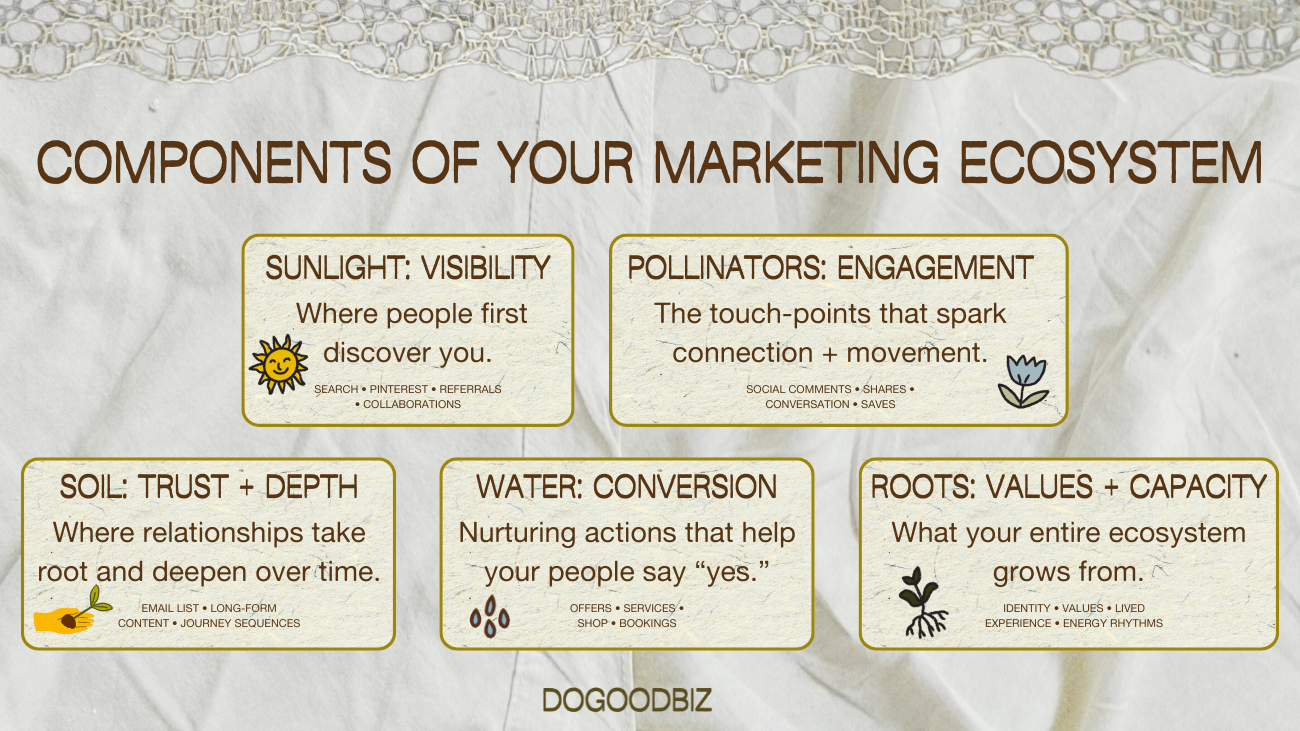
Sunlight → Visibility
(platforms that attract new people: Pinterest, collaborations, SEO)
Pollinators → Engagement
(places where people interact: Substack, Instagram comments, events)
Soil → Depth + Trust
(email newsletter, blog, long-form content)
Water → Conversion
(your website, sales pages, booking flows)
Most people try to do everything in the “sunlight layer.” But ecosystems thrive when all layers work together.
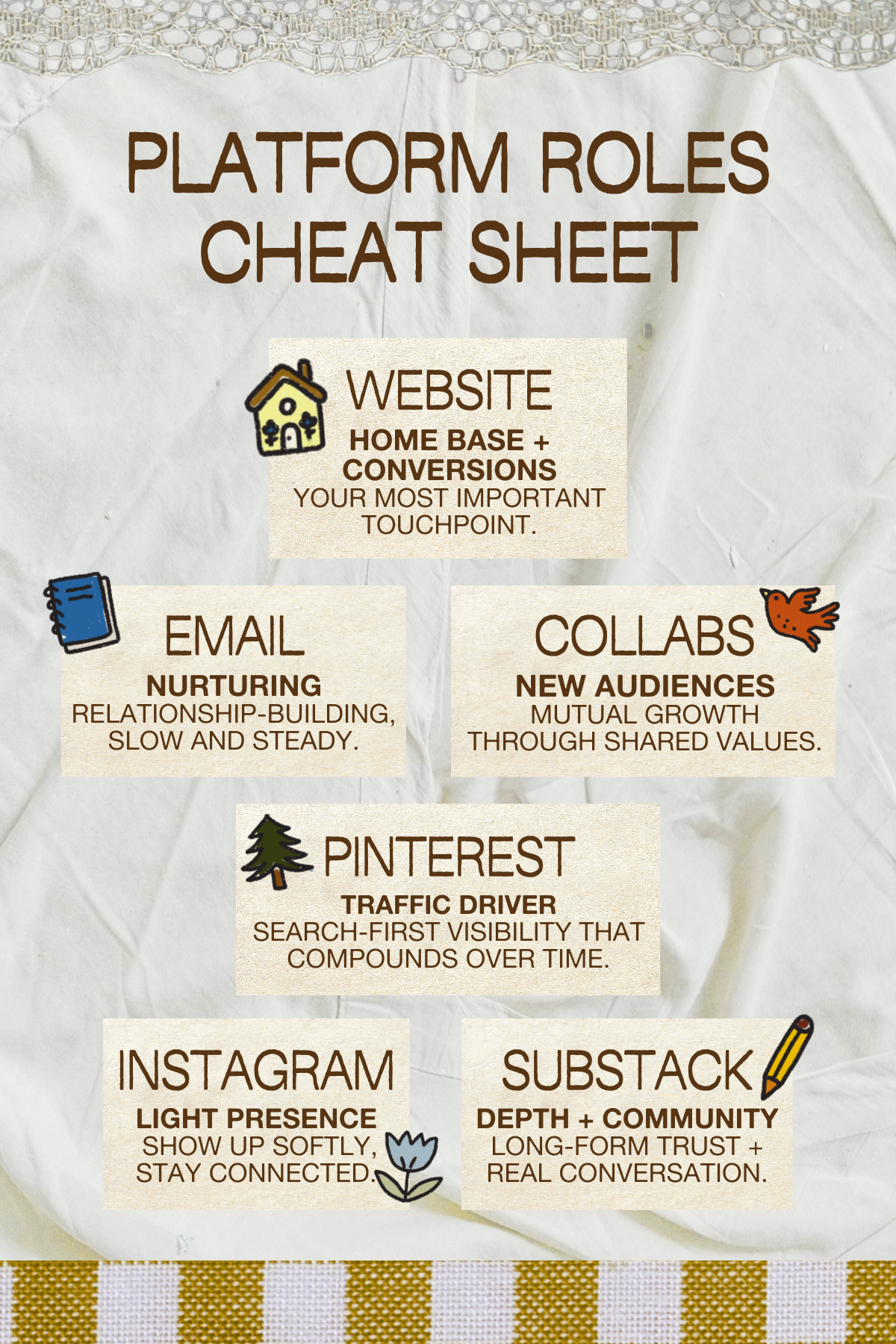
3. Define Each Channel’s Role
Ask:
What is the purpose of this platform in my ecosystem?
Maybe:
Instagram = minimal presence, human touch
Pinterest = traffic driver
Website = conversion hub
Substack = community + long-form writing
Email = deeper nourishment
Collaborations = new audiences
When platforms have a role, they stop feeling overwhelming.
4. Align Your Content With Your Values + Energy
Your ecosystem should reflect who you are:
If you love writing → Substack + blog + email
If you love visuals → Pinterest + website
If you love community → collaborations
If you’re burnt out → simplify drastically
You get to build a marketing system that fits your life.
5. Build Regenerative Loops (So You’re Not Constantly Creating)
Regenerative loops are systems where:
one piece of content feeds multiple channels
you reuse ideas seasonally
your marketing grows richer over time
Example:
Blog → Substack → Email → Pinterest Pins → Website evergreen content
This approach protects your energy, and grows your audience.
Why Ecosystem Mapping Changes Everything
It helps you:
✔ get out of reactive mode
✔ stop treating Instagram as your business backbone
✔ focus on platforms that nourish you
✔ build long-term assets (email, SEO, blog)
✔ create content that lasts
✔ feel connected to your mission again
✔ grow slowly, sustainably, intentionally
✔ feel like your marketing finally makes sense
Marketing stops being a grind. It becomes a grounded, nature-based system that can support you for years.
Ready to Build Your Marketing Ecosystem?
If you’re overwhelmed, burnt out, or unsure where to begin, you’re not alone. Most creatives were never taught how to build a sustainable marketing system.
But once you map your ecosystem, everything becomes clearer.
Your next steps.
Your priorities.
Your pace.
Your content rhythm.
Your path forward.
If you want support, this is the work we love most. We help creatives, healers, coaches, and purpose-driven businesses build sustainable, regenerative marketing ecosystems that honor their energy, values, and mission. If you’re ready, we’d love to help you map yours.
Until next time,
DoGoodBiz Studio
Similar Reading: