

How creative work gets discovered online just changed. here's what I know
Can good work still be discovered online? Yes. But the rules changed significantly, and most of what you're reading about it is either panic or dismissal. Neither is actually useful. This post is the longer, more honest version: what actually happened to Google search, what it means for the kind of values-rooted, specific, human-made work most of us are building, and what to actually focus on, with two full checklists and a plain-language breakdown of the shift.
I've been prioritizing SEO and website optimization since January. I'm showing up in Google's AI Overviews for "ethical creative studio." It didn't happen by accident; it happened because I've been learning how the system actually works, and building something strong enough to be cited within it. Here's everything I've learned.
What Google SEO actually was
SEO stands for Search Engine Optimization. For the last two decades, it basically meant one thing: when someone types a question into Google, Google returns a list of links to websites. SEO was the practice of strategically working to get your website showing up near the top of that list.
The way Google decided which links to show first was complex; it looked at things like how relevant your content was to the search, how many other websites linked to yours, how fast your site loaded, and whether your pages were structured in certain ways. But the fundamental goal was simple: get Google to show your link, get the person to click it, and get them to your website.
That's it. That's what SEO was: a game of links and clicks.
And it worked. A well-optimized website with good content could reliably bring in a stream of new visitors: people who had never heard of you, searching for something you knew about, finding their way to your corner of the internet. For small businesses, creatives, and movement makers, it was one of the most powerful tools for reaching people who didn't already know your name.
What Google is now & why people are freaking out
Google is no longer primarily returning a list of links.
When you search for something today, especially a question, a how-to, or an explanation of a concept, Google often just answers it. Right there on the page. Before the links. Before you ever click anything. This is called an AI Overview, and it's generated by Google's own AI that reads, synthesizes, and summarizes content from across the web to give you an answer directly.
Think of it this way. Old Google was a librarian who handed you a list of books that might have the answer. New Google is a librarian who reads all the books and tells you the answer themselves, sometimes mentioning which books they drew from.
This is a hugely significant shift. In January 2025, AI Overviews appeared for about 6.5% of all Google searches. By March 2025, that had more than doubled to over 13%, and the trajectory suggests they could appear for 20–25% of all queries by the end of the year.
The reason so many people are in a spiral right now: if Google answers the question on the page, a lot of people never click through to a website at all. That's called a zero-click search, and it's becoming the norm. If you used to get 100 visitors a month from a particular search term, and Google now shows an AI Overview for that term, you might be getting half that traffic. Or fewer.
The impact hits hardest on informational content, how-to guides, educational posts, and explanatory articles, which make up 88% of the queries that trigger AI Overviews. If your blog strategy was built around answering common questions in your field, that strategy is significantly less effective than it was two years ago.
People are right to be concerned. But here's where the panic tends to go sideways.
What people are misunderstanding about this shift
Misconception 1: SEO is dead
It isn't. AI search actually depends on traditional SEO to work. Large language models don't invent information; they pull from indexed web content, structured data, and trusted sources to generate their answers. If your website is well-structured, loads properly, has clear content, and has earned credibility over time, all of that still matters. It now matters differently, but it matters.
Misconception 2: This affects all content equally
It doesn't. The traffic erosion has been particularly devastating for news publishers and large-scale educational content sites, not for small, specific, thought leadership practices and businesses. The content getting absorbed by AI Overviews is generic, information-first content that could have been written by anyone. That's not what most values-rooted creative practitioners produce.
Misconception 3: If your traffic drops, your business is in trouble
Not necessarily. Traffic and business health are not the same thing. If the people who find you are more qualified, more aligned, and more ready to reach out, because the generic browsers have been filtered out by AI, your conversion rate may actually go up even as raw traffic numbers fall.
Misconception 4: You need to completely change your content strategy
You don't need to throw out what you've built. You need to understand what still works, what needs to shift, and what new layer of strategy needs to be added on top.
Misconception 5: If you're done with Google personally, you should remove your business from it too
This one is worth addressing directly because the degoogling movement is real and growing. People are switching their personal search engines to DuckDuckGo, Brave, Startpage, or Perplexity, and for personal use, that's a completely reasonable choice.
But there's an important distinction between you choosing not to use Google to find things and removing your business from Google's ability to find you.
If you block Google from indexing your website, abandon your Google Business Profile, or stop publishing content that Google can read and reference, you are not opting out of a system you disagree with. You are making yourself invisible to the people who are still using it, which is still most of them. Google processes between 9 and 13 billion searches every day. Even as the degoogling movement grows and AI tools like ChatGPT and Perplexity take market share, Google remains the dominant infrastructure for how people find businesses, services, and information online.
You can reduce your personal dependence on Google's ecosystem while still maintaining a strong, well-optimized presence within Google's search infrastructure for the people who are looking for what you offer. Principled and findable are not opposites.
Traditional SEO vs GEO: what you need to understand about both
There's a term now being used in marketing circles: GEO, which stands for Generative Engine Optimization.
Traditional SEO asked: How do I get Google to show my link?
GEO asks: How do I get AI to cite me as a source?
Instead of trying to get clicks to your website, GEO aims to get your brand mentioned and cited directly within AI-generated responses. When someone asks Google's AI (or ChatGPT, or Perplexity) about your field, the goal is to have your perspective be the one it references.
The good news is that the foundations of both are more similar than different. Strong rankings, technical health, and authoritative content provide the signals AI platforms rely on to reference and recommend businesses in generated answers. What you've already done to build your SEO isn't wasted. It's the foundation that GEO builds on.
The difference is in emphasis. Traditional SEO optimized for keywords and clicks. GEO optimizes for credibility, specificity, and being genuinely citable… having a clear, named perspective on something that AI can point to as a source.
What this means for the SEO work you've already done
If you've already invested in your website's SEO (clear page titles, meta descriptions, well-structured content, keyword-informed writing) all of that is still working. It's part of what makes your site crawlable and credible to both Google and AI systems. Don't let anyone tell you to scrap it.
What may need to shift
Content that was generic is now largely invisible. If you have blog posts that answer questions in a way a hundred other websites also answer them, without your specific perspective, your specific experience, or your specific framework, those posts are now being absorbed into AI Overviews and not sending traffic your way. The solution isn't to delete them. It's to update them to include what only you can say.
Brand recognition is now protective. People who already know your name will type it directly into Google or navigate straight to your site. They bypass AI Overviews entirely. Building name recognition, through consistent publishing, through community visibility, through word of mouth, is now an SEO strategy. It always was, but now it's even more important.
Being cited matters more than ranking. If you appear inside an AI Overview as a named source, your authority goes up even if your raw traffic doesn't. This happens when your content is specific, well-structured, and useful in ways that AI can summarize and credit.
Why thought leadership is now your most important asset
Your specific framework, your lived experience, your named methodology, your distinctive voice… these are exactly what AI cannot absorb and reproduce. They're what gets cited. They're what builds authority. They're what make someone who finds you in an AI Overview want to click through anyway, because they want more than the summary.
This is why thought leadership matters more right now than it ever has, and not in the way marketing people usually mean it, as a content strategy or a personal brand play. The era of generic expertise is over. AI ended it. If you can say something that a thousand other people in your field could also say, AI will say it first, faster, and for free. The only things left with genuine value are the things that could only come from you; the ideas developed over years of doing this specific work, the frameworks built from your particular failures and revelations, the perspective shaped by everything you've lived and questioned and refused to let go of.
Thought leadership used to be optional. Now it's foundational. Not because it makes you look authoritative, but because it's the only thing that makes you uncopyable. AI can produce content. It cannot produce a point of view that took a specific life to develop.
The game has shifted from getting the click to being the source. For people already building something genuine and specific, that's a shift in your favor.
Your SEO and GEO checklist: what to actually focus on now
Not everything will apply to where you are right now, and that's fine. Start with what you can do this week.
Audit what you already have
☐ Google yourself and your business name. Do you show up? What does the result look like? Is there an AI Overview, and if so, are you in it?
☐ Open Google Search Console (free, and worth setting up if you haven't). Look at which pages are getting impressions and clicks. Note which ones have dropped significantly in the last 6–12 months, those are likely being absorbed by AI Overviews.
☐ Search 3–5 questions your ideal clients would ask about your work. What comes up? Is your content anywhere in the results? Are you being referenced in any AI Overviews?
Strengthen what you already have
☐ Go through your existing blog posts and identify any that answer generic questions without your specific perspective. Update them to include your named approach or framework, your personal experience with the topic, and an opinion or stance that is distinctly yours.
☐ Make sure every page on your site has a clear, specific page title and meta description, not "Home" or "About," but a full descriptive sentence that tells Google and AI exactly who the page is for and what it says.
☐ Add your name and credentials to your content clearly. AI systems are more likely to cite content attributed to a specific, named person with clear expertise. Named authorship is a citation signal.
☐ Check that your website loads quickly on mobile. Page speed is still a ranking signal and a credibility signal for AI systems. Test yours free at Google PageSpeed Insights.
Shift toward perspective-driven content
☐ For every new piece of content you publish, ask: what is the one thing I think about this topic that a generic AI answer could not say? Lead with that.
☐ Name your frameworks and methodologies explicitly. If you have a particular approach to something, give it a name, describe it clearly, use it consistently. Named methodologies are highly citable.
☐ Write longer, more substantive pieces rather than more frequent, shorter ones. AI systems favor comprehensive, authoritative content over thin, frequent posts.
☐ Include specific examples, case studies, and stories from your own practice. These are uncopyable and uncitable without crediting you.
Build direct relationships that bypass search entirely
☐ Grow your email list actively. Email subscribers navigate directly to your work; they bypass Google entirely. This is the most algorithm-proof audience you can build.
☐ Publish consistently in a place you own: a blog, a newsletter, your personal website. Direct relationships compound over time in ways no algorithm can replicate.
☐ Make it easy for people who find you in AI Overviews or search to subscribe or reach out immediately. A clear email sign-up in the header and footer of every page does this work quietly and consistently.
Start thinking about GEO
☐ Use clear, well-organized H2 and H3 headings throughout your content. AI systems read structure when deciding what to summarize and cite.
☐ Include a clear summary or key takeaway at the beginning or end of long posts. This is what AI Overviews pull from.
☐ Link internally between your posts and service pages. This helps both Google and AI understand how your content is connected and builds topical authority.
☐ Consider adding an FAQ section to key pages on your website. Questions and answers are heavily favored by AI Overview generation. (Like the one at the bottom of this post.)
☐ Get mentioned on other credible websites through guest posts, podcast appearances, collaborations, or press. External citations are a strong signal to both Google and AI that you are a trustworthy source.

Building roots that no algorithm can reach
SEO and AI optimization are not the whole picture. Not even close.
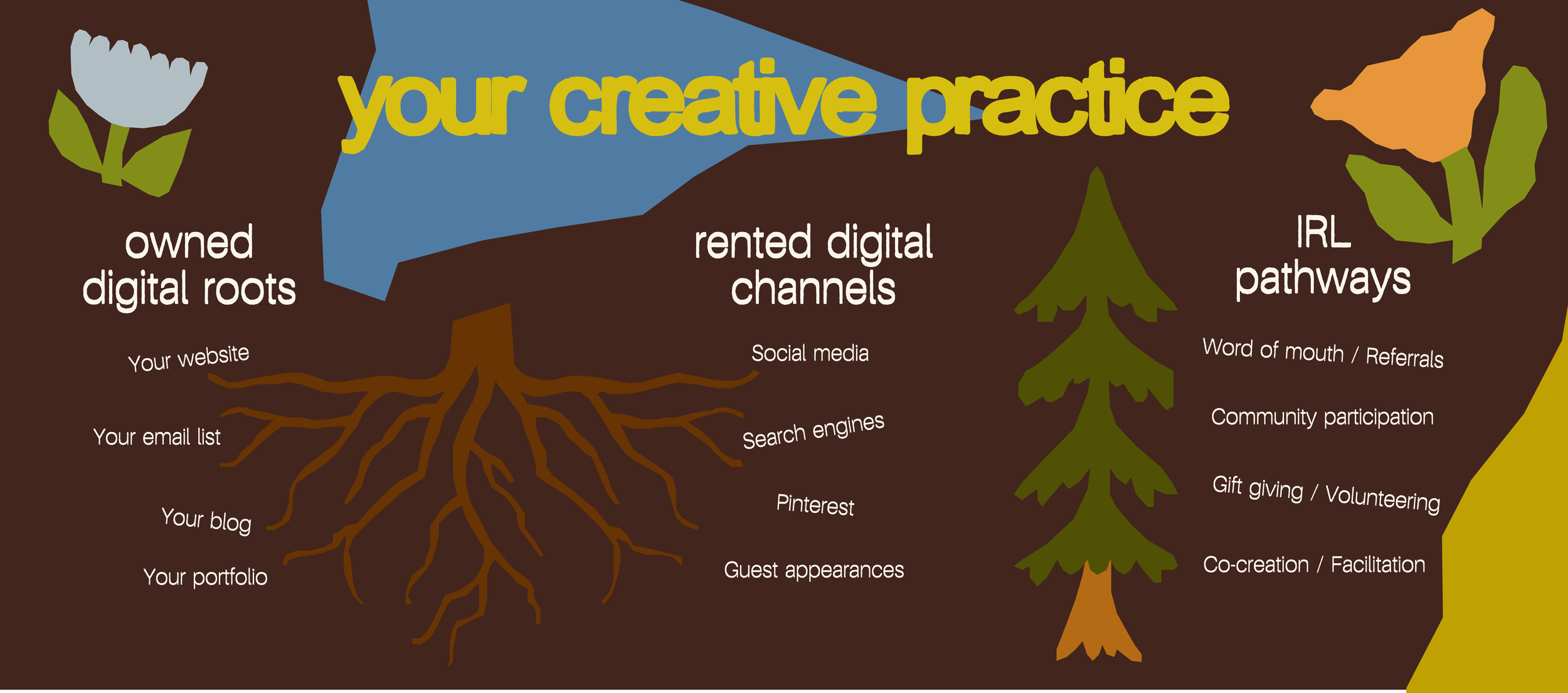
Building a sustainable practice in a world that keeps changing rapidly means not putting your whole ecosystem in rented ground. You need roots that go deeper and wider.
The IRL community building, the gift-giving, the referral network tending, the strengthening of your name in real rooms with real people… none of this is a backup plan for when the algorithms stop working. It's the primary practice. It's building something that belongs to you, and to the people you're in a relationship with, regardless of what any platform decides next.
The internet is changing fast, and in many ways that don't serve us. The platforms are not our friends. And the answer to that isn't panic, it's building something with enough roots that no single change can take it down.
Your IRL and owned ecosystem checklist
Protect your visual identity from AI sameness
☐ Do an honest audit of your brand visuals. Does your brand look like something a human made with intention, or does it look like it could have been generated in thirty seconds?
☐ If you've been using AI tools for your graphic design or social media visuals, pay attention to whether people are engaging with them the way they used to. Audiences are getting better at pattern-matching AI aesthetics and faster at tuning them out.
☐ Consider where you could introduce more human-made visual elements: illustrated details, hand-drawn elements, textured backgrounds, imperfect marks that carry authorship. Even small gestures of genuine making signal that a human who cares is behind this.
☐ If a full brand refresh isn't in reach right now, start with one thing: get a consistent, human-feeling photo or illustration of yourself that actually looks like you and represents your work. Use it everywhere. Faces build trust in ways that logos don't.
If your brand visuals need a rethink, the Take Root tier is where that work begins.
Build your owned digital infrastructure
☐ Identify where your primary writing or content home is, and whether you actually own it. Social media is rented ground. A website, a blog, an email list, these are things you own.
☐ If you don't have an email list yet, start one this week. Your email list is the most algorithm-proof audience you will ever build.
☐ Treat your website as living infrastructure, not a brochure you built once. Does it still say who you are, who you help, and what you offer? Does it sound like you wrote it?
☐ Build the habit of publishing in a space you own regularly, even once or twice a month. Consistency signals to both search engines and human readers that this is a place worth returning to.
Invest in IRL presence and community
☐ Identify one community, organization, cause, or recurring gathering that is genuinely aligned with your values, not your target market, and show up to it this month.
☐ Look for one opportunity to volunteer your skills this month. This is a values practice that also, over time, becomes one of the most powerful reputation builders available to small businesses.
☐ Get your Google Business Profile set up and updated. Local SEO is one of the most underused tools small businesses have, and one of the least affected by the AI Overview shifts at the broader search level.
☐ Show up in person to things in your field and community, not to network transactionally, but to be present, curious, and genuinely in relationship. The connections built in rooms together convert to referrals and collaborations in ways no content strategy can replicate.
Strengthen word of mouth and referral networks
☐ Make a list of five people who know your work well and whose communities overlap with your ideal clients. Reach out this month, not to ask for referrals, but to genuinely reconnect.
☐ Make it easy for happy clients and collaborators to talk about your work. Ask for testimonials while the experience is fresh. Give them specific language they can use. Make sure your website reflects the quality of what they were told to expect.
☐ Celebrate and publicly acknowledge people you've worked with, learned from, or been in community with. Generosity circulates.
☐ Think about your referral network as a garden, not a pipeline. You're building a web of relationships where trust moves in multiple directions and your name comes up naturally when the right conversation happens.
Frequently asked questions about Google, AI search, and SEO for small businesses
-
Yes, and it matters more than ever, just in a different way. Traditional SEO builds the foundation that AI search systems rely on to generate their answers. If your website is well-structured, has clear content, and has earned credibility over time, those signals are actively used by both Google and AI platforms like ChatGPT and Perplexity to decide what to cite and recommend. The game shifted from getting the click to being the source, and strong SEO is still what gets you cited.
-
GEO stands for Generative Engine Optimization. Traditional SEO focused on getting Google to show your link in search results. GEO focuses on getting AI systems to cite you as a source within their generated answers. The foundations of both are similar, well-structured content, clear authorship, and credibility signals, but GEO places more emphasis on named perspectives, specific frameworks, and content that is genuinely distinct from what anyone else in your field could produce.
-
The most reliable path to being cited in AI Overviews is publishing content that is specific, well-structured, and attributed to a named author with clear expertise. Generic how-to content is being absorbed by AI and not sending traffic back to the source. Content that carries a distinctive perspective, a named methodology, or a clearly articulated framework is much more likely to be cited, because it's the kind of content AI cannot synthesize from scratch.
-
No, and this distinction is important. Choosing to use a different search engine, personally switching to a privacy-respecting browser, or reducing your dependence on Google's ecosystem are all reasonable personal choices. But blocking Google from indexing your website or abandoning your Google Business Profile makes your business invisible to the people who are still using Google to find services like yours, which is still the vast majority of people. You can be principled about your personal Google use and strategic about your business visibility at the same time.
-
Content that is specific, personal, perspective-driven, and clearly attributed to a named author. The content getting absorbed by AI Overviews is generic, information-first content that could have been written by anyone. Your specific framework, your lived experience, your named methodology, your distinctive voice, these are exactly what AI cannot replicate. They're what gets cited, what builds authority, and what makes someone who finds you in an AI Overview want to click through anyway.
-
Start publishing content that only you could write… rooted in your specific experience, your named approach, your honest perspective on your field. Then make sure it's findable: clear page titles and meta descriptions, your name attributed to your content, internal links between posts and service pages, and a consistent publishing rhythm. One well-written, perspective-driven post per month outperforms ten generic posts every time.


About the author
Natalie Brite (they/them) is the founder and creative director of DoGoodBiz Studio, an ethical creative studio for conscious leaders and the movements they're building. With a background in fine art, philosophy, and sustainable development, Natalie works at the intersection of design, ecology, and collective care. They write about creative ecosystems, ethical business, and what it looks like to build work that is rooted in something real.
If this landed something for you, reach out and let us know what resonated. And if you're working through any of this in your own practice, the studio is here.
DoGoodBiz works with conscious leaders, creative practitioners, and movement builders on brand identity, web design, creative ecosystem strategy, and the kind of marketing that doesn't ask you to perform. If the work you're building deserves to be found, we can help make sure it is.
